




Tahu Matheson first encountered Engelbert Humperdinck’s opera Hansel and Gretel as a five-year-old. He remembers the experience to this day. Taken backstage after a performance conducted by his father, John Matheson, young Tahu’s gaze met that of the Witch (played by a male tenor) in full theatrical makeup.
“Those were the days of full ‘witchface’ makeup, prosthetic noses and everything. I remember being quite terrified,” Matheson tells Limelight. “Back then, nobody shied away from trying to scare the living daylights out of you.”
That memory has come into even sharper focus of late, as Matheson prepares for a full-circle moment: stepping onto the podium to conduct Opera Australia’s revival of Elijah Moshinsky’s production of Hansel and Gretel.

Tahu Matheson leading rehearsals of OPera Australia’s Hansel and Gretel. Photo © Opera Australia
Featuring larger-than-life sets and a cast that includes Margaret Plummer and Stacey Alleaume in the title roles and Jane Ede as the Witch, Moshinsky’s version offers audiences humour and heart suffused with unsettling undercurrents drawn from the Brothers Grimm’s original story, one veined with fears of starvation, abandonment and the threat of cannibalism.
Written in the early 1890s, Humperdinck’s score is anything but fairytale floss. It is one of remarkable depth and dramatic invention, says Matheson.
“Bits of it are with me all the time. When I’m sitting at the piano, noodling away, it often ends with me going into Hansel and Gretel somehow. It has lots of moments of fun and folksong, but it also holds some of the most affecting music in the repertoire – the Abendsegen (Evening Prayer). Put simply, it is one of the most beautiful and powerful things ever written.”
“The other great thing about the score is that there is absolutely no filler,” he adds. “It’s from that time when German composers just knew how to express things – how to do angst, how to do fear, how to express all the emotions. Humperdinck is at the pinnacle of all that. He’d worked with Wagner and was very much involved with Parsifal. He absolutely knew how it all worked.”
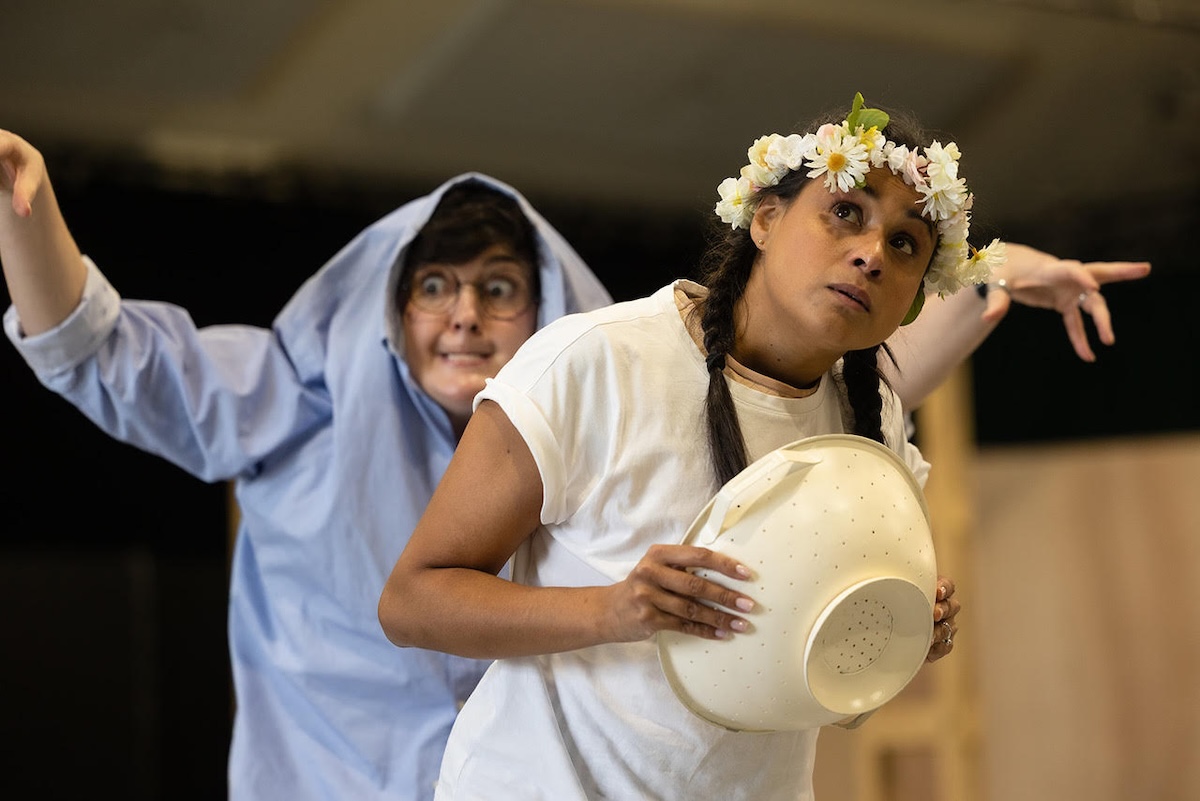
In rehearsal: Margaret Plummer and Stacey Alleaume. Photo © Opera Australia
The expertly written tensions in the score – between beauty and menace, innocence and threat – are mirrored onstage. Moshinsky’s production, revived for Opera Australia by director Claudia Osborne, doesn’t shy away from the grotesque or unsettling elements of the story. The Witch’s presence is genuinely formidable rather than cheaply cartoonish.
“Jane Ede is a wonderful Witch,” says Matheson. “She’s able to make the idea of eating children seem quite … scrumptious. And it’s such a great part – a 25-minute scene in which she gets to sing as many words as anyone else in the entire opera. It’s a brilliantly condensed package that brings out the best in an opera singer, and Jane does it so well. She’s frighteningly convincing.”
Part of the opera’s appeal is that it treats children as real protagonists, not caricatures. It trusts the audience to journey with them through woods both literal and symbolic. “I think Claudia is doing a beautiful job as director in that regard,” Matheson says. “You can’t just look at the old videos and repeat what was done 20 years ago. Things have changed and nuances have shifted, particularly with regard to presenting gender. She’s using all the wriggle room.”

In rehearsal: Jane Ede and Margaret Plummer. Photo © Opera Australia
For Matheson, tempo is key to the success of the show. “I like it all to be just slightly faster – certainly faster than it was when I first saw it. When you look at some of the original tempo markings, they’re very, very slow. You start to wonder whether Humperdinck’s metronome was working properly. You look at a passage and think, ‘Wow, can we really say things like that at this tempo?’ So we’ll be moving things along pretty quickly, about an hour each act. After all, this is Sydney in the summertime: it’s get on, get off!”
There will be no sacrificing of intricacy at the altar of speed, however. Conducting Hansel and Gretel is about finding an ideal balance – between musical refinement and dramatic immediacy, between voices and orchestra – so that the music supports meaning.
Matheson finds the challenge as rewarding as the music itself. “You have to concentrate like crazy. But it’s a thrill.”
Hansel and Gretel is performed at the Joan Sutherland Theatre, Sydney Opera House, 27 January – 28 February.






Comments
Log in to start the conversation.