




For its first program of 2026, Sydney’s boundary-pushing chamber collective Ensemble Apex is venturing into shadowy territory.
Behind Me Is The Dark, a new concert conceived by artistic director and conductor Sam Weller, pairs four striking contemporary works with an immersive lighting design that responds directly to the music.
Presented in collaboration with lighting designer Andre Vanderwert – known for his work with the visionary dance company Chunky Move – the program explores what Weller calls the “liminal spaces” of sound and sensation: the thresholds between heat and cold, calm and violence, intimacy and vastness.
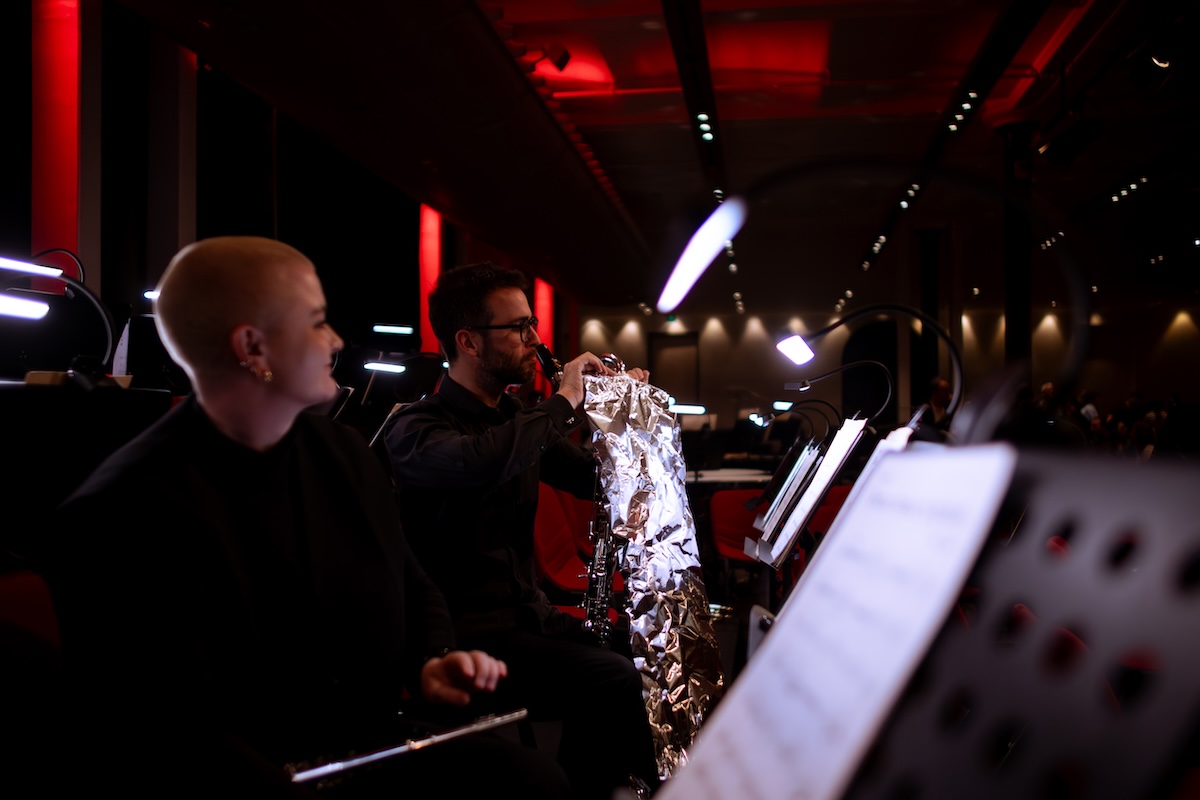
Ensemble Apex. Photo supplied
“It’s music that absolutely speaks for itself, but I think it’s also part of our job as musicians to help guide people into unfamiliar territory,” Weller explains. “If you’re asking someone to hear a piece for the first time – a piece that might seem difficult at first – it’s right and good to make that encounter as open and inviting as possible.”
The idea of integrating lighting into the performance was not an afterthought but a central part of the concept, says Weller. “When you use peripheral elements like lighting design alongside the music, it’s important to make sure they’re connected to the music itself and not just decoration, not just ‘let’s put on some fun lights so people don’t get bored’.”
Vanderwert’s lighting follows the score almost as closely as the musicians do. During the performance, a score reader will sit beside Vanderwert, calling cues as the music unfolds.
“In a sense, it’s like theatrical lighting,” Weller explains. “The score is a script. Every lighting decision has to be justified by what’s happening in it.”
The aesthetic they have landed on evokes what Weller likens to a “Gothic asylum” – a visual template that captures the darkness, tension and psychological intensity running through the program.
“It gives the audience a place to listen from,” he says.

Ensemble Apex. Photo © GabrielleMary Photography
A journey through extremes
The concert begins explosively with the Australian premiere of Shivers on Speed by German composer Brigitta Muntendorf. Though it is written for just four players, the work has an orchestral force.
“It’s bombastic,” Weller says. “There’s barking, screaming into clarinets – everything twitching and spasming. It’s only a quartet, but it sounds enormous.”
From there, the temperature rises – literally – with Januaries by Lisa Illean, a piece that evokes memories of searing Australian summers.
“It’s sweaty and humid,” Weller says. “After Muntendorf’s manic energy, Illean’s music feels like shimmering air in extreme heat.”
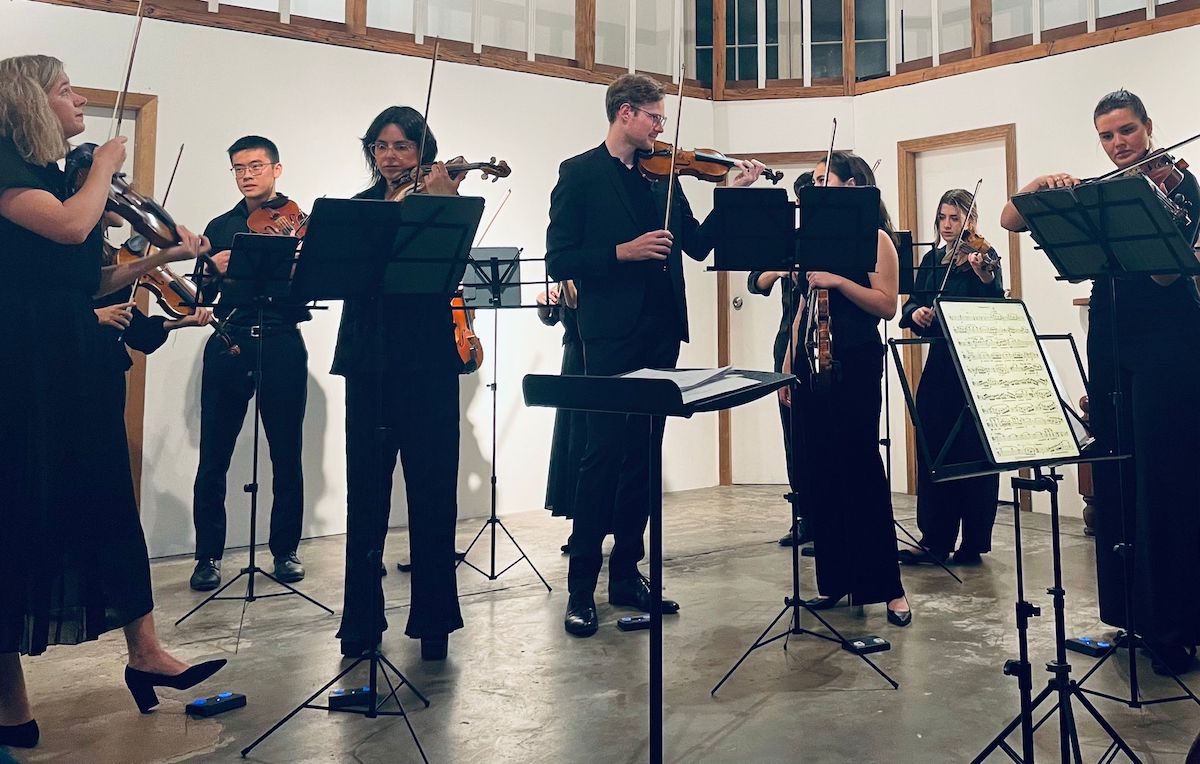
Ensemble Apex at Flow Studios, Camperdown. Photo supplied
The program then swings to the opposite climate with the Australian premiere of Hrim (‘frost’) by Icelandic composer Anna Thorvaldsdottir. Inspired by vast landscapes and geological forces, the work conjures glacial expanses through slowly shifting textures.
“It’s almost like you can hear these tectonic plates moving in the low instruments while the strings produce glistening harmonics, a bit like like frost in the sunlight.”
The concert concludes with the formidable Kammerkonzert by the late Hungarian modernist György Ligeti.
Written for 13 virtuoso players, the 1970 chamber concerto’s dense counterpoint and shifting textures make it “unbelievably difficult”, Weller says. “It’s one of those pieces that can take a few hearings to begin to understand, so our job is to make the first experience as compelling as possible.”
The lighting design will chart the same trajectory as the music, beginning with twitching nervous energy and expanding towards the explosive climax of Ligeti’s score.
“The start of Kammerkonzert uses a very narrow range of pitch,” Weller explains. “But by the end it explodes into countless musical strands. That mirrors the whole program – this gradual expansion from something small into something huge.”
For Weller, the program also highlights a particular challenge of conducting contemporary chamber works: knowing when not to intervene.
“With something like Ligeti, the parts are so virtuosic that the conductor’s job is to facilitate rather than impose,” he says. “You have to give the music space to happen.”
That philosophy also underpins his involvement with the Australian Conducting Academy, where he has been mentoring emerging conductors. The program, he says, has played a pivotal role in his own development.
“It was my introduction to working with professional orchestras,” he says. “And it’s important because conducting education in Australia has historically been quite limited.”
The pandemic years exposed the gap dramatically, when travel restrictions left Australian orchestras suddenly short of guest conductors.
“We realised how few pathways there were locally,” Weller says. “Now there’s real momentum to build those opportunities.”
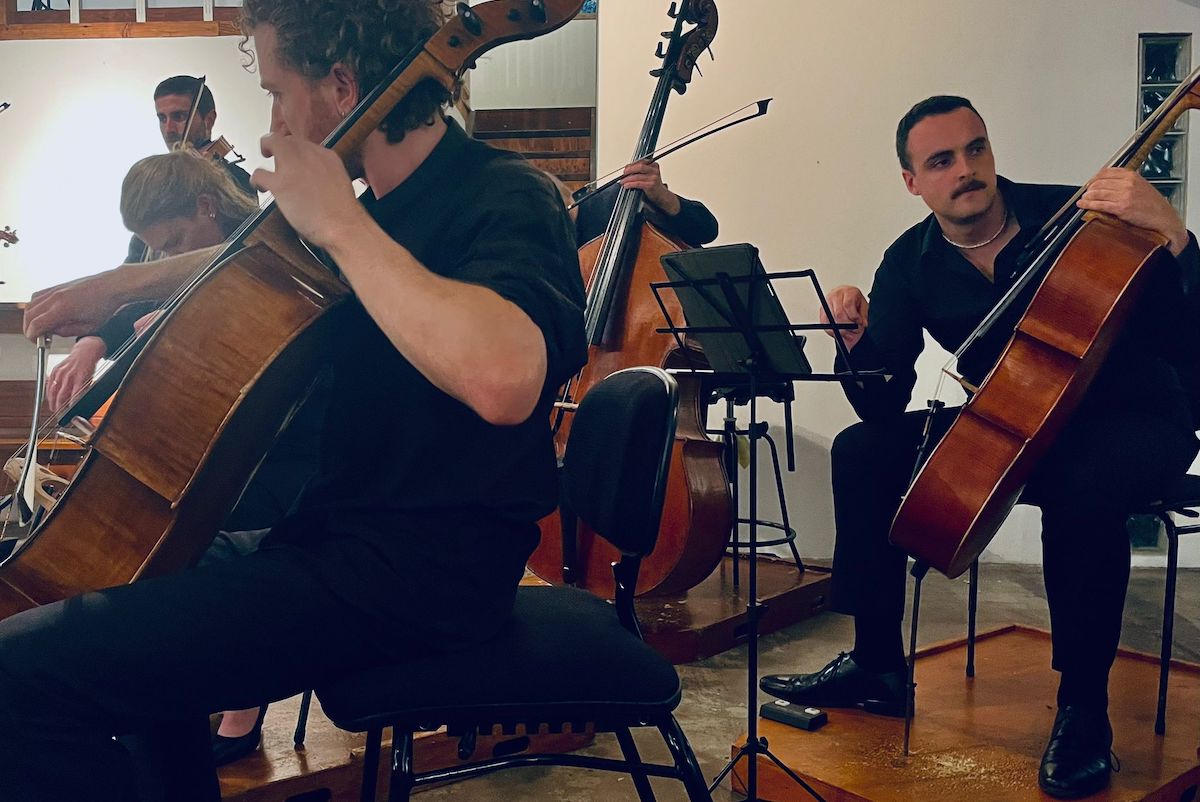
Ensemble Apex at Flow Studios, Camperdown. Photo supplied
Beyond the concert hall
Ultimately, Behind Me Is The Dark reflects Apex’s broader ambition: to make contemporary music feel less like an academic exercise and more like an immersive experience.
“There’s tension and wonder in these pieces,” Weller says. “But also pain, anguish and moments of huge release. If we can help people feel those things – rather than worrying about whether they ‘understand’ the music – then we’ve done our job.”
Ensemble Apex performs Behind Me in the Dark at ACO On The Pier, Walsh Bay, Sydney on 1 and 2 April.





Comments
Log in to start the conversation.