

At a time when classical music institutions are searching anxiously for ways to connect with audiences – and younger, non-traditional audiences in particular – the arrival of the unconventional French pianist Lucas Debargue in Australia feels conspicuously well timed.
The 35-year-old, who makes his Australian debut this month, is one of the most intellectually and artistically restless pianists of his generation – a performer who speaks of his admiration for Beethoven and pop music in the same breath, distrusts the “cult” of the musical score, and believes classical concerts too often resemble “a forensic examination”.
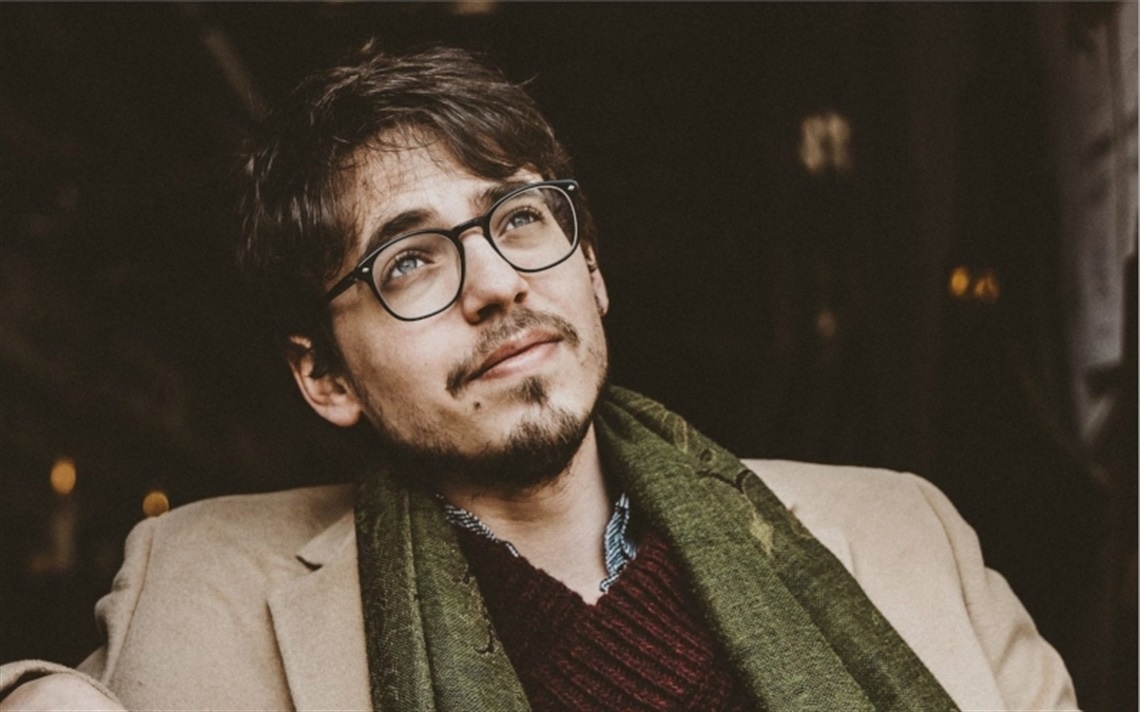
Lucas Debargue. Portrait supplied
Speaking to Limelight ahead of his Live at Yours tour, Debargue says that many of our timeworn concert conventions have become obstacles to genuine musical communication.
“So much of what you see in concerts actually harms the music we love,” says Debargue. “They can make it feel dead, like a kind of archaeology.”
The Live at Yours concert format, developed during the pandemic years, sets out to loosen some of those traditions. Recitals are typically presented in non-traditional venues, with theatrical lighting, a pop-up gin bar, and spoken introductions from the stage. For Debargue, these are not gimmicks; they are attempts to restore a sense of immediacy and shared experience to classical performance.
“We should remember that music is fundamentally about live performance,” he says. “Even in the age of recordings, the heart of music is sharing something live.”

Live At Yours at the Great Synagogue, Sydney. Photo supplied
The idea places him within a growing movement of performers seeking to soften the etiquette that has long defined classical concerts. Debargue points to pianists such as András Schiff, who increasingly speak directly to audiences rather than presenting concerts as untouchable rituals.
Underlying his scepticism regarding tradition in classical interpretation is his atypical path to an international piano career. Unlike the majority of concert pianists, he discovered classical music relatively late and spent much of his youth immersed in other art forms, especially literature and philosophy.
After eschewing the conservatoire path, working on a supermarket checkout and quitting the piano for three years in his late teens – when most pianists are ramping up their practice hours – it took an encounter with the renowned teacher Rena Shereshevskaya and a breakout performance at the 2015 International Tchaikovsky Competition to convince him to commit fully to music. He signed with Sony Classical later that year.
His own work as a composer has sharpened that perspective. Alongside his performing career, Debargue has written more than 20 works for solo piano and chamber ensembles. Composing, he says, reveals how “vague”, “porous” and “unstable” notation truly is.
“Composers have always revised works constantly,” he says. “Yet classical music has developed this cult of the definitive text.”
The danger, he believes, is that musicians become risk-averse, hamstrung by the idea of deviating from an accepted norm. “Performers can feel as though some invisible committee is watching them, ready to slap their fingers if they do something ‘wrong’.”
That fear, he argues, extends beyond music into contemporary culture itself. Social media, perpetual public scrutiny and endless commentary have produced a paradoxical environment in which people gain exposure at the price of becoming more self-conscious and restrained.
“It’s everywhere and part of modern life. But it’s especially strong in classical music because classical music sees itself as elite culture – a gourmet entertainment. There’s a fear of simply being yourself,” he says.

Lucas Debargue. Photo © Xiomara Bender
For Debargue, individuality in music has nothing to do with ego or self-indulgence. Rather, it involves allowing one’s inner personality to interact honestly with the composer’s ideas. The great composers, he argues, expected performers to bring something personal to the music rather than functioning as obedient executors of the score.
“That’s why personalities like Horowitz, Rubinstein or Arturo Benedetti Michelangeli remain so fascinating. It’s not just their sound – it’s their personality, their humour, their philosophy, their way of looking at life.”
“I miss the old idea of the generalist musician. Someone who was simultaneously a composer, improviser, philosopher, polemicist. Today the more common profile is of the shy, endlessly grateful musician whose only message is: ‘Music is my life, and here is my party piece’.”
He also worries about the idea that listeners must possess specialist knowledge in order to fully appreciate classical music.
“Music shouldn’t require effort to feel something,” he says. “Effort can deepen appreciation, yes, but the first connection should be immediate.”
The comments help explain Debargue’s eclectic listening habits and unusually expansive cultural references. During the conversation, he mentions Keith Jarrett to Radiohead, the Armenian jazz pianist Tigran Hamasyan and the English industrial metal band Godflesh. Discussing keyboard instruments, he enthuses about wanting to buy a Hammond B3 organ to join the Fender Rhodes and Minimoog he already has at home.
“Quality,” he says, “doesn’t belong to a genre – and snobbery kills classical music as well as every other kind.”
His broad artistic outlook also shapes the repertoire Debargue has chosen for Australia. The tour focuses entirely on French music, combining canonical works with lesser-known repertoire and contemporary pieces, including his own variations of Gershwin’s Summertime. Ravel’s virtuosic Gaspard de la nuit anchors the program, while works by Gabriel Fauré and newer composers provide less familiar terrain.
The freedom to build such an unconventional program mattered to him. “Vladimir [Fanshil, founder of Live at Yours] gave me complete freedom to choose the music, which I appreciated. Anything but another Beethoven-and-Chopin recital!”
Lucas Debargue plays at Brisbane City Hall on 28 May; at the Castlemaine State Festival (30 May); Toorak Synagogue Melbourne (2 June), the Great Synagogue, Sydney (3 and 4 June) and the UKARIA Cultural Centre, Mount Barker, South Australia on 7 June.
For more information and bookings, visit liveatyours.com.au

Comments
Log in to start the conversation.