Composer Stephen Adams has an incredibly storied history with radio, both professionally and musically. Between a 19-year turn at ABC Classic FM, a celebrated musical career and a new radio-centric live work on the horizon this week, there’s a lot of ground to cover – and that’s barely the half of it.

“One of my fond early memories is of me and my sister Prue as kids on a Saturday morning taking mum’s small transistor radio from the kitchen into the backyard while Mum and Dad were still in bed,” Adams tells Limelight.

“We’d go down and sit swinging on the old iron swings behind the oleander bush listening to songs on AM radio, the experience coloured by the dawn chorus of birds bursting into song on two huge gum trees in the next-door neighbour’s garden.”
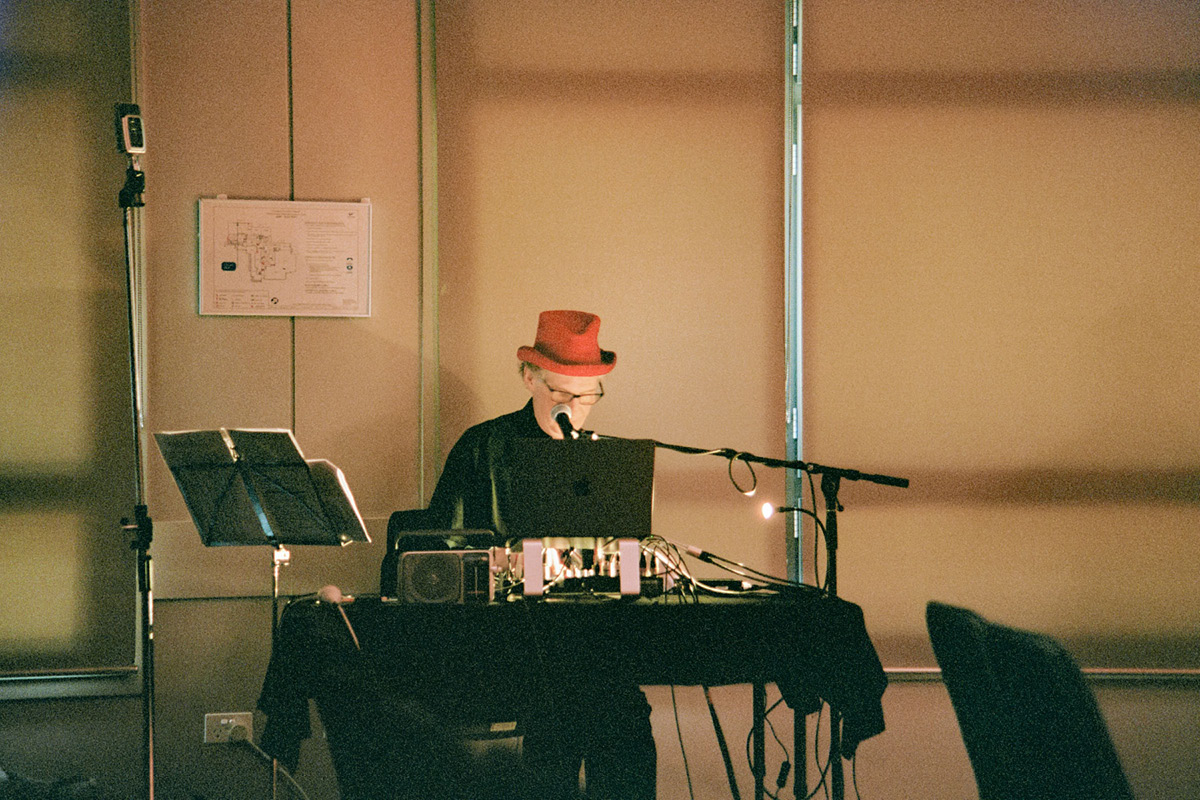
Stephen Adams showcasing Imaginary Radio Station. Photo © Nick Barnett

In 2004, Adams’ life “took a surprise turn” and he began working as the Australian Music Curator and Producer for ABC Classic (the first and, as yet, the only one he notes), where he remained until 2023. It’s a natural home for someone with a lofty appetite for sound. Working directly with sound and recordings, and engaging with the musical ideas of others were parts of the job that he found “hugely imaginatively stimulating” and which found their way into his musical practice.

His 1992 work Sydney Dreaming Theatre touches on those early radio memories with his sister, but Adams first used a radio in his 2007 Cage-inspired piece A Short Service for The Song Company. The radio was centre stage, serving both to interrupt its vocalists and add texture to their sounds. In 2012, armed with a tiny FM transistor, his use of radios as a compositional device really took off  – “and my radio collection grew,” he adds.

His 2014 Art Music Award-nominated choral work Afterwards, which used radios tuning through on and off-station sound as a rhythmic device, and his 2024 radiophonic project Sonic Hugs feature among the many eclectic electronic experiments marking his discography. He was also involved with commissioning, producing and delivering radiophonic works at ABC, including Jon Rose’s Talking Back to Media and Richard Bartlett’s Codex IX. It’s no surprise that Adams was awarded a National Luminary Award at the 2025 Art Music Awards for his “outstanding contribution and dedication to Australian music as a broadcaster, producer, composer and advocate”.

“There’s something about the intimacy of radio’s presence – invisible, ephemeral, often fragile,” he explains, “It’s a companion to the everyday, whether filling lonely spaces or colouring spaces already saturated with sounds. It has this capacity to evoke the presence of another world, another reality, in kitchens and cars to workplaces and other public spaces.”

“[It’s also] subject to all kinds of interference and distortion, evoking for me a kind of realm of spirits, and its absence of the visual encourages a rich imaginative experience. It’s such a flexible space of sonic play.”

Career-wise, Adams is now ‘post-radio’ – that is, “freed of the necessity to spend most of my waking hours making radio programs” – and is relishing new opportunities for composition and collaboration. First envisioned as “some mash-up of live radiophonic art, lo-fi amplified chamber music and a kind of performing sound installation”, Imaginary Radio Station is one of those.

The “modular music-theatrical sound work” has its world premiere performance at 21 Shepherd – Livingroom Theatre in Marrickville, Sydney this Saturday. The Music Box Project, an ensemble that is exploratory and playful in its musical approach, is an ideal collaborator for such a curious work.

Stephen Adams and Naomi Johnson. Photo © CactusCan

Imaginary Radio Station, in fact, follows on from A post-radio interview developed by Adams and and Naomi Johnson for the Cut Paste Play Festival in 2024. It begins as an unassuming interview between the two, which slowly unfurls into a musical work about their shared history with ABC radio. “That performance was the moment that my use of radios and FM transmitter as instruments joined up with my studio and live radio-making practice in a way that excited me,” Adams explains.

I could describe Imaginary Radio Station as a mobile sound installation, or a mash-up of electro-acoustic chamber music, live radio-making and sound performance,” he says.  “It’s this fusion of music, spoken word and ecstatic noise. My experience to date of trying to explain the work is that it doesn’t make sense to people until they experience it!”

In the setup for Imaginary Radio Station microphones feed into a mixer and an FM transmitter, which sends the signal to a “motley collection” of radios which are positioned and moved around the performance space. What then feeds the microphones is an eclectic set of sounds – live performance from TMBP (flutes, trumpet, tenor sax, piano accordion and violin) pre-recorded music and interviews, tied together with Adams as presenter.

As the performers manipulate the radios, all of these sounds are shaped by “shifting, immersive diffusion, lo-fi distortion” and an interesting variety of colours created through feedback.

Movement becomes a key part of the world that Imaginary Radio Station concocts. The way the performers and radios move around a space, the way sound behaves in each venue means that this “incredible richness” of feedback will be unique, each and every time – a compellingly attractive proposition for a work, says Adams. It brings a performance space into conversation with the music, rather than just “simply a static container” for it.

Stephen Adams and The Music Box Project showcasing Imaginary Radio Station. Photo © Nick Barnett

“Music is a physical experience that acts directly on the body, and space is a dynamic element of musical experiences. The multi-sensory atmosphere of a space, and the movement of people within it, are all such powerful frames for musical experiences, affecting how we feel and how we interpret what we hear. And moving is fun!”

The pre-recorded material includes station theme music and a “sonic mosaic” built from samples of TMBP members individually, as personal one-on-one interviews about the musicians’ thoughts on radio and radios, their relationship with their instruments and the music that’s important to them.

“There’s a lot of the individual and collective personalities of The Music Box Project that shine through this work,” says Adams. “The individual stories [through the radios] provide opportunities to feature members of TMBP as soloists, improvising within the frame of a text score.”

The Music Box Project showcasing Imaginary Radio Station. Photo © Nick Barnett

[Radios] retain a sense of locality, fragility and intimacy to the presence of recordings in a performance space – the opposite of the big PA ideal. The lo-fi textures appeal to me as a medium, and there’s these additional creative possibilities of playing with a variety of radios with different timbral qualities, bringing them in and out and moving them to alter the sound diffusion in a space, as well as using the tuning dials and antennae to alter or obscure the source sounds, and introduce off-station sound or other station ‘interruptions,” explains Adams.

As well as its technical capabilities, the cultural role of radio has been a major part of his work. Sydney Dreaming Theatre looks at radio as “something that inserts itself into our sonic and social experience of the world”; Imaginary Radio Station, revisits it as a “cultural and social experience” in light of radio’s shifting role in a modern context.

“Radio’s now becoming increasingly pre-recorded rather than live, and available after the fact on a vast array of streaming and podcast platforms,” notes Adams.

“In a world where radio’s [less] live, where local and regional stations are increasingly dominated by syndicated or even AI-generated content, the idea of going 180 degrees in the opposite direction and making it even more local than it was in its heyday, returning it to an ephemeral shared experience in the moment which you either tune in to or miss, seems particularly attractive to me.”


Stephen Adams’ Imaginary Radio Station is presented at 21 Shepherd – Livingroom Theatre, Marrickville, Sydney on Saturday 24 May.

Contribute to Limelight and support independent arts journalism.