Prime Minister Anthony Albanese has declared that Australian artists, writers, musicians and journalists must retain control of their work in the age of artificial intelligence, using a major policy speech to rule out allowing AI companies to train models on copyrighted material without permission.

Speaking at the University of Sydney on Wednesday, Albanese said Australia would pursue AI development that served the national interest while protecting creators. He also announced a new Office of AI within the Department of the Prime Minister and Cabinet to coordinate national policy and develop mandatory Australian AI standards.
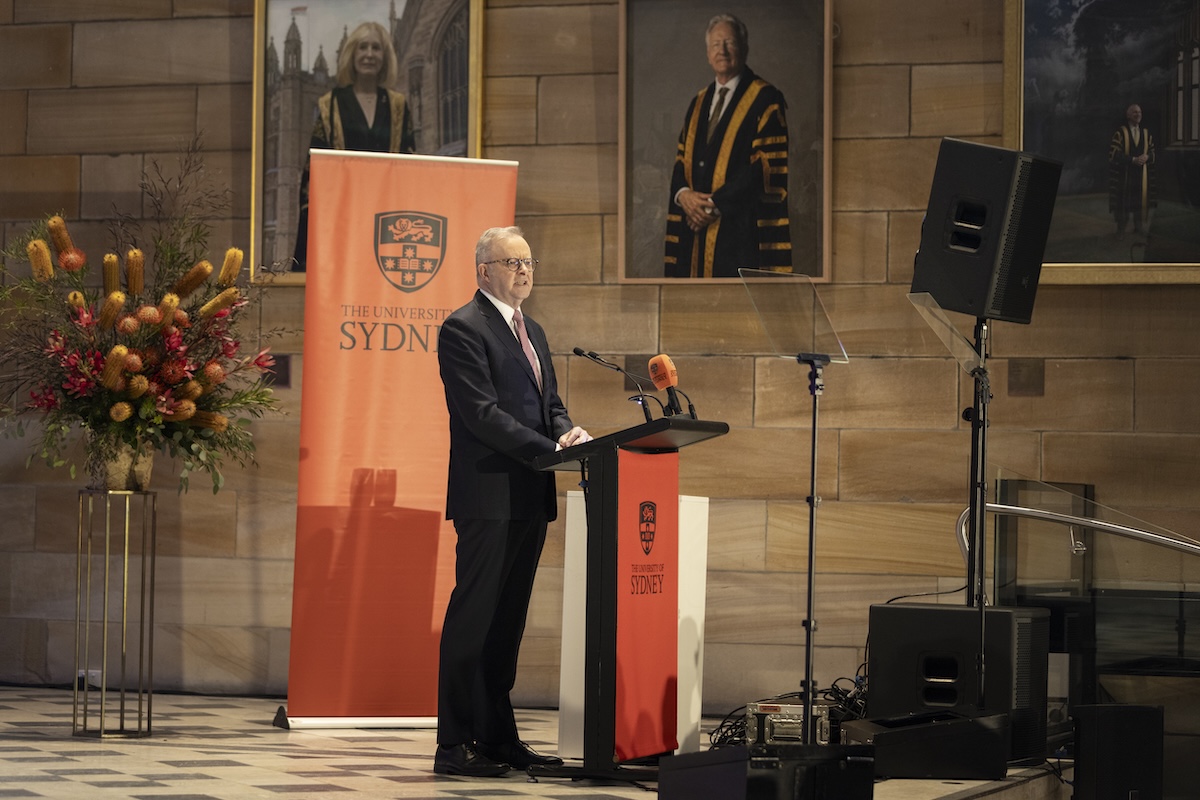
Prime Minister Anthony Albanese in the Great Hall, University of Sydney. Photo © The University of Sydney/Fiona Wolf

In one of the government’s strongest statements yet on copyright, the Prime Minister said Australian creative works should not be used to build AI systems without the consent of rights holders.

“Australian writers, musicians, artists and journalists must retain ownership and control of their work. Our laws will spell that out, plain as day,” Albanese said, adding that, “No company should use Australian books, music, art or news to build or train AI without the artist’s control. That includes the artist’s control of the price and value of their work. Anything less is theft.”

The speech comes amid intense lobbying from AI companies seeking access to Australia’s copyright material at the same time foreshadowing billions of dollars in data centre investment.

The government also announced measures requiring large-scale AI data centres to meet mandatory standards, including obligations to support new power generation and limit water use, as part of a broader regulatory framework intended to attract investment while addressing environmental concerns.

Music rights organisation APRA AMCOS welcomed the Prime Minister’s remarks, describing them as “clear and unequivocal” support for Australia’s creative sector.

Chief executive Dean Ormston said the speech confirmed that AI development in Australia must respect creator rights through “permission and payment”, and called for the new Office of AI to help establish a licensing framework based on consent rather than copyright exceptions.

“The Prime Minister has made it clear. The future of AI development in Australia must respect creator rights,” Ormston said.

Ormston also urged the new office to place Indigenous Cultural and Intellectual Property at the centre of AI policy and criticised AI company Anthropic’s push for data centre investment while contesting copyright obligations.

“Australian artists and copyright owners should not be expected to subsidise Anthropic’s business model,” he said, arguing Australia’s intellectual property should be treated as a long-term national asset rather than “a line item to be settled quickly and cheaply”.

The government is expected to introduce legislation establishing mandatory AI standards early next year as it seeks to balance innovation, investment, environmental sustainability and stronger protections for Australian creators.

Get our free weekly round-up of music, arts and culture.