




Sophocles’ ancient tragedy about Oedipus’s cursed children is distilled into a compelling, highly physical three-hander to open La Boite’s 2026 season.
When Antigone’s brothers kill each other on opposing sides of a bloody civil war, their uncle takes the throne of Thebes. King Creon decrees that one brother will be buried with honour, but the other is to be left untouched, eaten by animals and eroded by the elements.
Unswayed by her cautious sister Ismene, Antigone defies the law and sets out alone to bury their brother. When her deed is discovered, she is sentenced to death, and her unrepentant acceptance sparks debates about loyalty, principle, and duty to family, state, and the gods.
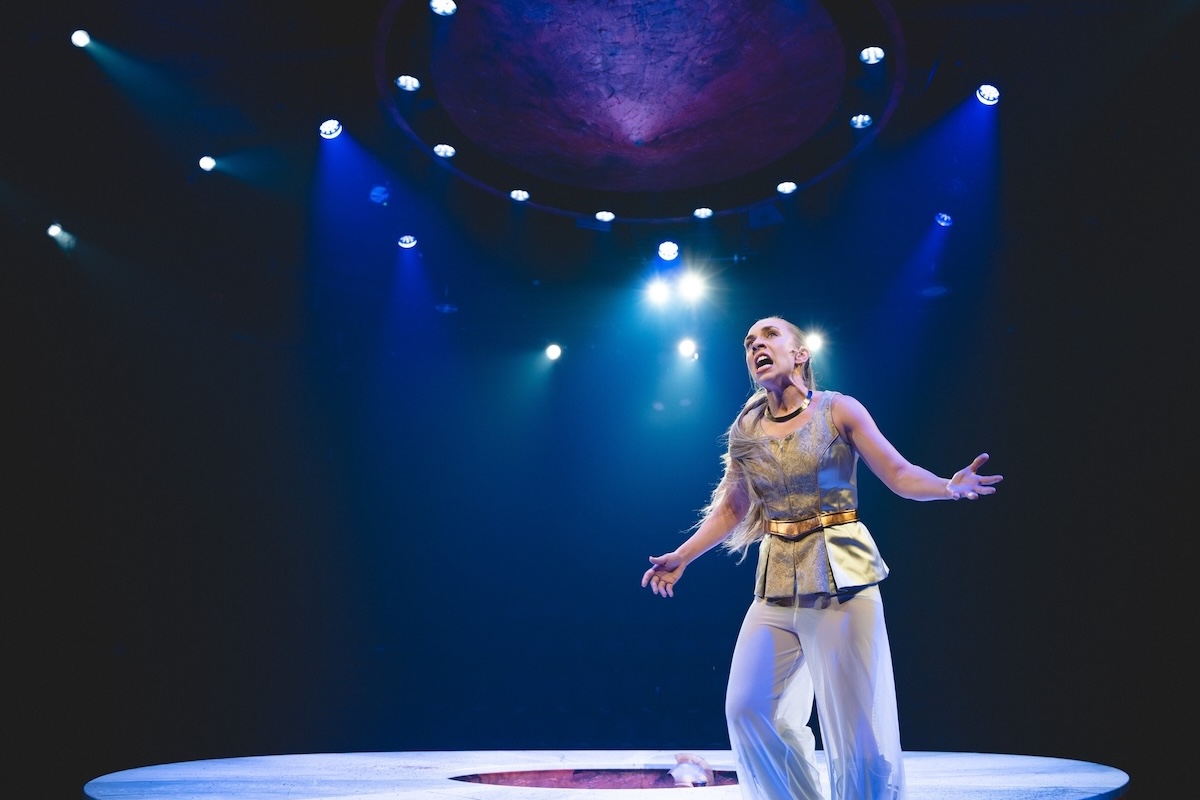
Maddison Burridge in Antigone. Photo © Dean Hanson
Antigone was written around 440 BCE, and its arguments about the nature of justice have remained strikingly relevant, frequently revisited and reinterpreted in the ensuing millennia. This classical work opens La Boite’s 101st season, co-directed by Artistic Director Courtney Stewart and Nigel Poulton in his mainstage directorial debut.
At the core of La Boite’s Antigone is a stylised physical language informed by Poulton’s extensive career as a fight, movement, and intimacy coordinator, although all weapons except Tiresias’s staff are mimed without props. Scenes of pure movement are occasionally overlaid by the whispering, recorded voices of an unseen Greek chorus – Liz Buchanan, Aurora Liddle-Christie, and Barbara Lowing – credited as The Fates.
Performed in the round, the majority of the action takes place on a circular catwalk surrounding a mirrored pit and a staircase extending into the audience over one of the tunnels. Grit pours from the ceiling to obscure reflections, mirroring Antigone’s burial of her brother and evoking sand pouring through an hourglass as she awaits death. The play is full of visual parallels, with movement and stillness used to denote shifts in emotion, status, and power.
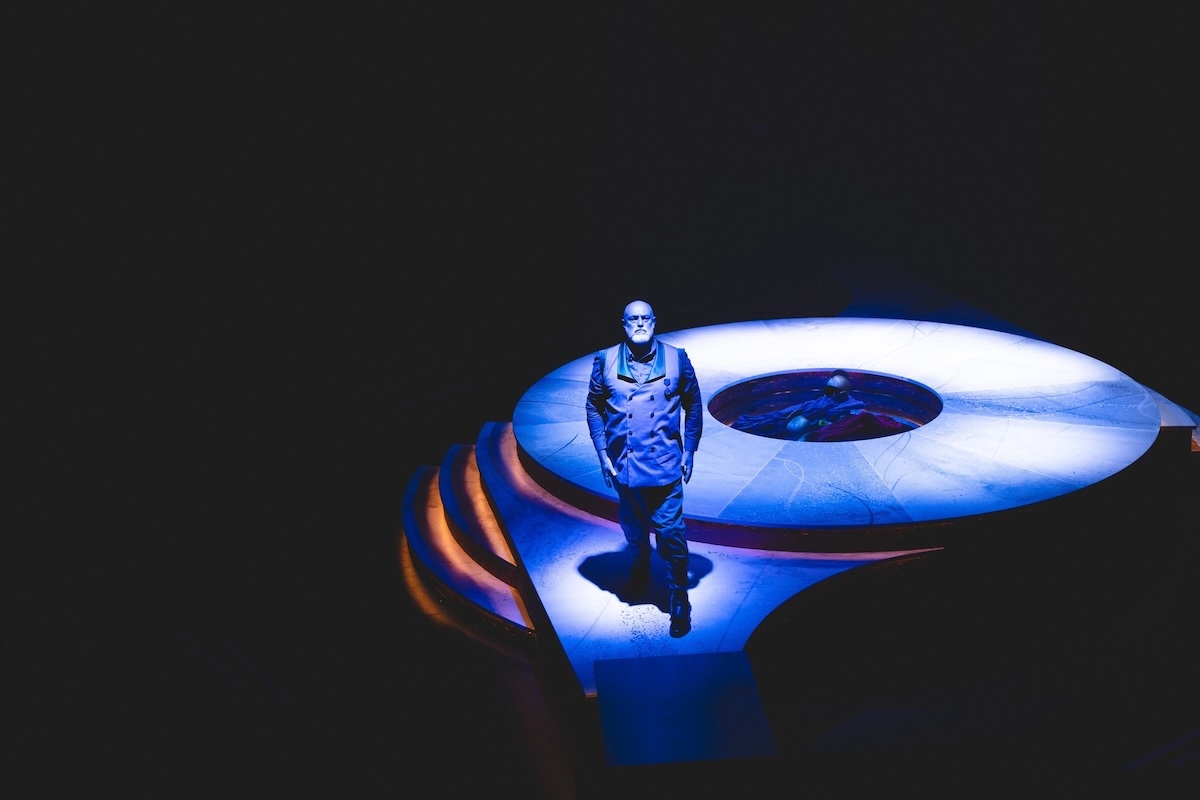
Hayden Spencer in Antigone. Photo © Dean Hanson
The most significant diversion from the original text – a device that has become common in classics adaptations – is the insertion of a monologue likening the character of Antigone to women of more recent times. Malala Yousafzai, Ruth Bader Ginsburg, Harriet Tubman, Julia Gillard and Jacinda Ardern are name-checked, among others, insisting on drawing comparisons rather than trusting an ancient text to speak to the present in its own words.
This interlude, at the moment of Antigone’s suicide – which is narrated after the fact – could close the play beautifully, drawing the audience back to the present with a modern moment of reflection. However, the play continues for a couple more scenes with the death of Haimon (artfully constructed and executed, a highlight of the performance) and the grief and remorse of Creon.
Layered costumes designed by Josh McIntosh, who also designed the set, allow for ease of movement and contrast plain fabrics for Creon and Haimon with sheer, glittery attire for the Theban princesses.
Lighting design by Teegan Kranenburg conjures streaks of lightning and dramatic spotlights that add distance between characters on a contained stage.
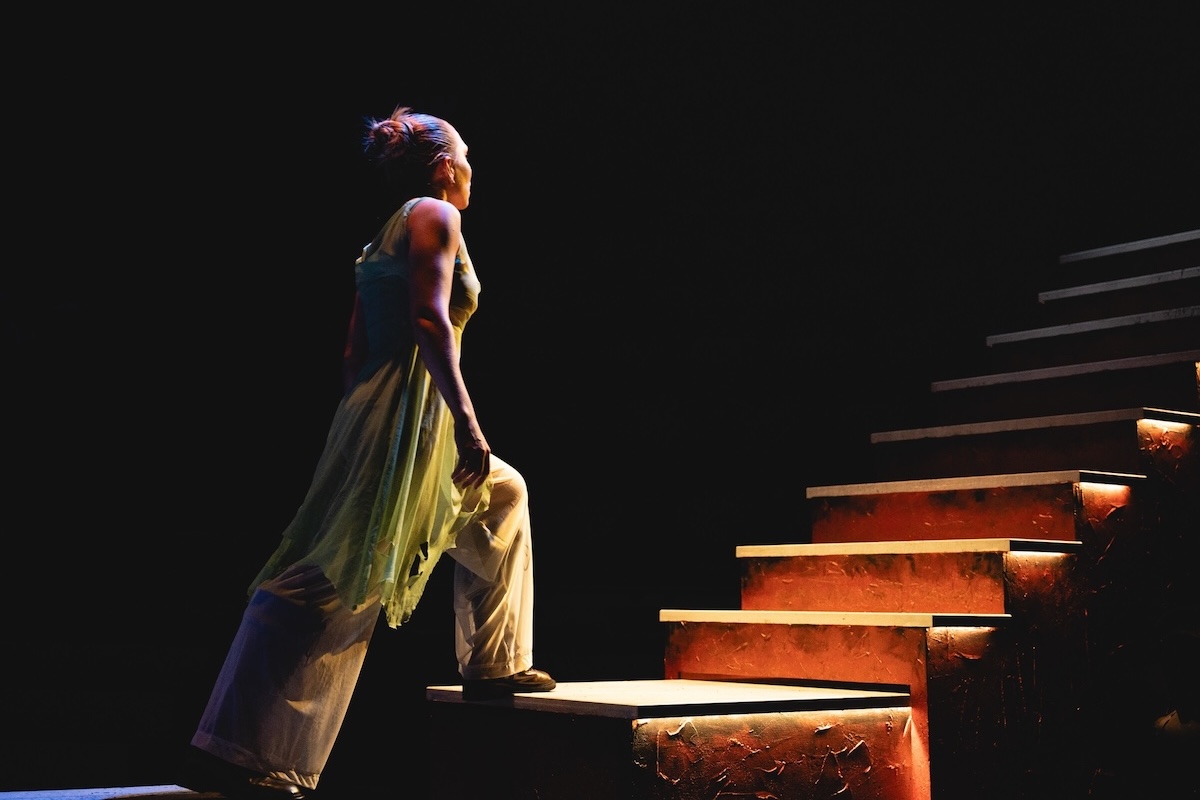
Maddison Burridge in Antigone. Photo © Dean Hanson
Composition and sound design by Brady Watkins, who is also co-dramaturg with Stewart, drive the play forward with the beating of war drums, the murmuring and crackling beneath Tiresias’s prophecies, and musical underscoring of the play’s most poignant moments.
The use of personal microphones in a 400-seat theatre is distracting, especially in the round. The visible wires create greater distance between audience and actors in the intimate setting, which the play otherwise attempts to bridge by having Creon address the audience.
Maddison Burridge brings a burning emotional intensity to the title role, burying an invisible body with shaking hands and tear-stained cheeks. Wide-eyed with both fear and defiance as she faces Creon, Antigone’s grief and conviction shine through Burridge and illuminate the stage in her expressive performance.
Hayden Spencer plays an assured and arrogant Creon, sweating and spitting as Antigone’s act threatens to destabilise his rule. Spencer’s characterisation escalates well, but the transition to grieving father and repentant tyrant is less believable than his volatility and violence.
Billy Fogarty is a force, showcasing impressive versatility and emotional range. Fogarty cycles rapidly and repeatedly through the characters of Ismene, Haimon (Creon’s son and Antigone’s betrothed), the blind seer Tiresias, and an anxious city sentry, shifting character and costume subtly and seamlessly.
La Boite’s Antigone vibrates with emotion, bringing movement and design into a beautiful balance for this timeless tale of love, power and justice.
Antigone plays at the Roundhouse Theatre until 21 March.







Comments
Log in to start the conversation.