There are many reasons to applaud this release. First of all, there’s Voilà Records, a new French label dedicated to the rediscovery of neglected voices from the past. Secondly, the performances by a group of rising stars are all of them first rate. Chiefly, however, it’s hats off to the composer, a lost soul resurrected from out of the murky netherworld of fin de siècle Vienna. Despite being close to Mahler and Schoenberg, Oskar Posa is today a complete unknown with not one note of recorded music in the current catalogue. But what music!

First of all, some background. Oskar Posamentir (the ‘mentir’ was ditched, perhaps to conceal his origins) was born in Leopoldstadt, the Jewish quarter of Vienna, in 1873, two years after Zemlinsky and one year before Schoenberg. Trained as a lawyer, he took private lessons in composition and converted to Catholicism aged 24. By the turn of the century his early Lieder were being enthusiastically received across Europe. He was even taken up by Brahms’ publisher Simrock. The Viennese press, however, did him down, panning his Violin Sonata much as they did Mahler’s symphonies or practically anything by Schoenberg.
As secretary of Vienna’s newly formed Society of Creative Musicians Posa enjoyed some success, or should that be notoriety. In 1905, his Five Soldier Songs were performed, sandwiched between the premieres of Zemlinsky’s Die Seejungfrau and Schoenberg’s Pelleas und Melisande. A series of conducting posts in Bavaria and Berlin led to a longer term position at the opera in Graz and a job at the Vienna Conservatory followed. His compositional output, however, seems to have dwindled. A victim of antisemitic attacks over the years, he was blacklisted by the Nazis and ultimately rooted out of his posts. He died in complete obscurity in 1951.
So, what of his music? “In the Vienna of 1900, where Brahms and Wagner seemed to embody two irreconcilable worlds, Posa did not choose: he absorbed and fused both aesthetics,” writes Olivier Lalane, the musicologist whose four years of work piecing together Posa’s life and works began as a lockdown project. It’s a good description of a musical voice that will be familiar in parts to lovers of Wolf, Strauss, Schrecker or even Korngold.
At nearly 30 minutes, the Violin Sonata is the major find on the first of the release’s two discs. It’s a powerful work, beginning with a dark, turbulent Allegro moderato balanced by an achingly sweet second subject. The slow movement, with harp-like effects in the piano, really sings, while the finale features a maniacal waltz that seems to channel klezmer in its brief coda. It’s played with gorgeous tone and considerable bravado by Eva Zavaro with Juliette Journaux on piano. Like everything on this release, it’s recorded in first-rate, natural sound.
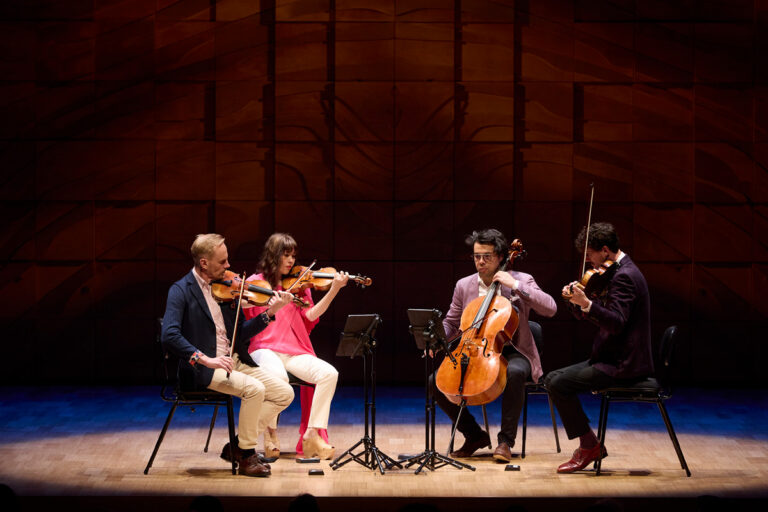
The String Quartet in F, performed with bags of personality by Quatuor Métamorphoses, is a real charmer. Opening with a wistful Allegro moderato that at times might be by Brahms or Dvořák, it includes a lyrical ‘Doric’ canzonetta, an infectious Intermezzo with a whiff of an Irish jig, and a long, mysterious fugal finale that at one point bursts into a hornpipe.
The Lieder, if possible, are even finer. Twenty-four out of a potential 80 are presented here, all of them sung with perception and panache by soft-grained baritone Edwin Fardini. Again, Journaux is the thoughtful, sure-fingered pianist. The four Opus 1 songs open with the aching Heimweh (Homesickness), followed by Heimkehr (Homecoming), which in its easy-going tunefulness could almost be Butterworth. The granitic fourth song, Ende, might be by Wolf.
Among other highlights are the pensive Irmelin Rose, Goldammer – a lyrical ode to a songbird – and the gallant Der Handkuss, its text calling for OTT outbursts of French smarm. Four songs on texts by Richard Dehmel, one of Strauss’s favourite poets, bring forth a flood of Schubert or Schumann-inspired melody, including one of Posa’s most praised settings, the haunting Beschwichtigung (Appeasement).
The jewel in the crown, though, are the five Soldatenlieder, given here with piano accompaniment though Posa later arranged them for orchestra. The musical language is not a million miles from Mahler’s eerie Wunderhorn settings, with march rhythms and the ominous rumble of drums often lurking in the background. Any of these miniature masterpieces would sit comfortably in a recital exploring the vicissitudes of war.
A stunning set, then, and superbly documented. With so many interesting composers seeing the light of day, it can sometimes be hard to sort the wheat from the chaff. Oskar Posa, however, is wheat all the way.
Composer: Oskar C. Posa
Works: Lieder, Violin Sonata, String Quartet
Performers: Juliette Journaux p, Eva Zavaro v, Simon Dechambre vc, Quatuor Métamorphoses, Edwin Fardini bar
Label: Voilà Records V001DB (2CD)

Comments
Log in to start the conversation.