Last Tuesday night I watched investors across Australia spit the dummy as Labour’s new budget recast housing as ‘shelter’ rather than investment while, at the same time, I accepted the terms on a rent increase from my own landlord.

On Friday night, I was in Malthouse’s Merlyn Theatre watching a family of seven threatened with eviction by a land-grabbing Priest.
Bloomshed’s Pride and Prejudice. Photo © Photo Simon Fazio

Bloomshed have been pinballing around Melbourne’s independent theatre scene for more than 10 years with their larger-than-life adaptations of various classics. The 16-strong ensemble have thrown Tennessee Williams into a dodgeball game, made Adam and Eve do jazzercise, and theatricalised an Orwellian Royal Commission with equally Orwellian animals.

For their long-awaited, glittering mainstage debut, they’ve put their satirical stamp on Jane Austen’s 1813 canonical portrait of class, love, and family, Pride and Prejudice.

Pride and Prejudice takes Austen’s most famous couple – Elizabeth Bennet and Mr Darcy – and throws them to the dogs of an Australian rental market transposed onto the English countryside. Call it the cost of loving: romance in a time of housing crisis. It’s an Austenian marriage plot about the love of plots of land.

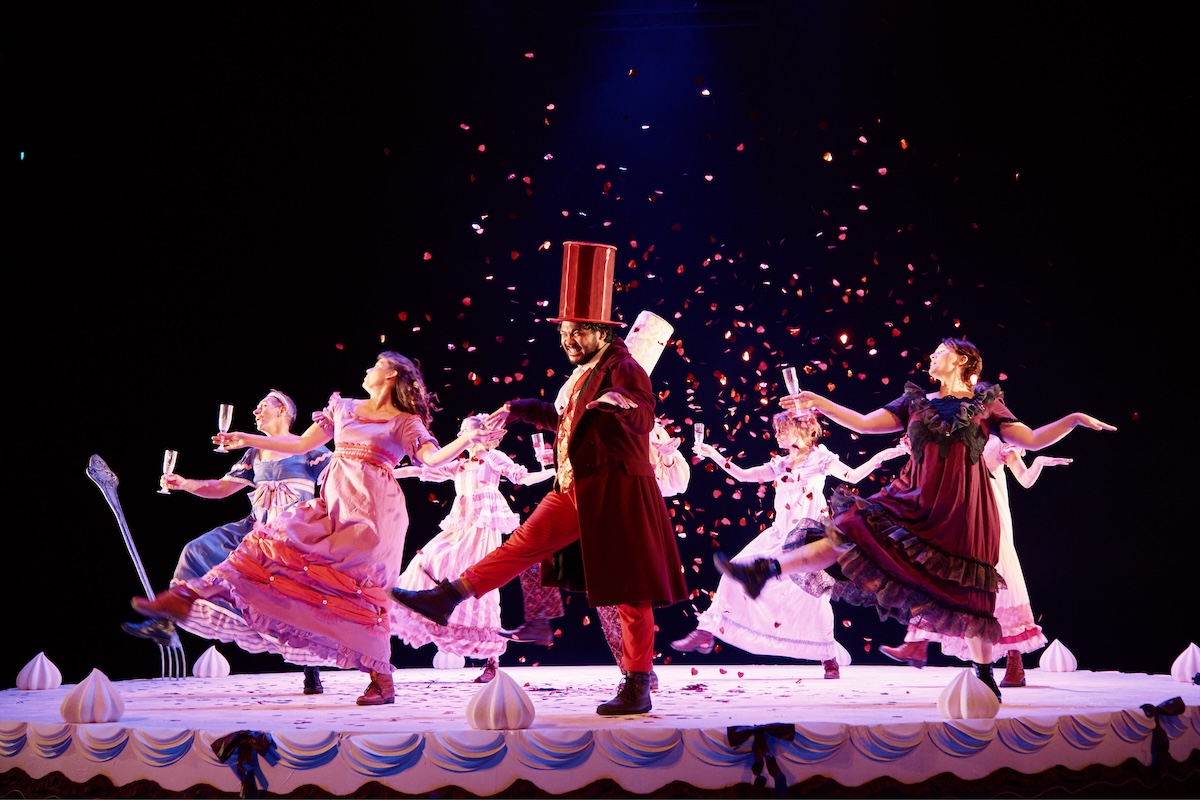
This production affirms what we’ve known for years: Bloomshed are our smartest theatrical satirists. They are as committed as ever to comedic spectacle, physical tomfoolery, and confetti. The patriarch of the Bennet family is a wilting houseplant; General Wickham (the uproarious Lauren Swain) is a performative douchebag; Kitty (Syd Brisbane) is a runt no one likes; Caroline Bingley (Laura Aldous) is a self-righteous snake; Mrs Bennet (a standout Emily Carr) is a wine mom at a wedding reception trying to sell off her daughters.

Bloomshed’s Pride and Prejudice. Photo © Photo Simon Fazio

This is what distinguishes Bloomshed’s farcical revisionism: every larger-than-life choice exaggerates the quirks of already outrageous characters; every side-splitting conceit takes the questions of its source text seriously enough to parody them. It’s true that Kitty is a runt no one likes in the novel and that General Wickham is a douchebag. Too often, classics are reimagined on our stages in ways that treat their status as a problem to be solved with theatrical gimmicks or explicit modernising. This production is brash and outlandish, but it shows Bloomshed choosing instead to revel earnestly in Austen’s world, her characters, and her ideas.

Astor Piazzolla’s bouncing score turns every ball into a lively, jazzy flash mob; costume designer Samantha Hastingsexaggerates the Regency setting with boldly coloured chemise dresses and towering top hats. Every character – whether you’ve read the novel or not – feels wacky yet familiar. And every question about love and class already baked into Austen’s writing is sharpened into an entertaining but astute point.

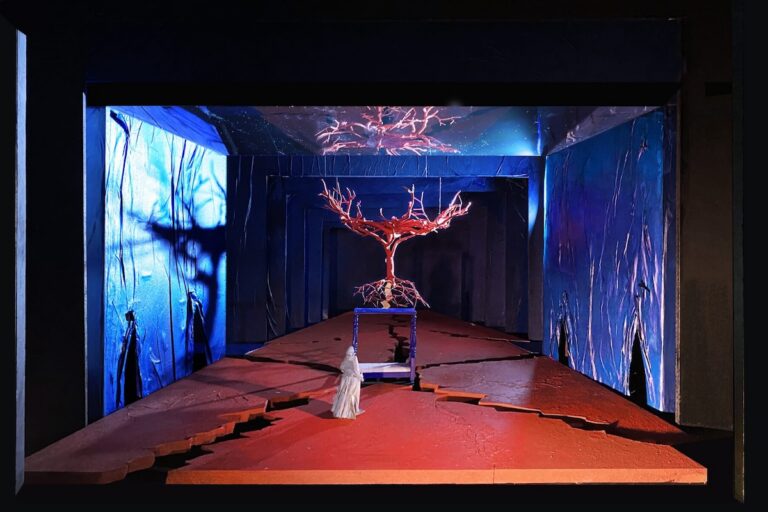
I mean “baked” literally here. Our stage (ornately designed by Savanna Wegman) is a pastel sponge cake that nearly fills the Merlyn stage – a clear metaphor for the problem facing the Bennet family: their home is a consumable delicacy for landlords with a sweet tooth lying in wait. This is the distinction between the Bennets and everyone else: they are tenants hungry to marry a landlord in a world of landlords hungry for more property and more tenants.

Bloomshed’s Pride and Prejudice. Photo © Photo Simon Fazio

The push-and-pull of our favourite literary couple, the whip smart Lizzie Bennet (Elizabeth Brennan) and the brooding curmudgeon Mr. Darcy (James Jackson), is not only a battle of wills but of ideological difference.

Lizzie, our proto-Marxist, believes in property as a human right and opposes the monopolising cultural elite who benefit from intergenerational wealth and often make fun of her muddy boots.

Darcy is a strict economist who has made being a landlord a personality trait. He’s never thatched a roof, he tells us in uproarious deadpan, but he does love one particular Thatcher (“Hell of a woman”, he quips). 

And so Bloomshed brings out another tension key to the novel’s enemies-to-lovers storyline: the political and ideological disparity that makes Lizzie resist Mr. Darcy. Over 90 minutes, they come up with evermore outlandish ways to play up this tension.

William Collins (Brisbane) makes plans to put the Bennet’s cottage up on AirBnB; Kitty is jettisoned to Australia to find a better, freer market; Mary Bennet (Swain) uses anarchic violence and a spiritual connection to a certain raven to crack the local housing market.

When Darcy reveals that he’s refurbishing an estate for the poor, and actively gives to an orphanage, Lizzie’s belief that their ideological difference is insurmountable buckles. Is there an ethical way to be a landlord? Is Darcy irredeemable?

Beneath the ethical quandary is a romantic one: Lizzie can’t logic her way out of love. If I have one criticism of the production it’s that it didn’t give Brennan more chances to show Lizzie grappling with these problems.

In a production full of big performances, Brennan’s more minimalistic style of physical control – a darting eye here; a lumbering run there – covertly holds the show’s themes together. You only wish she had the chance to showcase her talents. 

But you can guess how things end. It’s a truth universally acknowledged that love makes us stupid, landlords are twats, and this is an uproarious show you don’t want to miss.


Bloomshed presents Pride and Prejudice at Malthouse Theatre, Melbourne until 23 May.

Contribute to Limelight and support independent arts journalism.