In years prior, Melbourne’s theatre foyers would be a sea of puffer jackets by June but it’s been concerningly warm. This frog is noticing the water getting hotter in the proverbial pot and choreographers Amber Haines and Kyle Page and Lucy Guerin are as well, if their works in the Australian Dance Biennale held during this year’s Rising Festival are anything to go by.
Haines and Page’s Red looks ahead to the moment humans run out of resources needed to live, in a dance cum endurance performance art production. Guerin’s The Forest, which delivers a collection of dances with a thematic throughline, looks backward to a time where western cultures positioned humans alongside, not on top of, nature.
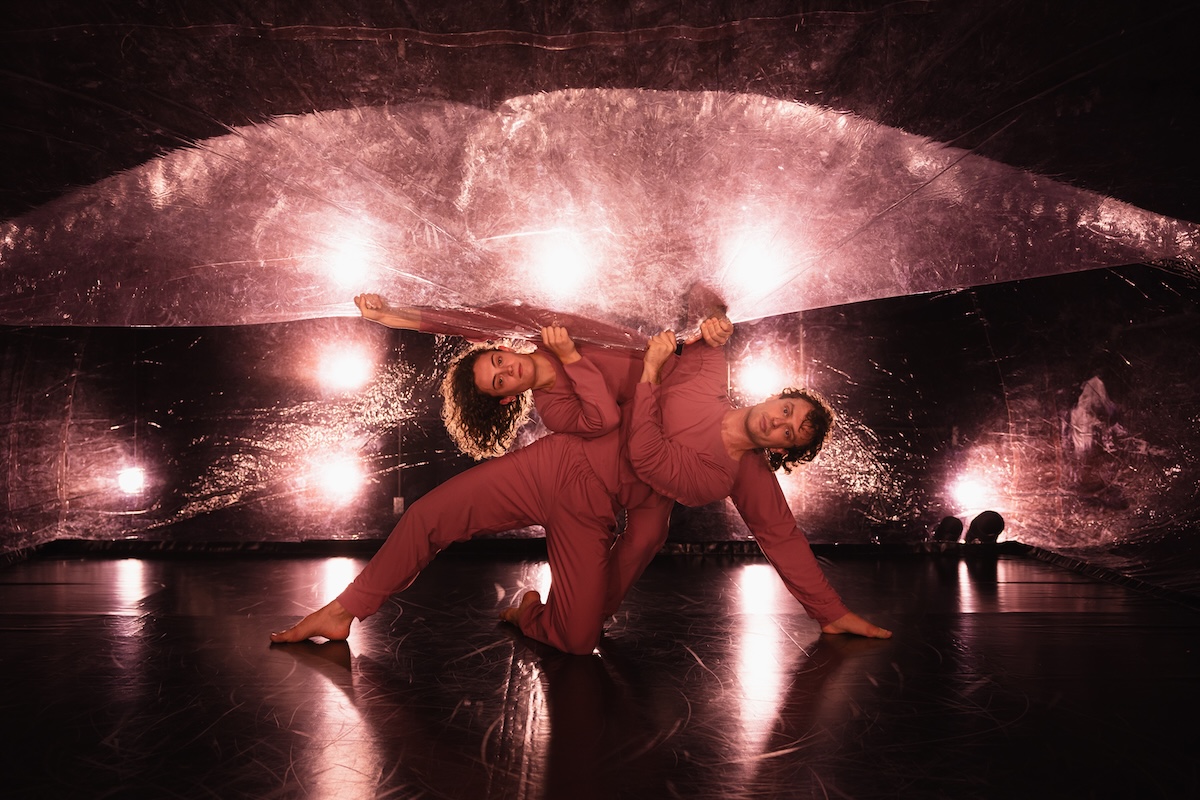
Sabine Crompton-Ward and Michael Smith in Dancenorth Australia’s Red. Photo © Tszar
A surprising similarity between the productions is how they borrow from BDSM kinks to explore humans’ relationship with nature. For The Forest this is a dalliance; one scene sees a dancer turned tree tied up like a maypole in red ribbons a la Shibari. In Red, asphyxiation and a hint of mummification is the foundation of the piece. A plastic dome encroaches on dancers Sabine Cromptom-Ward and Michael Smith who perform continuously even as the condensation from their breath obscures our view of them becoming trapped with less and less air to breathe.
BDSM, which plays with power on a physical and micro scale, is an oddly fitting arena to explore humans’ historical battle for dominance over nature. In Red, the suffocating plastic dome transforms environmental processes, like the greenhouse effect, into something we can see. We can therefore also see, as the dome closes around Crompton-Ward and Smith’s fitful movements, exactly how little control we have over nature and that we are indeed a part of it. The Forest’s maypole vignette shows how control is central to society’s engagement with nature as the dancer must be immobilised before being pulled to the ground by the rest of the ensemble to the sound of a falling tree.

Lucy Guerin Inc: The Forest. Photo supplied
Like Red, The Forest also calls for audiences to position themselves as part of nature by exploring Western folk lore that considered forests as alive as humans. Guerin takes it further in an impressive tableau where one dancer becomes enmeshed in the forest, held in its embrace.
Both productions’ choreography brings nature into the theatre. Guerin’s work opens on the ensemble performing together as if they’re one of Earth’s first trees, reaching toward the sun, but relies on design elements like lighting effects and a looming forest backdrop to remind us of The Forest’s topic otherwise.
Haines and Page’s choreography often emulates fungi or life forms from the Mesoproterozoic period that seem unnatural for bodies with bones to achieve but the cast somehow do it anyway. It’s as if we’re watching evolution in 45 minutes or Haines and Page’s imagining of life on a post apocalyptic Earth. This, plus the dancer-orchestrated, cloud-like fluctuation of the dome that flows into a nailbiting third act as their air runs out, sees Red leave a more lasting impression.
Dancenorth Australia performs Red in the Lawler, Southbank Theatre, Melbourne until 7 June.
Lucy Guerin Inc performs The Forest in the Unoin Theatre, University of Melbourne until 7 June.

Comments
Log in to start the conversation.