




First of all, this was smart programming for a Friday morning concert. The SSO brought us two English masterpieces, both associated with the Second World War. Benjamin Britten’s Violin Concerto was completed in 1938 when he was in America, where he and his partner, Peter Pears, soon found themselves trapped by the outbreak of war.
It was premiered in 1940 by the New York Philharmonic under John Barbirolli, with violinist Antonio Brosa, but after the war it was rarely played at all until Britten recorded it in the 1970s. Today, it is part of the central repertoire and much recorded.
It is a serious work – the composer had recently been moved by Alban Berg’s Violin Concerto – but it is also well within the virtuoso tradition, with plenty of double stopping and passages in high harmonics for the soloist. It seems to sense the coming tumult in sections of the opening and scherzo movements, with stabbing, unexpected orchestral chords, while the ending exudes unease as the harmony fluctuates between major and minor.
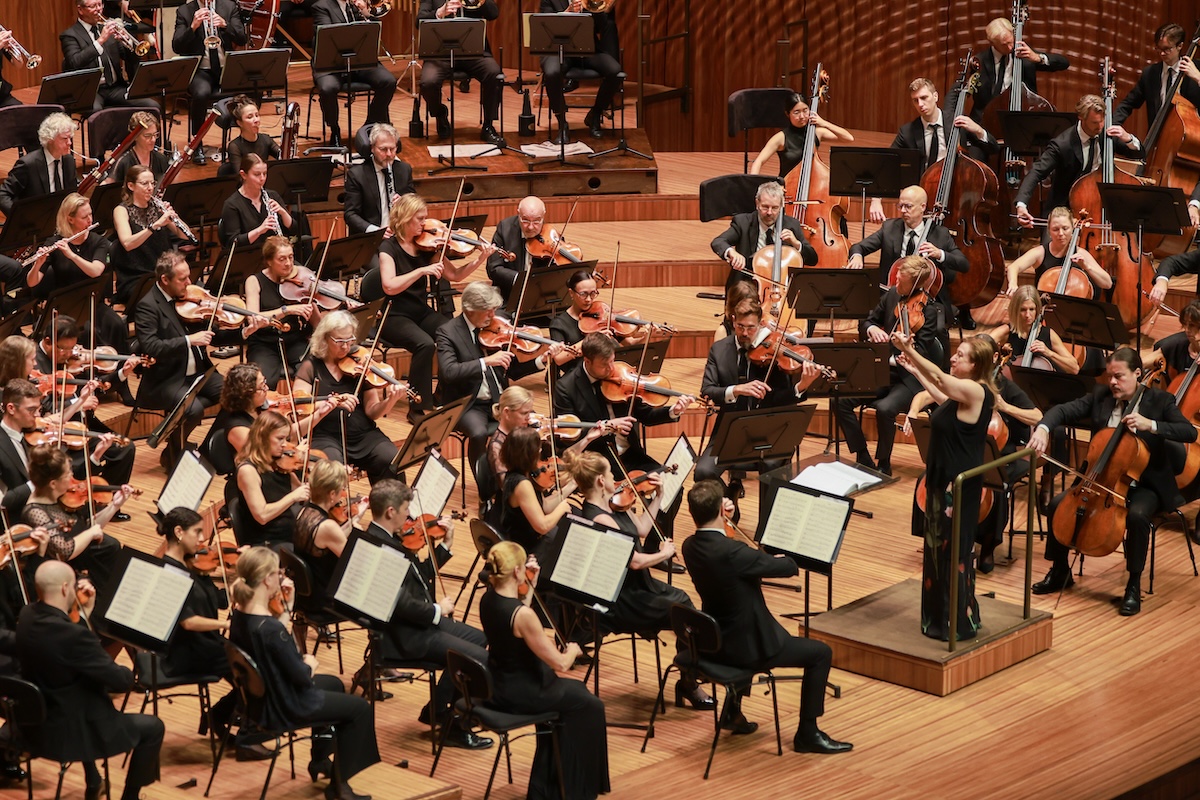
Simone Young conducts Britten & Vaughan Williams. Photo © Sydney Symphony Orchestra
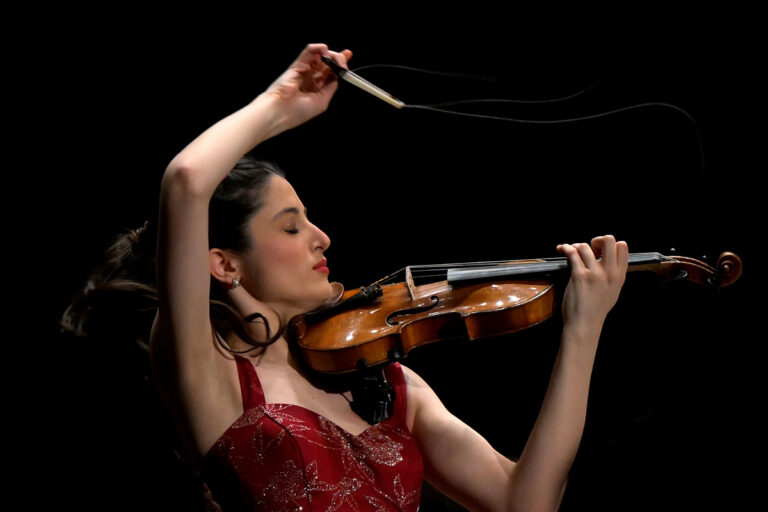
Conductor Simone Young took the fast sections briskly, impelling the virtuosity required from Dutch violinist Simone Lamsma. A physical player who uses her whole body, Lamsma dispatched the solo part with commanding strength and clarity, and with a lovely singing tone in the lyrical moments.
Young (again) proved herself a superb accompanist, timing the orchestral part with great precision; the strings sounded gorgeous when they took up the violin’s theme in the first movement. She also made the most of the extraordinary orchestral climax towards the end of the final movement. (The movement is in passacaglia form, predating the great passacaglia from Peter Grimes by six years.)
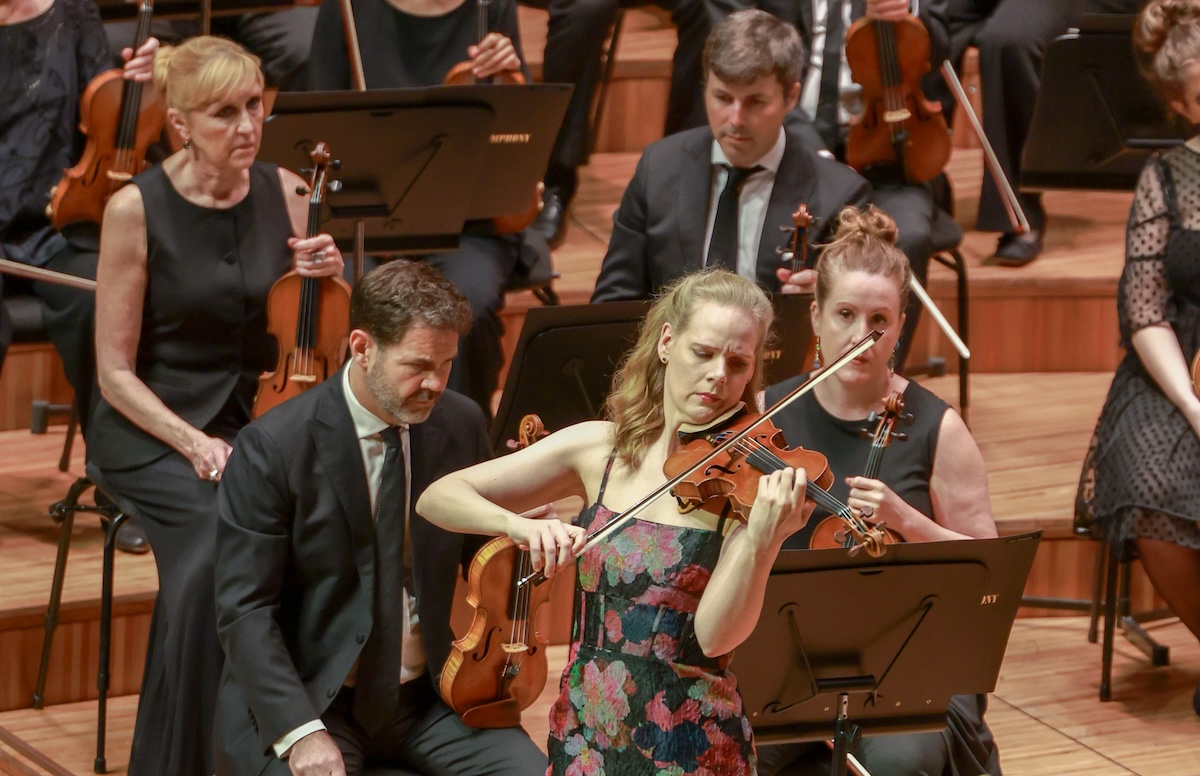
Simone Lamsma: Simone Young conducts Britten & Vaughan Williams. Photo © Sydney Symphony Orchestra
Ralph Vaughan Williams had written a “war” symphony between 1939 and 1943 – his Fifth – but it was conciliatory and peaceful rather than a portrait of combat. In his Sixth, written post-war in 1948 at the age of 75, he seems to have decided to tackle the actual chaos of the event. He always denied this, saying the music depicted nothing specific, but the urgency of Young’s performance told a different story. She found sturm und drang from the first note and again was very brisk in the opening and scherzo movements. There is mayhem in this music if you don’t sit back on it.
The eerie fourth movement, on the other hand, has been likened to a desolate, post-apocalyptic landscape — even a post-nuclear war world. It can be very cold music (as in Paavo Berglund’s recording with the Bournemouth Orchestra), but the innate warmth of the Sydney woodwinds and, later, the cello section brought a strain of quiet hope to the proceedings.
Overall, this was quite an individual interpretation of the symphony, but Young knows what she wants and how to get it. The orchestra played with great dramatic punch throughout, with some lovely work from first oboe Shefali Pryor and flautist Emma Sholl, while the brass covered themselves in glory from top to bottom.
This was a dynamic concert, and Young is a brilliant conductor of Vaughan Williams. I understand the pure balm of the Fifth Symphony may be in the programming pipeline. Considering the state of the world, we could do with it – sooner rather than later.




Comments
Log in to start the conversation.