




The central character in Griffin’s The Elocution of Benjamin Franklin, Robert O’Brien (billed simply as Man), is a 50-ish sometime-actor (and surreptitious transvestite) who finds himself giving private elocution classes out of his house in Double Bay.
Stutters and lisps are his material, phonetics and breathing exercises his tools. But while his pupils are only looking for a way to fit in to their everyday lives, O’Brien aspires to create entertainers.

Simon Burke in The Elocution of Benjamin Franklin. Photo © Brett Boardman
His stymied dreams are recharged by the arrival of one Benjamin Franklin, a lightning rod of a 12-year-old boy whose stutter disappears while he’s discussing his sex life. Benjamin is a born raconteur whose ability to communicate is curtailed when he’s not free to be himself. Their relationship evolves from the pedagogical to something approaching friendship, or at least interest in one another’s lives; a sinister development, to the world around them.
Much depends on the role of O’Brien, who is the only on-stage character. Simon Burke gives an outstanding performance, with great depth and range. He is raw and vulnerable, but powerfully rather than timidly so (including during the play’s opening striptease). At other times, as the script demands, he can be heightened and melodramatic, afraid or confused, tired and defeated.
It’s non-stop and frenetic, and Burke often pivots from scene to scene within seconds, particularly during some lightning-crash montages. On a few occasions, he’s also called to provide lines for other characters, holding up both ends of a conversation capably.
However (as befits an elocution teacher) it’s also a remarkably controlled vocal performance. Burke slips in and out of accents, registers and voices with ease and precision. The character O’Brien is by nature a performative ham, but with Burke there’s no danger of overdoing it. Instead, he retains the attention of the audience.
Playwright Steve J. Spears was in his early twenties when writing The Elocution of Benjamin Franklin, but the play reveals an understanding beyond his years of human nature, its social performance, and how to manipulate and manifest it on a stage. This is the 50th anniversary of the work which, while Spears’ most famous, remains rarely produced.
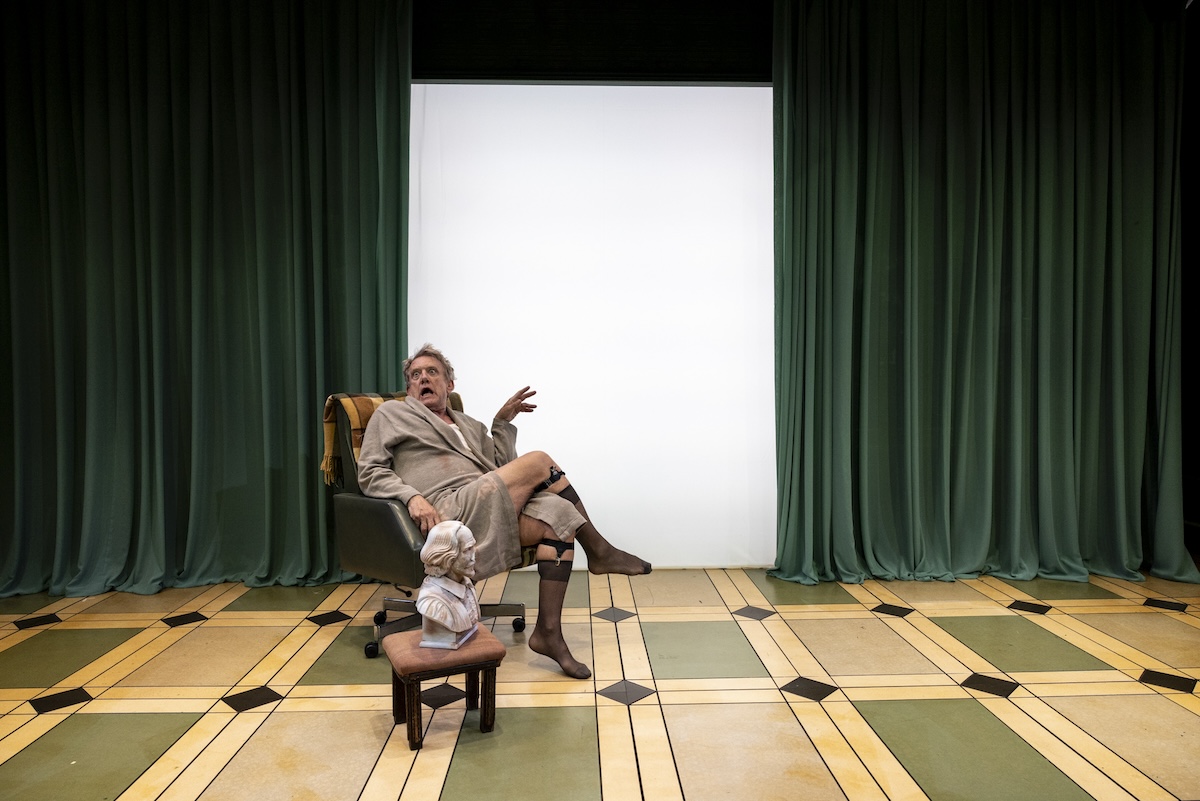
Simon Burke in The Elocution of Benjamin Franklin. Photo © Brett Boardman
Director Declan Greene has done well to elicit this performance from Burke, and he has made some interesting elisions in adapting from the original text. The mid-Seventies setting is retained, and while much has changed (principally the legal treatment of homosexuality and insanity) many of the play’s concerns are as relevant now as they were then. Ideas of privacy and performance, of restriction and freedom, may even resonate more in an era of social media and a ‘loneliness crisis’.
Where the play possibly suffers is in the final stretch, when O’Brien is incarcerated as criminally insane. It’s an opportunity for Burke to demonstrate more range, but as a narrative crutch, the inclusion of O’Brien’s madness can feel unsatisfying and gimmicky.
That doesn’t detract, however, from what is an outstanding production, and an insightful interrogation of what it means to live privately and performatively, underpinned by a masterful performance from Burke.
Griffin Theatre Company presents The Elocution of Benjamin Franklin in the Downstairs Theatre, Belvoir, Surry Hills until 29 March.







Comments
Log in to start the conversation.