Larry Kramer’s The Normal Heart is not an elegantly written work of theatre. Far from it. It is didactic to the point of polemic. Its dialogue is frequently pedestrian. Its repetitive speechifying feels better suited to the protest platform than the stage.
But four decades after its premiere – and even though it has been overshadowed by more artful plays, most notably Tony Kushner’s epic Angels in America – The Normal Heart still captivates with its furious urgency, and its challenge to institutional thinking remains as topical as ever.
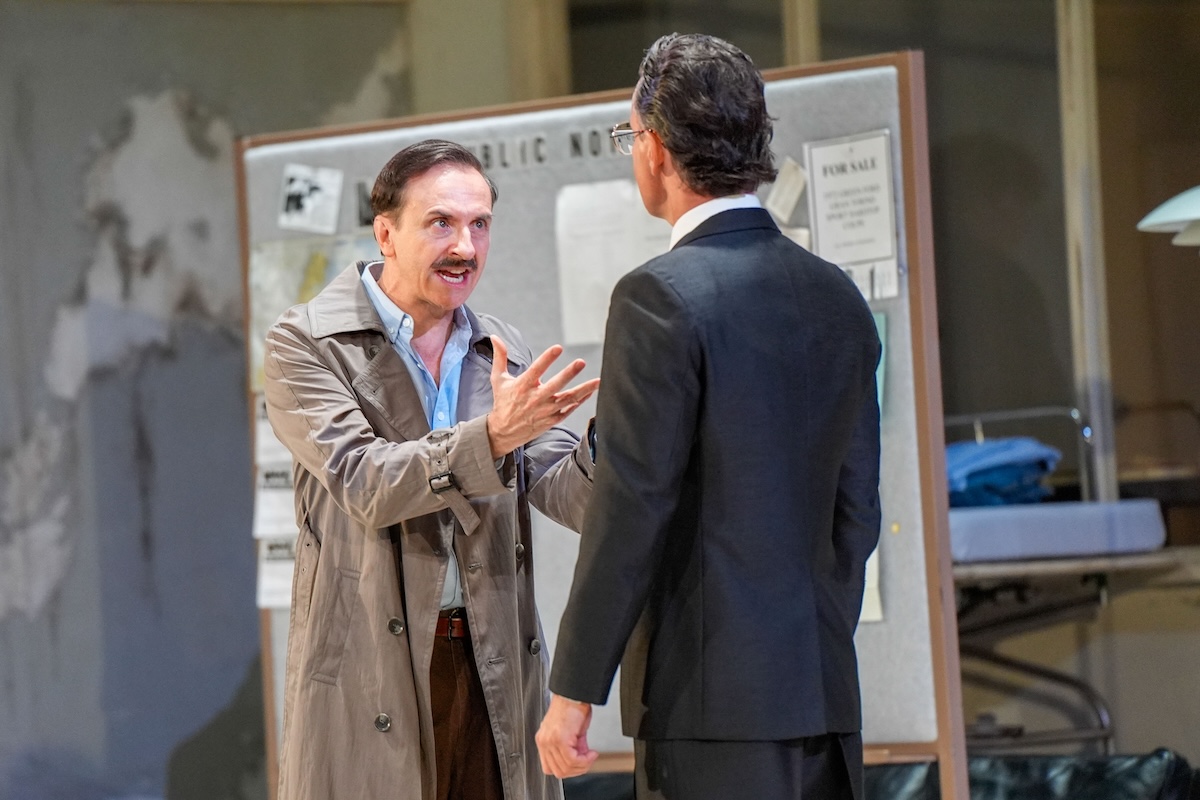
Mitchell Butel and Michael Griffiths in The Normal Heart. Photo © Neil Bennett
Premiering in New York City in 1985 (it was first seen in Australia in 1989, in a Wayne Harrison-directed production for Sydney Theatre Company), The Normal Heart was one of the earliest and most strident theatrical responses to the AIDS crisis. It is easy to overlook now what an eye-opener it was. Kramer’s depiction of queer life in New York was frank, to say the least. He also made no bones about apportioning blame for the unfolding catastrophe: a homophobic city government; a cowardly medical and media establishment; and – most controversially – a gay community for whom sexual promiscuity and pleasure were the political hill on which they were, quite literally, dying.
At the play’s centre is Ned Weeks (played here by Mitchell Butel), a gay and temperamentally combative New York Jew, removed enough from the scene to see what others do not: that more and more men in his community are dying from a mysterious disease. Schooled by a doctor, Emma Brookner (Emma Jones), who works on the hospital frontline, Ned sets out to spotlight the emerging pandemic in the media, secure funding to help those in crisis, and convince his community to change its ways.

Nicholas Brown, Mitchell Butel and Mark Saturno in The Normal Heart. Photo © Neil Bennett
His take-no-prisoners approach wins him no friends – certainly not in government. It also corrodes his friendships and relationships, most obviously with his straight brother Ben (Mark Saturno), with the Gay Men’s Health Crisis group he helped build, and with its closeted president, Bruce (Tim Draxl), a former Green Beret now working for a bank.
Ned’s new lover Felix (Nicholas Brown), a New York Times reporter, is not immune to events, either – in any sense.
Directed by Dean Bryant and played on a widescreen set by Jeremy Allen that perfectly conveys both institutional neglect and the shabbiness of 1980s New York, The Normal Heart unfolds with force and pace.
The clunkier passages of Kramer’s writing notwithstanding, the one-man-against-the-system narrative emerges strongly, and the core relationships are well drawn – especially that between Ned and Ben, which carries a convincing, dry warmth. By comparison, the scenes between Ned and Felix feel flaccid and sentimental. Jones, zipping around the stage in an electric wheelchair, is a standout as Brookner.

Emma Jones in The Normal Heart. Photo © Neil Bennett
Not all are as adept as Butel and Jones at delivering Kramer’s broadsides (Evan Lever, as old friend Mickey, has a particularly onerous speech to blast his way through), but the cast – which includes Keiynan Lonsdale and Fraser Morrison – has no weak links and is perfectly schooled in the body language and physical attitudes of the period. The costuming is excellent.
Bryant keeps much of the cast on stage as silent yet intensely engaged witnesses when they are not required in a scene or executing a quick change – a device that proves highly effective. Though the production has already had a season in Adelaide, it still has to find a solution to a difficult physical moment at the play’s end.
Pianist Michael Griffiths (who also plays Mayor Ed Koch’s slippery assistant, Hiram Keebler) and cellist Rowena Macneish perform composer Hilary Kleinig’s original score alongside arrangements of New Order’s Bizarre Love Triangle.
The Normal Heart occupies a vital place in the modern canon: not because it is the most artful play about the AIDS crisis, but because it was among the first to report from the trenches, demand action, name names.
It’s a production that leaves one somewhat moved but with mixed feelings. Its power lies less in writerly finesse than in its enduring ferocity. It reminds us that theatre, at its most urgent, is about bearing witness.
The Normal Heart plays at the Drama Theatre, Sydney Opera House until 14 March.

Comments
Log in to start the conversation.