




US minimalist composer Philip Glass calls his adaptation of Franz Kafka’s story of a man who wakes to find himself accused of an unnamed crime by an omnipotent and incomprehensible bureaucracy a “pocket opera”.
Lost & Found Opera’s production is indeed modest compared to your standard Verdi, but it nevertheless involves eight singers in multiple roles, together with eight instrumentalists – highly ambitious for an independent company.
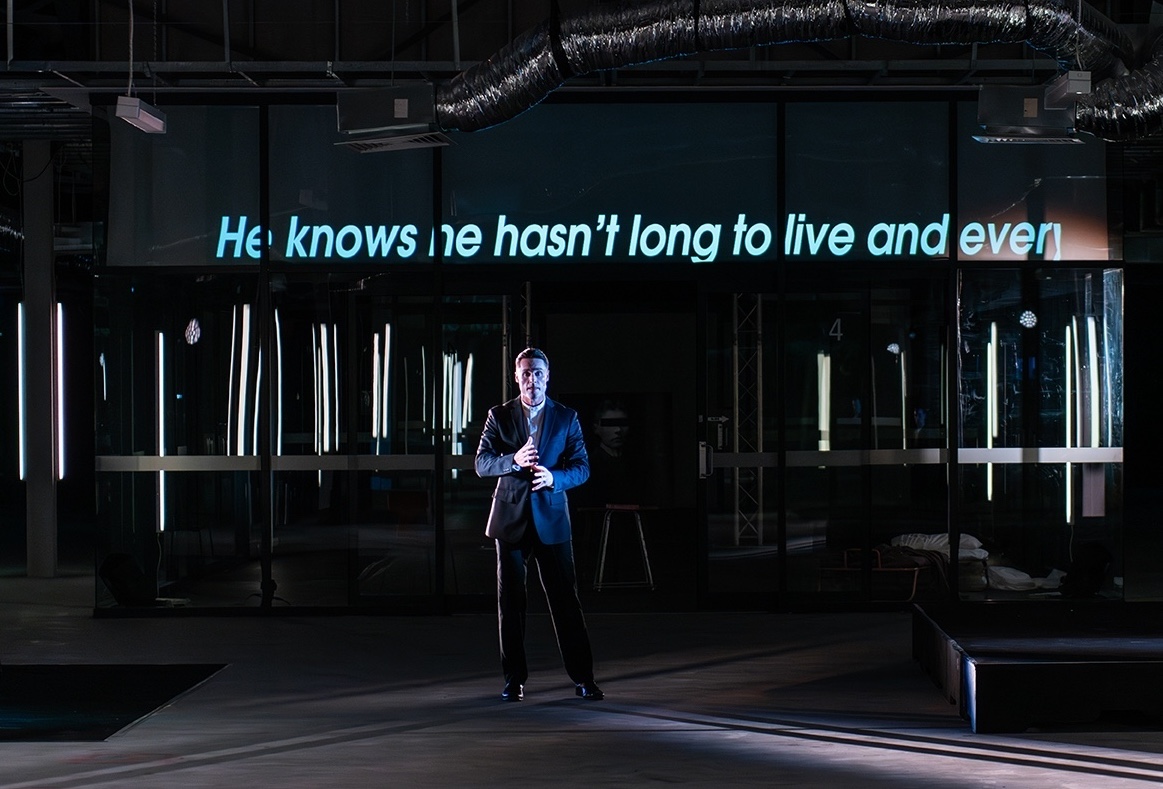
Lachlan Higgins as K in Lost & Found Opera’s The Trial. Photo © Chris Canato
Designed by Bruce McKinven, the production is staged in a stripped-out warehouse, punctuated with four black squares on the ground or built up as raised platforms, within whose boundaries most of the production’s intimate scenes occur.
Between these playing areas run routes along which the characters process backwards and forwards, or right to left, as though locked onto tracks within some grotesque machine.
At the back of the space lies a glass-enclosed office in which other scenes occur, a scenographic flourish that inevitably brings to mind the use of similar on-stage see-through walls in the work of Benedict Andrews, Richard Foreman and others. These architectural constraints render director Melissa Cantwell’s production efficient but distanced.
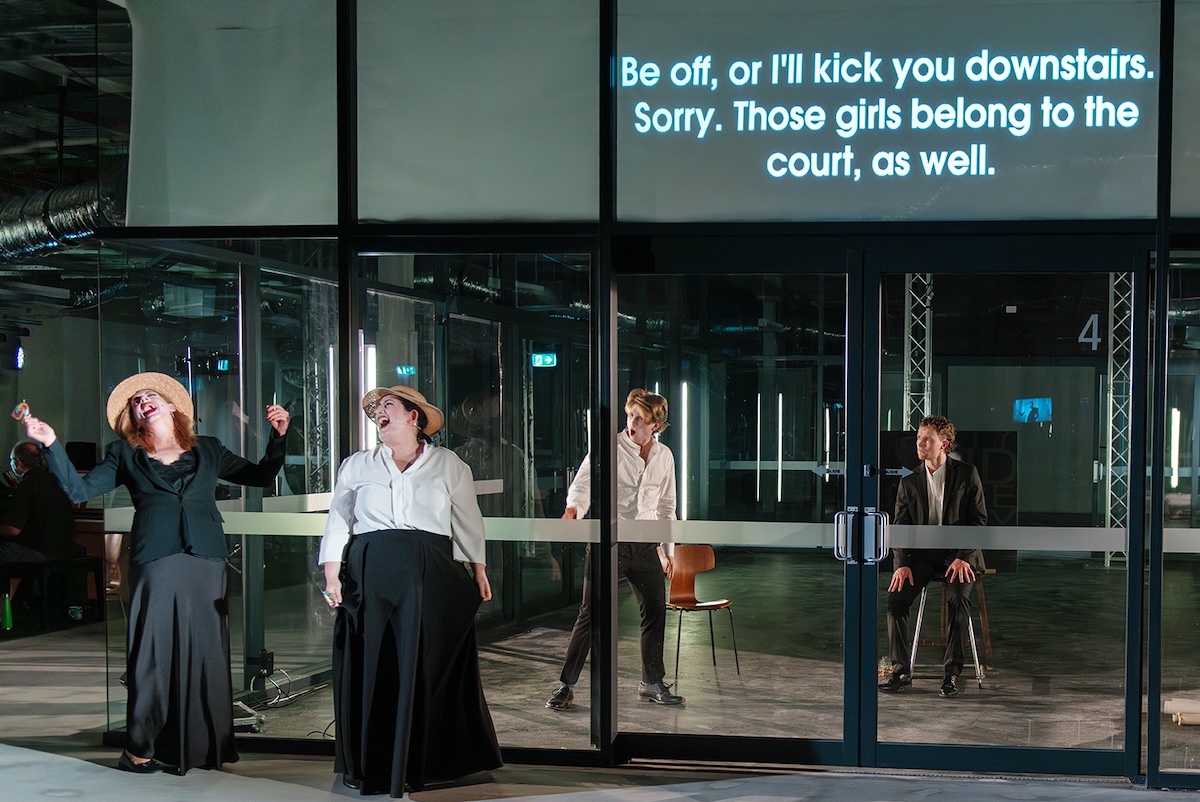
Lost & Found Opera’s The Trial. Photo © Chris Canato
The production is meticulously crafted, yet rarely surprising. Its aesthetic lineage is unmistakable: Bertolt Brecht and Kurt Weill (especially Rise and Fall of the City of Mahagonny); Heiner Müller; Robert Wilson (not least The Black Rider); and stage and screen versions of The Trial by Steven Berkoff, Orson Welles, Peter Weiss and Jean-Louis Barrault. The mechanistic precision of Cantwell’s staging and McKinven’s design even suggests Charlie Chaplin’s Modern Times and Vsevolod Meyerhold’s “biomechanical” The Magnanimous Cuckold.
Glass, for his part, largely eschews the polyrhythmic ostinatos he is so well known for in other works like Einstein on the Beach. There are touches of Wiener cabaret and interwar German music theatre in the way the clarinet, trumpet and trombone often provide dominant textures, while staccato raps on the drums hint at fractured waltzes, jigs or oppressive military drills, as with Weill and Brecht.
Musical leitmotifs associated with characters sometimes arise, as when blurred trumpets prefigure a meeting between K and his Uncle. The trombone itself is often linked to our hapless protagonist, K (strongly voiced by Lachlan Higgins).
Overall, the music carves out a series of rhythmically punctuated blocks or plateaus that shift into and out of each other, or ratchet up a gear from scene to scene. Only in the penultimate scenario, where the Prison Chaplain (Lachlann Lawton) ecstatically sings of the glow emitted by the inaccessibility of the Law, does the music become truly emotional or expressive.
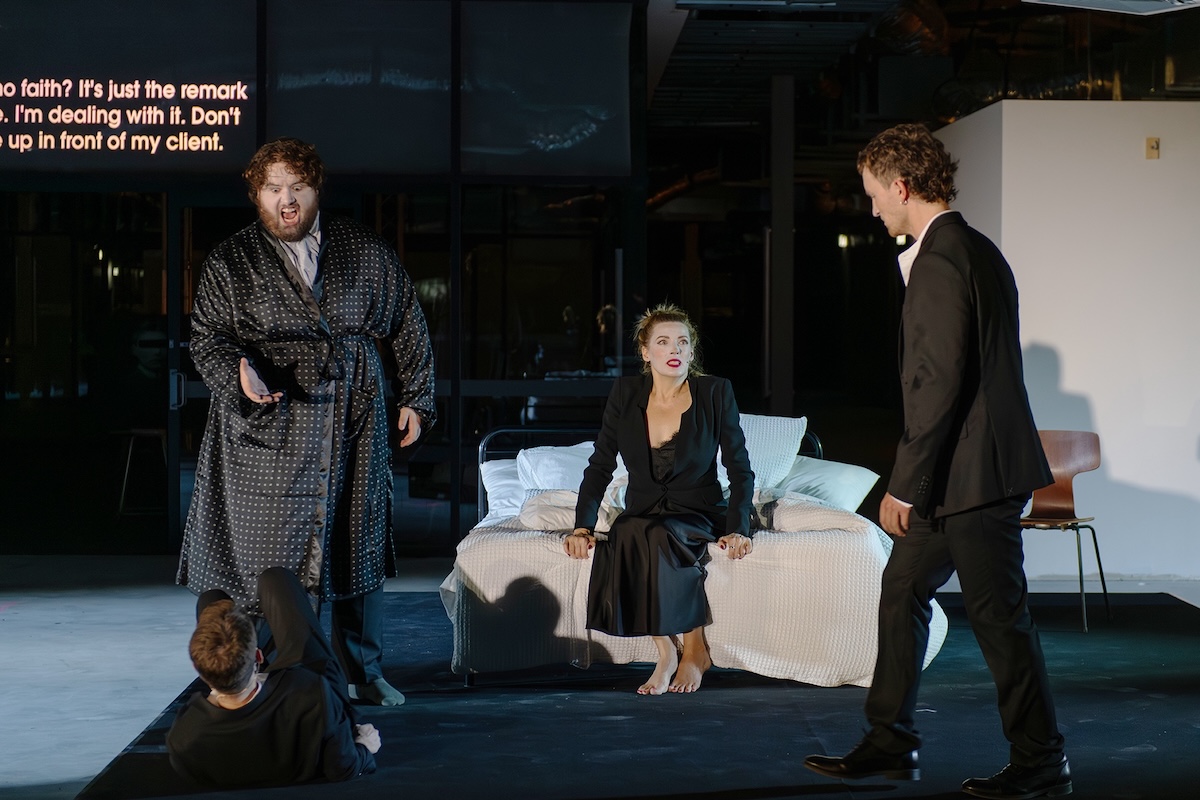
Lost & Found Opera’s The Trial. Photo © Chris Canato
Affect is otherwise kept at bay. Text is delivered in an almost matter-of-fact way to reveal, through incrementally accumulating absurdities, a hopeless tangle of bureaucratic indifference and pompousness. Horror is barely able to arise because each scene itself seems so ridiculous in its pettiness. Moreover, very little of the text is sung along with the score, rendering the words crisp but also dramatically suspended. The characters and the music that surrounds them keep carrying on, doing whatever it is they seem compelled to do, but nothing has any purpose or clear arc.
This is therefore a bleak portrait of human existence, very much in keeping with fears accompanying the rise of factory production and office bureaucracies in early 20th-century Europe. Everyone has become a meaningless cog in an infernal machine, and no individual is able to guess at what – if indeed any – larger purpose is being fulfilled.
Cantwell has claimed that The Trial has lessons for the oppressive regimes of today, but the pathetic and colourless office staff whom Kafka sees as orchestrating our doom have little parallel in our digitised and mediatised horrorscape.
K is only rarely passionate, otherwise a boring little grey man doomed to fall between the cracks of a system that neither loves him nor hates him, but is simply indifferent to him. Today’s totalitarian regimes, by contrast, are drunk on hate and vitriol, baying into mediatised digital foghorns for more blood every second.
Apparently recognising the lack of any external ideological enemy within Kafka’s oeuvre, Cantwell follows convention in having the production end with K acting as his own executioner, stabbing himself in the belly as he exclaims that he is now going to die “like a dog.”
The Trial was presented by Lost & Found Opera as part of the 2026 Perth Festival program.





Comments
Log in to start the conversation.