


By her own admission, Madeleine Easton has never been very good at doing things by halves. The violinist, teacher and artistic director of Bach Akademie Australia runs a busy independent music organisation, maintains a busy teaching and playing schedule and, on occasion, runs marathons.
But a fall on a Sydney footpath this year brought her busy musical life to an abrupt halt. Forced to pause, Easton had to confront a question she had never seriously considered: what happens when you can no longer do the thing you have devoted your life to?
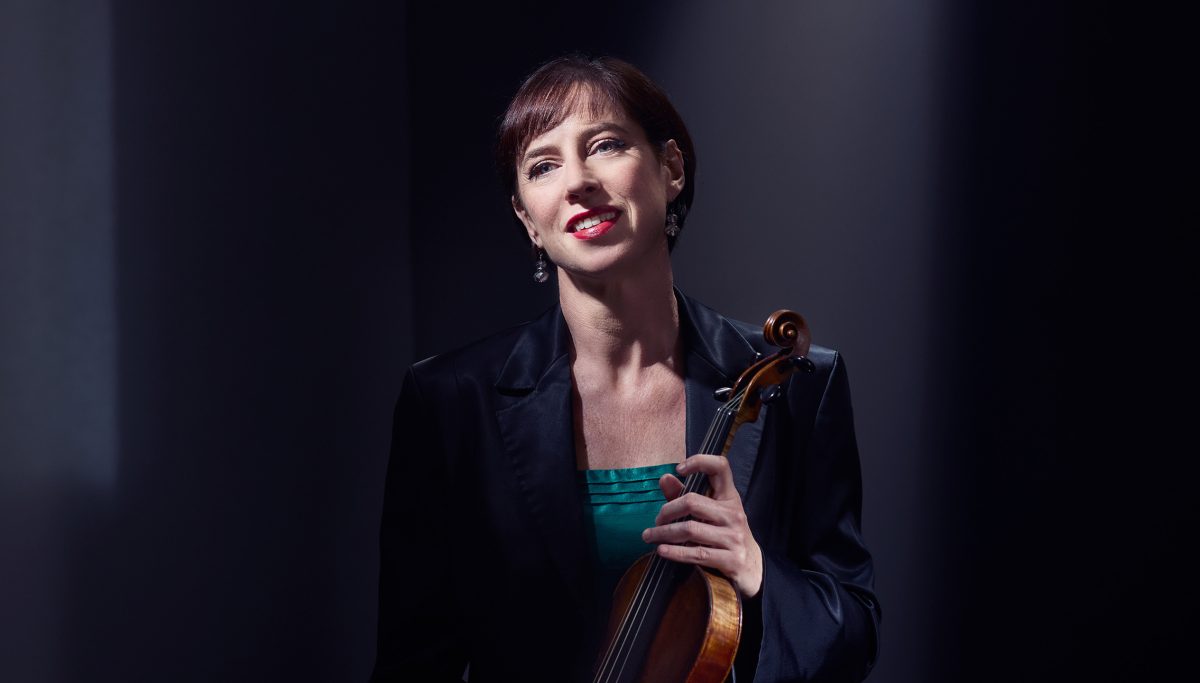
Madelaine Easton. Portrait © Keith Saunders
Easton was walking up from Circular Quay towards Macquarie Street, carrying her violin, a heavy bag containing her laptop and more. Distracted while searching for her Sydney Conservatorium lanyard, she caught the front of her shoe on a raised paving brick.
“When the lights went green, I went to move my leg and it wouldn’t,” she recalls. “By then, my weight had already tipped forwards, and I couldn’t get my legs underneath me.”
The weight of her bags contributed to her being off-balance. She landed heavily on her left elbow and head, sustaining a nasty gash, concussion and a severe fracture of the radius at the head of her left elbow. She also badly sprained her wrist and injured her thumb.
Easton was taken by ambulance to St Vincent’s Hospital. X-rays confirmed what the doctor suspected at first glannce: a broken arm. Fortunately, the bone had not separated; surgery was not required.
“They gave me a sling and some painkillers and sent me home,” Easton says, adding, “And I now have a forever scar on my head.”
The pain was considerable but so was the worry. Bach Akademie Australia was due to start rehearsing for a two-week tour in four days. Who could play her first violin role at extremely short notice?
She called musicians across the country, but finding an outstanding player available for two weeks at four days’ notice proved difficult. Eventually, violinist Simone Slattery agreed to take on the first violin part, while Baroque specialist Jane Cameron – who had recently moved to Sydney from Perth – came in as second violin.
Easton was deeply grateful. The tour (headlined by soprano Miriam Allan) could proceed, and she travelled with the ensemble despite being unable to perform, her injured arm and bruised face a visible reminder of what had happened.
“I was gutted I couldn’t play,” she says. “But I still went on tour with everybody, and I got through that.”
For an independent organisation with no government funding, cancellation was not a realistic option, Easton explains. Ticket sales typically cover only a fraction of the expenditure, and every dollar matters. Calling off the tour would have threatened Bach Akademie Australia’s financial viability.

Madeleine Easton and musicians of Bach Akademie Australia. Photo © Noni Carroll
That precariousness is part of the reality of a career in music. The public sees the concert, the finished performance and the apparent ease with which a musician produces sound. Less visible are the hours of practice, the physical conditioning, the administration and endless fundraising.
For Easton, though, the most pressing challenge was personal. Her recovery would depend on regaining mobility and strength in her left arm and hand, then discovering whether she could play to the standard her career demanded.
Physiotherapy came first. The muscles around her injured arm had seized up, leaving her unable to straighten or bend it properly. As the fracture healed, she worked to restore movement, followed by exercises with a specialist hand physiotherapist to address the damage to her wrist and thumb. “There was lots of really deep, very painful tissue massage while the bone was knitting itself together,” she says.
It was several weeks before she picked up her violin, she says, adding that when she did, she made a decision to do so differently: “I just thought, this is a golden opportunity, actually, to completely reset my playing.”
Rather than immediately attempting scales or repertoire, Easton began with the most basic movements. She raised her arms into playing position without holding the violin, paying attention to which muscles were engaging and whether they were necessary. She worked on releasing tension in her back and neck before introducing the instrument.
Once she could hold the violin comfortably, she began experimenting with open strings, listening for different colours in the sound. Then came the painstaking process of putting down a single finger on a string, repeatedly examining the movement and identifying unnecessary muscular effort.
“One finger at a time, one day at a time,” she says.
The process revealed habits she had not previously recognised, including places where she had been holding tension unnecessarily. What had initially seemed like a threat to her professional future became an opportunity to reconsider the physical mechanics of playing.
The violin is an instrument of extraordinary subtlety, but its demands are unforgiving. Repetition can make complex movements feel automatic, yet ingrained habits can also conceal tension. Easton’s enforced break gave her a chance to examine those habits without the immediate pressure of maintaining a performance schedule.

Madeleine Easton and Bach Akademie Australia. Photo © Keith Saunders
She was also able to approach the instrument with renewed curiosity. Her violin, a beautiful Grancino, had been taken to an expert, who adjusted its soundpost by a tiny amount to open up its resonance. Easton began exploring the instrument’s tonal possibilities through open strings alone, searching for different colours rather than working towards a particular musical goal.
By October, Easton felt ready to take on a substantial solo program in Brisbane for International German Week: Bach’s Partita No. 2 in D minor, BWV 1004, culminating in the monumental Chaconne, the French Suite No. 5 in G major, BWV 816, and the Sonata No. 3 in E major for Violin and Harpsichord, BWV 1016.
It was an ambitious undertaking – even for someone who wasn’t recovering from serious injury. Easton says the rebuilding of her technique helped considerably. “For the first time in my life, I was absolutely free, my neck, my shoulders …” she says. “And my God, it felt good.”
That recital, she believes, was among the best she had ever played.
The experience has also informed her teaching. The discoveries she made during rehabilitation are now finding their way into her lessons. She now encourages students to examine the minutiae of their posture and movement and work towards playing with less tension and greater physical freedom.
“In my world, the attitude is always ‘go hard or go home’,” she says. “Classical musicians are the most driven people you’ll ever meet. Failure is not an option. But sometimes, that comes at a cost. We have to get over the idea that you continue to play with injuries. That kind of thing can end your career.”
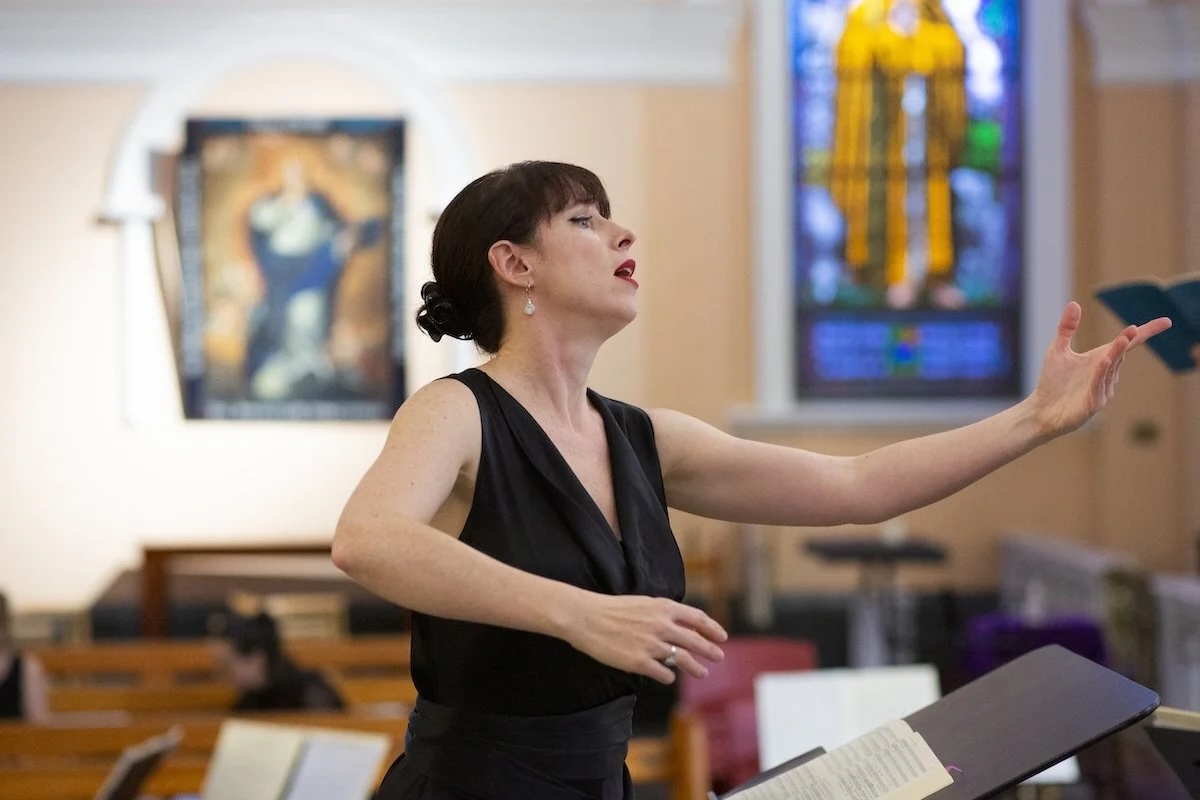
Madeleine Easton. Photo supplied
Easton is now readying herself for another physical challenge – that of conducting. She will be directing a program of festive music, Bach & Charpentier: Music for Christmas, featuring singers Susannah Lawergren, Elizabeth Cooper, Kyle Stegall and David Greco.
“I conducted the Ku-ring-gai Philharmonic a couple of weeks ago and that hurt more than playing the violin!” she says. “It was quite vigorous stuff, you know, a Matthew Hindson piece, music by Honegger and Holst. I had to tone myself down a bit for that one. Hopefully the wafting beats of Charpentier will be a lot easier.”
Bach Akademie Australia presents Bach & Charpentier: Music for Christmas at St Finbar’s Catholic Church, Glenbrook on 13 November, Our Lady of Dolours Catholic Church, Chatswood on 14 November and St James’ Church, King St Sydney on 15 November.







Comments
Log in to start the conversation.