“Chemistry” has to be one of the most commonly used but ill-defined words in the classical music lexicon. We all understand that a great chamber music experience depends on it – but what exactly is it, and where does it come from? 

Few musicians are better placed to ponder those questions than Australian Chamber Orchestra principal violist Stefanie Farrands, who has joined the internationally acclaimed Sitkovetsky Trio for the first time on its Australian tour.
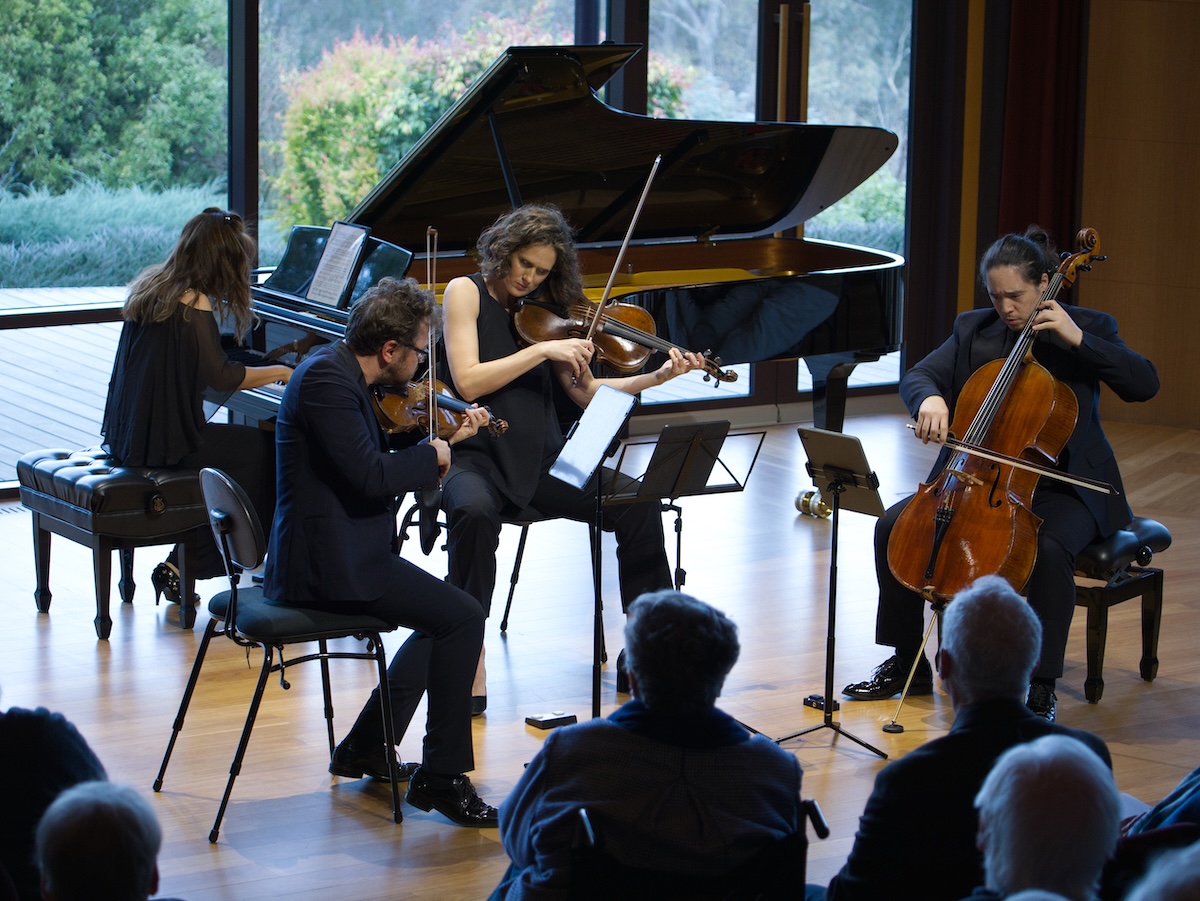
Stefanie Farrands and the Sitkovetsky Trio at UKARIA Cultural Centre. Photo © Ben Nicholls

The trio – violinist Alexander Sitkovetsky, cellist Isang Enders and pianist Wu Qian – already has chemistry in spades. Friends since their student days at the Yehudi Menuhin School, they’ve gone on to perform in the world’s leading concert halls, win the BBC Music Magazine Chamber Music Award and earn widespread acclaim for their Beethoven recordings.

Sitting down to play with such an established ensemble could easily feel intimidating. After all, that kind of chemistry is hard won and particular.

“It’s always a very thin tightrope to walk along,” Farrands says. “It requires me to relinquish all preconceived ideas and absorb everything that is musically handballed to me.”

Her strategy? “To be open, honest and very present helps me to take in as much information as I can, both through the rehearsal process and in the concert environment.”

On being ‘the intruder’

Farrands joins the Trio for the Brahms’ G minor Piano Quartet, which takes up the second half of the Sitkovetsky’s touring program. The viola occupies a particularly satisfying place in its musical architecture, she explains.

“In this particular situation it’s nice being the ‘intruder’. Typically the DNA of a piano trio does not include a violist. So I get the opportunity to fill out their sound and be the luscious bridge between the top and bottom registers of the trio.”

Over her years as a professional musician, Farrands has come to understand that the chemistry audiences witness on stage doesn’t always carry beyond it. “I’ve learnt that musicians can have very different personalities depending on whether the instrument is in their hand or not,” she says.

Instead, musical relationships and their associated chemistry develop through shared experience.

“Humans are complex creatures, and nurturing a musical relationship with someone over a long period of time can create a special dynamic on stage. Each performance you share with someone adds another layer to your shared musical experience.”

Stefanie Farrands: “A lot can be said without the need for words.” Photo © Australian Chamber Orchestra

Communication within an ensemble extends well beyond spoken discussion. During performance, musicians rely on an intricate web of visual and physical cues that pass almost imperceptibly between players.

“You need to notice, react and process every single signal you can possibly find – and at lightning speed,” Farrands explains. “How and what exactly I communicate is a direct reaction to being within the group environment. My actions also fundamentally affect how the rest of the group communicates. It’s very fluid and flexible – like watching a school of fish.”

The rehearsal room, she says, is only part of the chemistry experiment. A musician who dominates a rehearsal for example may not necessarily exert the strongest musical influence once the performance begins. Equally, players who contribute little verbally can shape an interpretation profoundly through their playing alone.

“A lot can be said without the need for words.”

That uncertainty remains one of chamber music’s enduring thrills.

“It can be terrifying walking out on stage for the first time, because the dynamic you’ve experienced has only been through the rehearsal process. It’s a delight to see what happens next.”

Stefanie Farrands and the Sitkovetsky Trio at UKARIA Cultural Centre. Photo © Ben Nicholls

Farrands also believes musicians benefit from resisting complacency. While long-standing ensembles develop extraordinary cohesion, regularly encountering new collaborators encourages artistic growth.

“We often get comfortable playing with the same people because it forms the backbone of our musical village,” she says. “Sometimes I do wonder if a musician should ever feel too comfortable. Being in a new environment gives us perspective, keeps us honest and allows so much room for growth – both as people and musicians.”

For audiences, these subtle interactions may seem invisible, yet Farrands is convinced listeners instinctively recognise genuine connection.

“Audiences certainly can sense chemistry within an ensemble on stage, and it’s one of the most beautiful experiences to be a part of.”

She experiences that daily with her colleagues in the Australian Chamber Orchestra, but every concert creates a fresh relationship extending beyond the musicians themselves.

“Audiences shouldn’t forget that there is also the chemistry we create with the audience too, and that is different for every single performance. And some performances just have something beyond description – it’s hard to pinpoint exactly what that is. Sometimes there are no words …”


Stefanie Farrands performs with the Sitkovetsky Trio at Snow Concert Hall, Canberra on 2 August

The Sitkovetsky Trio also perform on 26 July at the Australian Festival of Chamber Music in Cairns/Gimuy.

Contribute to Limelight and support independent arts journalism.