




For composer Miriama Young, dusk is the ideal time for listening. As the sun dips and shadows lengthen, the boundaries between the natural and human worlds seem to soften. Familiar sounds take on a different quality.
It is an idea that has already inspired Young to one work, DuskLit, written for clarinet, piano and string quartet and performed by Sydney’s Omega Ensemble in 2025.
Now she is about to return to the concept with DuskLit Meditations, a new work commissioned for Melbourne Chamber Orchestra, supported by the University of Melbourne’s Biodiversity Institute and Melbourne Climate Futures, and shaped by the sounds of a new generation of listeners.

Miriama Young. Photo © Ishna Jacobs
Aotearoa/New Zealand-born and Melbourne-based, Young has long been interested in the meeting point between acoustic and electronic sound, as well as music’s capacity to engage with ecology and place. Her original DuskLit grew from an ABC Victoria rural network callout inviting young people in climate-affected communities to submit field recordings of their environments and places that were special to them. The response became part of the musical fabric of the work.
In DuskLit Meditations, Young has taken the idea further, this time working directly with Year 7 students at Candlebark School in Central Victoria. The project involved sound walks around the school grounds, with students given hand-held digital recorders to capture the places and sounds that mattered to them.
“It’s quite a vast area with lots of different types of interesting places and sounds,” Young tells Limelight. “There were no limits placed on the children. They just went out and recorded their favourite spot to share with the world.”
The new work, which combines those collected sounds with a score for a chamber string ensemble, emerged after Sophie Rowell, artistic director of Melbourne Chamber Orchestra, heard the 2025 DuskLit performance and approached Young about adapting it for MCO. Rather than simply recasting the existing piece, however, Young saw an opportunity to create something new.
“There were things I think I learnt from that first piece, and I’ve incorporated them into this one,” says Young. “It’s different – a new iteration of a similar idea.”
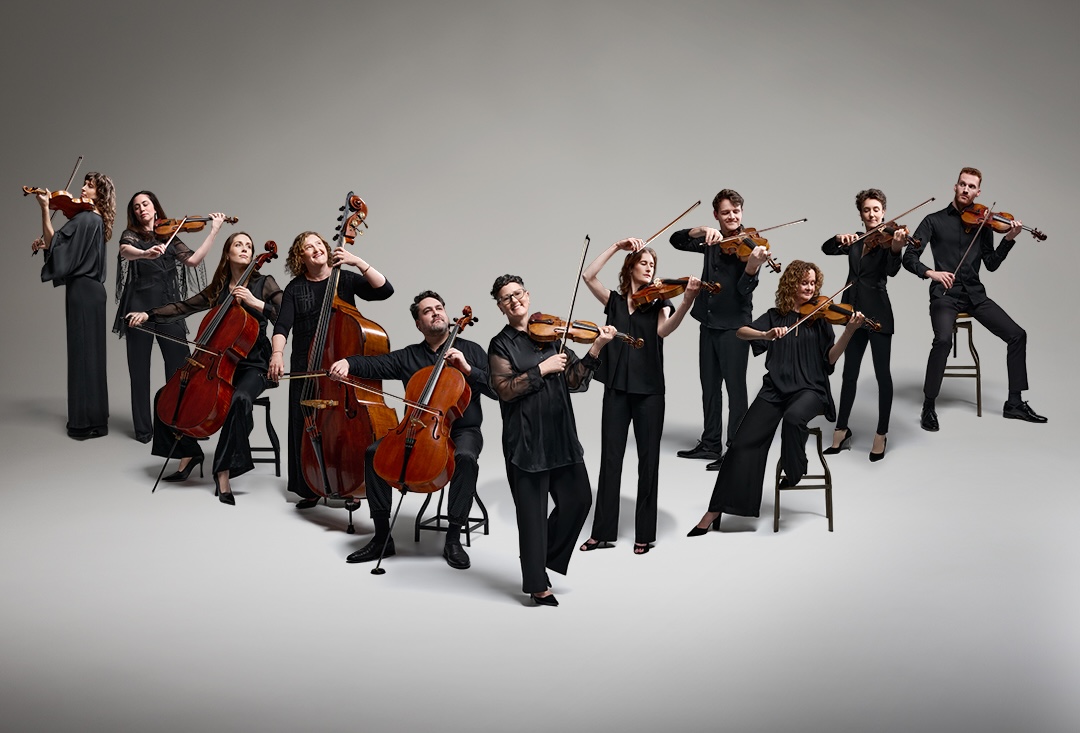
Sophie Rowell (centre) and Melbourne Chamber Orchestra. Photo © Albert Comper
Young’s title for the work, Meditations (“Just off the top of my head,” she admits) became an instantly apt description of the mood it created. While the original DuskLit explored environmental awareness through sound, Young describes its sequel as more explicitly meditative – an invitation to pause and consider the environmental crisis while also celebrating the natural world.
“It’s a chance for people to reflect on the environmental crisis,” she says. “Hopefully, give people a sense of hope. Again, it’s a celebration of nature, and it’s all done through a youthful lens.”
At the centre of the live music is Rowell’s violin. Young was struck by the violinist’s virtuosity when she heard her perform Vivaldi’s The Four Seasons, and decided the new work should be written specifically for her.
In the piece, Rowell becomes a kind of fantastical songbird, with the violin drawing on bird calls and patterns of mimicry. Young describes the imagined creature as closer to a lyrebird than a single species, with fragments suggesting birds such as the whipbird and magpie.
“I wanted to capture the spirit of bird, as capricious, joyful and lyrical,” Young says.
There is also a more personal avian presence. Living in suburban Melbourne, Young has become fascinated by a magpie in her garden that sings through the night.
“In the middle of the night when I couldn’t sleep, I started composing,” she says. “So, the violin melody forms a reply to that magpie calling into the night.”
The musical language of DuskLit Meditations is similarly layered, drawing together historical and contemporary influences. Young returned to Beethoven’s late string quartets and considered Vivaldi’s elegant violin writing, while also listening to American composer Caroline Shaw and the ways she reimagines the string quartet.
There are hints, too, of older musical voices.
“I’m trying to call up those ancient voices,” Young says. “There’s almost a Renaissance sound in parts, and moments of avian polyphony, but it’s blended with a modern minimalist aesthetic to create a calming, ethereal piece that allows space for the soundscapes to be heard, and space in time to reflect.”

Andrea Lam. Photo © Lisa Marie Mazzucco
The work will sit within a program that also includes Mozart’s Piano Concerto No. 21, performed by Andrea Lam, and Mendelssohn’s Italian Symphony. Young has deliberately considered the relationship between her new work and the older repertoire rather than treating the commission as an isolated statement.
Reacquainting herself with Mozart’s concerto, she began thinking about its original environmental context. Written in February 1785, the work was created in a very different climate from the one experienced by audiences today.
Young imagines Mozart composing during a winter whose conditions would have been markedly different from those experienced three centuries later. That idea of historical environments – and the environments that may already have disappeared – has become increasingly important to Young’s thinking.
The juxtaposition of Mozart, Mendelssohn and DuskLit Meditations therefore creates an unusual dialogue across centuries: music written in response to landscapes and seasons that have changed, alongside a contemporary work asking listeners to pay attention to the world around them now.
For Young, however, the ultimate purpose is not to leave audiences overwhelmed by climate anxiety or depressed by its inevitability.
“I hope that it’s a very calming piece,” she says. “A piece that brings both a sense of hope and a feeling that can help us to fall in love with nature again.”
The children whose recordings form part of the work may have something to teach the adults in the room, she believes.
“I think this comes through with the way that the children approach and celebrate their natural environment,” she says. “I think we can learn a lot from them.”
Melbourne Chamber Orchestra presents DuskLit at Melbourne Recital Centre on 1 October; Bunjil Place, Narre Warren on 2 October and Melbourne Recital Centre on 4 October.








Comments
Log in to start the conversation.