The very first Montreux Jazz Festival closed with a legendary set by Charles Lloyd, who returned triumphantly at this year’s 60th edition of the festival.
Between those two performances sits everything the festival has since become: a two-week musical city extending along the shores of Lake Geneva, hosting some of the greatest artists in modern music at some of their most memorable moments.
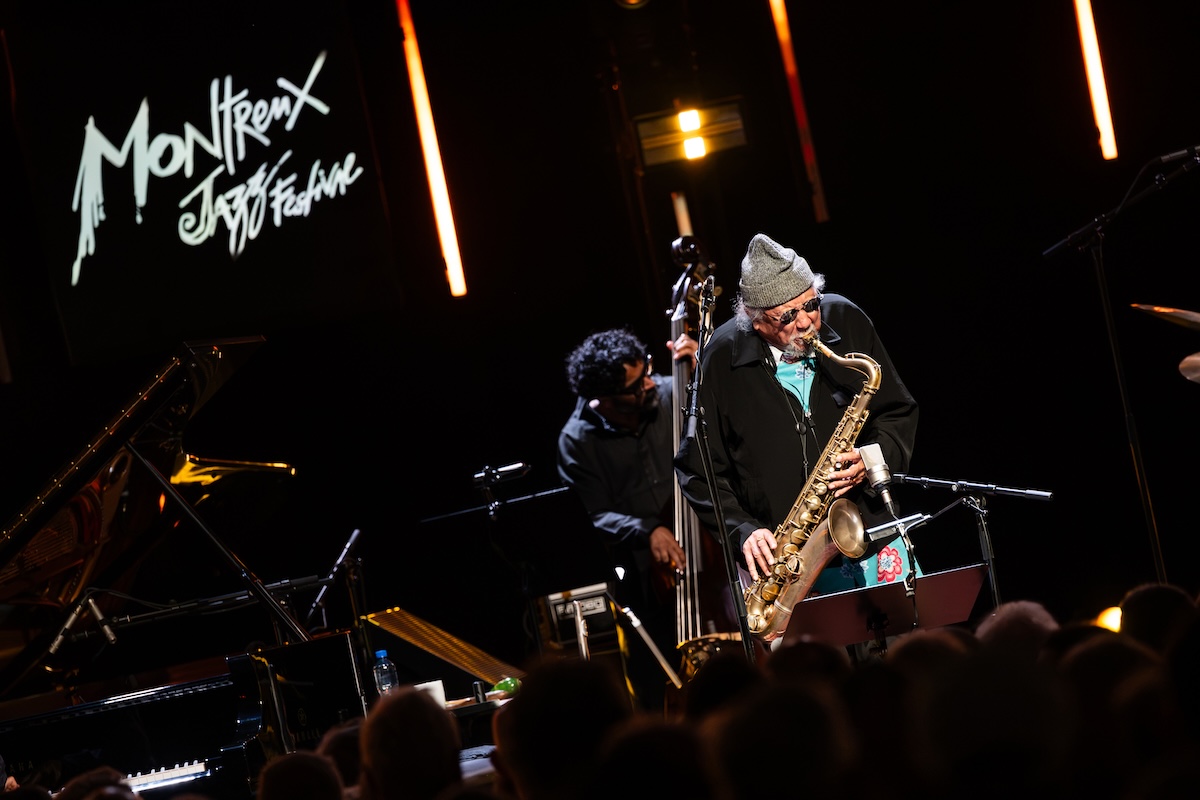
Charles Lloyd at the Montreux Jazz Festival 2026. Photo supplied
Search “Montreux” in your streaming service and you will find legendary recordings by Nina Simone, Miles Davis, David Bowie, Prince and countless others.
This year’s opening concert by Raye made that relationship between occasion, performance and history unusually explicit. Her third consecutive appearance at Montreux was a journey through six decades of music, interweaving her own songs with reimagined classics, collaborations and direct acknowledgement of the Montreux artists who shaped her.
The result was both celebration and application: an artist sufficiently conscious of the history around her to engage with it, but sufficiently self-possessed not to be overwhelmed by it.
Already available to watch again, it has begun the transition from event into artefact — from something experienced by a few thousand people in a room to something that will acquire a longer life in the festival’s recorded memory.

Raye at the 60th Montreux Jazz Festival. Photo © Emilien Itim
Every Montreux regular plays some version of the same game: which of this year’s shows will appear on vinyl next year and still be spoken of in 10 years? Which will enter the archive as more than a curiosity, and which will simply have been a good show, forgotten by the following summer?
It is a game Montreux invites because, uniquely among festivals, it keeps the evidence: every set on the main stages, every year, is recorded and preserved, with the very best released and treasured among the artists’ greatest recordings. Lloyd’s performances at the first and 60th festivals are proof the game isn’t idle. It seems a safe bet that his mesmerising saxophone session this year will soon be available for purchase and careful comparison with his first appearance.
Which raises the question: what makes a performance more than merely another stop on a tour, a show of genuine artistic importance? Every artist who plays Montreux arrives with a set to perform. Only some of those sets become part of the story of the place.
Montreux cannot guarantee that outcome. It gives artists the tools of possibility — intimate rooms with famously attentive audiences within a festival whose accumulated history gives every moment additional weight – but ultimately it depends on what each artist is prepared to do with the opportunity.

Faouzia at the 60th Montreux Jazz Festival. Photo © Marc Ducrest
Take this year’s pairing of Faouzia and Zara Larsson. Faouzia – demure and restrained, her voice carrying Arab-inflected phrasing with real power held in reserve – gave us a cover of Sting’s Desert Rose only days after Sting himself had performed the same song on the same stage, and did it far better.
It was a quietly audacious thing to do, and she pulled it off.
Larsson, whose set followed Faouzia’s, delivered a note-perfect, high-energy show, tightly scripted and choreographed – the kind of production built to travel unchanged from festival to festival, with little space for the accident or discovery that can make a classic Montreux set. This is not a criticism of her competence; it is a description of a certain kind of show design.
But the contrast with Faouzia was instructive. Montreux doesn’t discriminate between artists: the room, the sound and the attention were the same for both. What separated them was what each artist was willing or able to do with the opportunity.
Sometimes the effect is subtler. Angus & Julia Stone sounded sharper, cooler and considerably less twee than in their recent Australian shows, as though the weight of the occasion had restored an edge that comfort at home can allow them to misplace.

Marcus Miller at the 60th Montreux Jazz Festival. Photo © Marc Ducrest
Marcus Miller faced a different version of the same test with We Want Miles! – a reunion of musicians from Miles Davis’s 1981 album of the same name. The performance marked the centenary of Davis’s birth by revisiting music from across his career.
The risk in revisiting Davis was never incompetence but reverence. Such is his authority that musicians can turn timid in his presence, turning celebration into conservation: accurate, respectful, dead.
Miller avoided that trap entirely. His own funk bass playing invoked Davis’s electric years, while trumpeter Russell Gunn, entrusted with the impossible task of standing in Davis’s place without impersonating him, found something evocative rather than imitative: an aura of detachment paired with genuine engagement with the band around him. This was memory functioning as something alive rather than embalmed, which is exactly the trick the game asks every contender to pull off.
Not every legend meets the moment. On the festival’s closing night, Van Morrison arrived with immense history behind him and a voice that remains remarkably strong. Yet he spent much of the set complaining about the sound mix, treating his band, technicians and audience as nuisances to be endured.
Even Montreux’s sin-covering eye could not disguise the late-career spiritual contraction that now separates Morrison from the transcendent music he once made. It was only when he unceremoniously left the stage midway through the final song that the band, suddenly released, gave us classic Van. Reputation had brought him to the room, but presence deserted him once he was there.
James Taylor, playing after him, offered the opposite lesson. His gentler idiom may ask less of an ageing voice, but the success of his show depended on more than accommodation.
Across a generous two-hour set, he embraced the years rather than fought them, allowing the hopeful songs of his youth to acquire a careworn tenderness while sharing the stage on equal terms with his band – most notable among whom was his son Henry, whose voice carries an uncanny echo of his father’s younger self.
Where Morrison seemed affronted by the demands of the occasion, Taylor understood that artistic significance can lie in meeting the present rather than raging against the dying of the light.

Lewis Capaldi at the 60th Montreux Jazz Festival. Photo © Thea Moser
Lewis Capaldi offered a smaller-scale version of the same lesson. His, too, was a touring show rather than something built anew for the room – on paper, the kind of night that risks feeling like one more stop on a long tour. It didn’t. What carried it was command – of the material and of himself — which was especially striking given his candid discussion during the performance of his struggles with mental health.
Where Larsson’s touring show proved a production could survive Montreux unchanged, Capaldi’s proved one could be genuinely lifted by it, and the difference is one of talent and maturity.
Which brings the game back to where it started. If this year’s festival added one fresh name to the list of future contenders, it might be Nick Cave & the Bad Seeds. Their Montreux performance drew on the strongest music from a formidable back catalogue without becoming a retrospective, possessing the emotional power of the religious experience that has always informed their best work. Replayed in 10 years, it might look like the moment a great artist became a Montreux artist.
Whether that turns out to be true – or whether it’s Lloyd’s set, Miller’s or Raye’s that ultimately endures – is not something we can know now.
Only the recordings, and the people still listening to them, get to settle that. It is the same question the festival has been asking since 1967 of every artist who takes one of its stages: not whether you can fill the room, but whether the room will still remember you when you have gone.
The 60th Montreux Jazz Festival took place from 3-18 July.
Lewis Capaldi and Raye headline the Spilt Milk Festival in Canberra, Gold Coast, Geelong and Perth from 12-20 December.


Comments
Log in to start the conversation.