Last week, Katia Geha was announced as a recipient of the 2026 Art Music Fund.

It’s the latest achievement in a fast-growing list for the Sydney-born composer, who also works as the Australian World Orchestra’s librarian – a 2027 ANAM Set commission, a 2025 Emerging Artist Award from the Australian Women in Music Awards and First Prize at the 2025 Engine Room International Sound Art Competition, with her winning installation played in London.

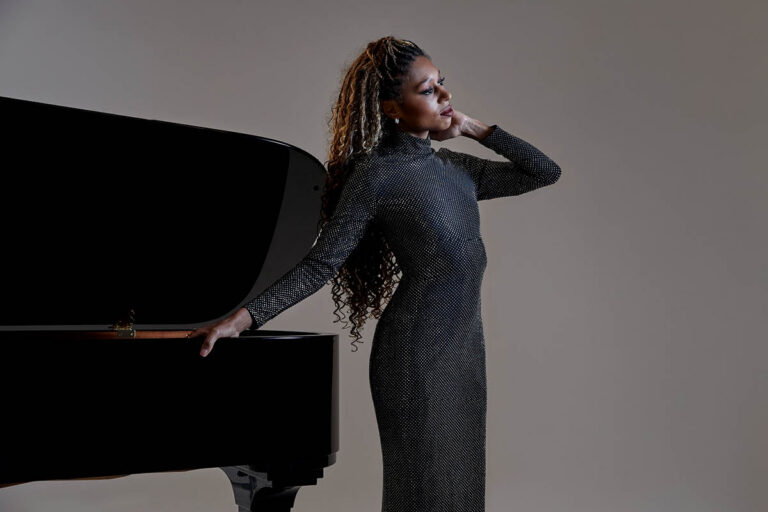
Katia Geha. Photo supplied

Currently based in Basel, Geha is an Australian-Lebanese composer whose musical approach favours an experimental, performance art approach to composition. Her output ranges from solo, chamber, choral and orchestral music to screen and multidisciplinary approaches, and has been performed across the US, Europe and in Australia by groups including the Melbourne Symphony Orchestra, Ensemble Offspring and Omega Ensemble.

In 2025, she was awarded the Australian Women in Music Awards’ Emerging Artist Award, and took home First Prize at the Engine Room International Sound Art Competition, which saw her debut an installation work in Morley Gallery in London.

Chatting to Limelight, Geha talks about her time in Basel, her upcoming projects and her role with AWO.


How’s it going in Switzerland? What are you up to there?

Switzerland is amazing, I feel very lucky to be able to call Basel my home here. I am currently undertaking my Masters in Music Composition at the Musik-Akademie Basel. What many people don’t know about Basel is that the new music scene here is incredible. I go to at least four concerts a week all over the city, listening to new or improvised or electronic music. Basel is also on the border of France and Germany, so sometimes I’ll take a 20-minute tram to get to France and see a concert there – which coming from Sydney is still genuinely mind blowing. 

What are you excited about in composition right now?

In the European New Music scene, I have noticed a gradual standardisation of video being accepted within the new music ensemble format which I love. I think it makes new music more approachable, and it gives composers and artists a chance to collaborate with visual artists, or even themselves to delve into another artistic medium and create further conversation between the two. I did not think of this as something possible while composing in Australia, and now almost all my pieces include video or some other form of interdisciplinary aspect. 

What have been your compositional highlights over the last year?

I have had so many it’s unbelievable! When I arrived in Basel last year, I had an hour-long commission with KlangLab Ensemble, and from there, I also was able to write for the alumni ensemble of the Musik-Akademie for the end of year concert. I have also had premieres and attended festivals and conferences in Slovenia, Lebanon, Italy, the US, the UK and Germany.

I also travel a lot for my work and seek out concerts of that area of the world. Some highlights that I’ve seen are the London Symphony Orchestra performing Strauss’ Salome, the Basel Sinfonietta performing John Adams’ Harmonielehre, Patricia Kopatchinskaja performing her own work at the Lucerne Festival, James Morley, Alex Waite and Valerie Fritz performing works by Liza Lim and Georg Friedrich Haas at the Fondazione Giorgio Cini in Venice, and Tame Impala’s performance at the Hallenstadion in Zürich

What does your role as the Australian World Orchestra’s librarian entail?

People often ask what a music librarian actually does. Put simply, I manage the music. I don’t choose the music, but I make sure that the music gets to the musicians in a presentable way, and it gets to and from the music stand in the correct place at the correct time. Most of my job in the time-sense deals with bowings. When an audience member sees an orchestra play, in the string section, you would notice that all the bows of the string players move up and down in synchronicity. This isn’t telekinesis. That’s all me!

Katia Geha at the Melbourne Symphony Orchestra’s 2024 Cybec Showcase. Photo © Laura Pemberton

I work in dialogue with our conductor of the season, and our concertmasters to decide on a set of bowings (where the bow should go up and down) and then copy them into all the parts. What many people don’t know is also how protective many conductors, concertmasters and ensembles are of their bowings: the bowings stand as part of their interpretation of a piece, so we librarians in many ways are not only music nerds but secret keepers, too.

What do you love about the role?

I love the dialogue and the conversations that I get to have with the musicians and conductors to really spend time with the minutiae of sound. As a composer, it is also such a blessing to be able to spend time with such amazing pieces of music. I get to spend my days looking and marking and examining scores for Australia’s finest musicians to interpret.

There is always a moment in an AWO concert where all of the bows of the strings are placed at exactly the same angle at the same time, and in that moment you have this incredible correlation of visual experience with sonic exploration and that for me is a job well done. 

Have there been any standout moments during your time with the AWO?

It’s hard to pinpoint one because each season is so different and every program is different, but I think my first season with Zubin Mehta would be a highlight. I had just been introduced into the music library world, and I was so nervous that I had missed or incorrectly written in a bowing, mainly because Mehta conducts totally from memory.

My flight was delayed the morning of the first rehearsal, and I bolted to rehearsal from the airport dripping in sweat about 60 seconds before he came in. As he entered the room, the first thing he said to Alex Briger (our Chief Conductor) was, “I need to speak with your librarian!”

Alex claims that I went totally white and I believe him, but Mehta just wanted some extra rehearsal markings written in the parts and his score. But at the end of the soundcheck before the final performance, I went to grab the score off his stand and he grabbed my hand and said, “Thank you for your hard work,” and I thanked him for his.

It was a small moment, but receiving such genuine gratitude from a musician of his stature is something I will carry with me for a long time.

Alexander Briger conducts the Australian World Orchestra. Photo © Daniel Boud

What’s next for you after the AWO performance?

After the AWO season in August, I head back to Basel to finish the last year of my Master’s degree. I will be preparing for my graduation recital, which is an hour of new music written by myself for the students studying contemporary performance. I also have to write and submit a 60-page thesis.

On top of this, I am also writing and preparing some wonderful projects to happen in Australia: I am one of the composers for the ANAM Set where I will write a work for the fantastic oboist Ethan Seto, and I have just been awarded the Art Music Fund for a project I will do with ELISION Ensemble, where I will write an oboe concerto for a metal reed for amplified ensemble.


The Australian World Orchestra peforms Stranvinsky, Mills & Shostakovich at Hamer Hall, Melbourne on 19 August and Sydney Opera House on 20 August.

Contribute to Limelight and support independent arts journalism.