Soprano Stacey Alleaume takes her character research seriously. Preparing for the role of Violetta Valéry, the doomed protagonist of La traviata, she took to the roads of Northern France to visit the towns and villages where the real-life inspiration for Violetta – the courtesan Marie Duplessis – grew up.
In those small towns and quiet streets, far from the gilded Parisian salons that made Duplessis famous, Alleaume says she came understand “who Marie was before she became a myth.”
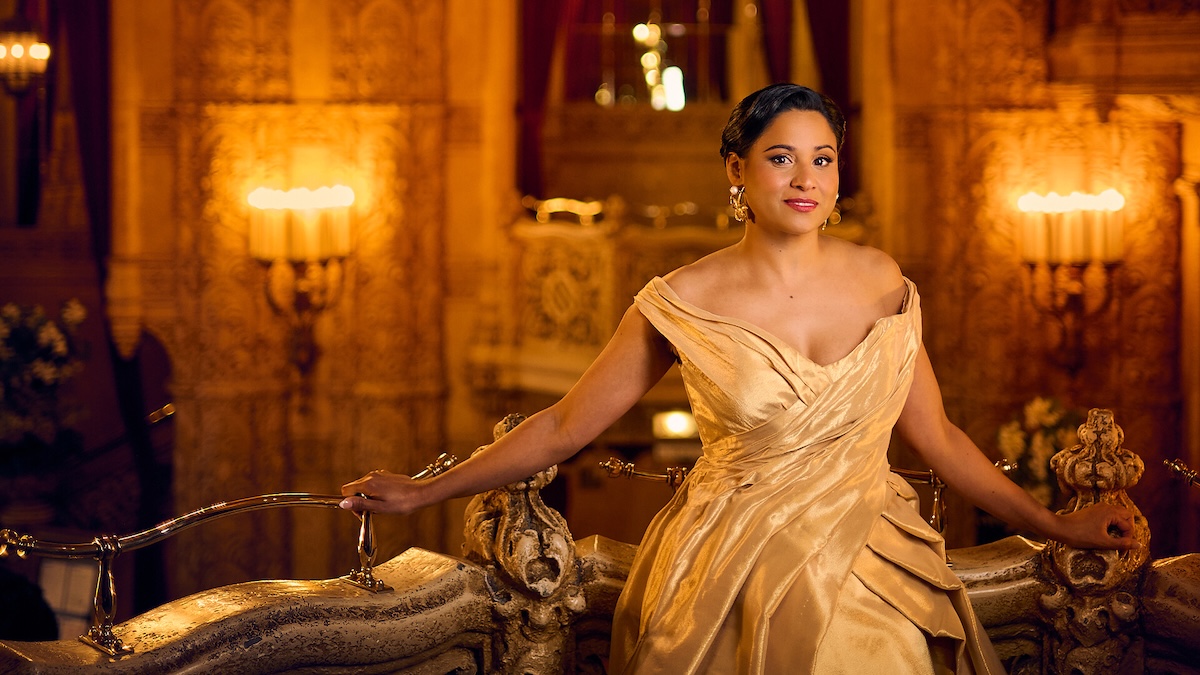
Stacey Alleaume in the Regent Theatre, Melbourne. Photo © Eugene Hyland
“We always imagine her as a glamorous courtesan, but Marie Duplessis came from real poverty. Walking through those towns – and some of them haven’t changed a lot – you feel the distance she travelled – socially and emotionally – and the cost of that transformation. Being there and feeling the atmosphere, seeing where she came from. It gives you a different kind of connection. It’s something you can’t quite get any other way.”
During the trip, Allueame also visited a museum in Gacé dedicated to Duplessis. “There were some fascinating artefacts – items with her initials, even a coronet from when she styled herself as a countess. It really brings home what an extraordinary story of social mobility she had.”

Stacey Alleaume and Ho-Yoon Chung in La traviata, Opera Australia, 2022. Photo © Jeff Busby
Marie Duplessis was born Alphonsine Plessis in rural Normandy in 1824, the daughter of an impoverished umbrella merchant. By her late teens she had reinvented herself in Paris, adopting the name Marie Duplessis and rising swiftly through the demi-monde.
Renowned for her beauty, intelligence and refinement, she counted aristocrats, artists and writers among her lovers – including Alexandre Dumas, who would later immortalise her in his novel La Dame aux Camélias. Dumas also adapted his story into a 1852 play which, in turn, became the basis for Giuseppe Verdi’s 1853 opera.
Duplessis died in 1847 of tuberculosis. She was 23. Her funeral attracted hundreds of onlookers. Within a year, her story had already begun its transformation into legend.
For Alleaume, that knowledge is central to her portrayal in Opera Australia’s critically acclaimed production of La traviata, which is about to be staged in Melbourne’s Regent Theatre.
“There’s a danger in playing only the icon,” she says. “But she was a young woman who had fought her way out of nothing, who understood survival in a very real sense. That gives weight to every choice she makes.”

Stacey Alleaume as Violetta in the Handa Opera on Sydney Harbour. Photo © Prudence Upton.
Verdi’s La traviata – literally “the fallen woman” – follows Violetta as she falls in love with Alfredo Germont, only to be forced by his family to renounce him. Already gravely ill, she sacrifices her happiness in the name of respectability, dying in poverty after a final, fleeting reunion.
It is one of opera’s most familiar narratives, but its emotional impact remains undiminished. Alleaume believes that lies in its stark humanity.
“At its heart, it’s about love and sacrifice, but also about society’s hypocrisy,” she says. “Violetta is celebrated in the salons, but the moment she tries to step outside that role – to live a ‘respectable’ life – she’s rejected. There’s something about that contradiction that feels incredibly modern.”
“Her’s was a very different world to ours. But you try to find parallels. The closest modern equivalent might be internet celebrity – that idea of having a public persona that’s very different from your private self.”
Alleaume’s research trip sharpened her sense of those contradictions. She encountered not only the physical landscapes of Duplessis’s early life but also the echoes of a social history that continues to resonate.
“You realise how limited her options were,” she says. “For a woman of her background, there were very few paths available. Becoming a courtesan was, in a way, a form of agency – but it came with enormous vulnerability.”
That tension informs the way Alleaume approaches Violetta’s journey. Rather than playing a simplified arc from champagne-fuelled frivolity to tragedy, she sees a character constantly negotiating her identity.
“In the first act, she’s not just carefree – she’s actually in control,” Alleaume explains. “She understands the rules of her world and plays them expertly. But when Alfredo offers something different, something genuine, it destabilises everything. She’s suddenly confronting a life she’s never allowed herself to imagine.”

Opera Australia’s production of La traviata, 2025. Photo © Guy Davies
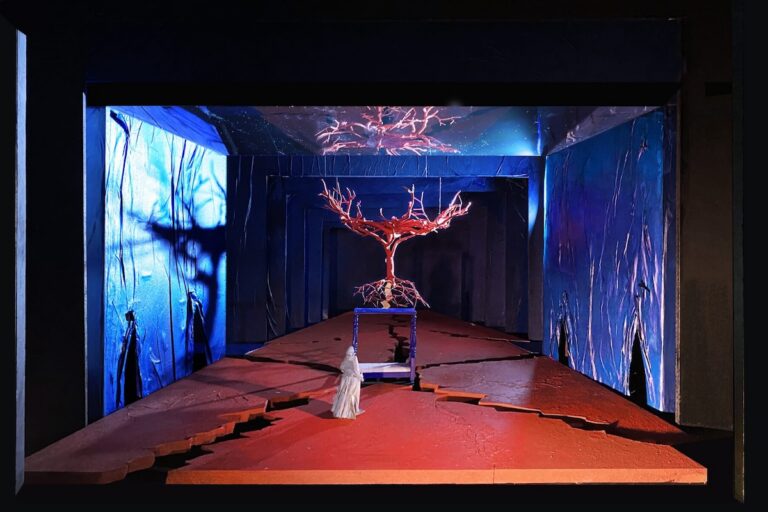
The production’s director, Sarah Giles, brings a deep theatrical background to the work and correspondingly interest in depth of character, Alleaume adds. “She’s interested in the contrast between Violetta’s public and private selves. The set reflects that; you see both her bedroom and the salon at the same time. Even the costumes reflect that idea. There’s one with a very large bow – almost like she’s a gift, a possession, something to be displayed. It speaks to how men saw her.”
Vocally, the role charts Violetta’s arc with extraordinary precision. The glittering coloratura of Sempre libera gives way to the lyrical warmth of the second act and, finally, the fragile, stripped-back intensity of the third.
“It’s like she has three different voices,” Alleaume says. “But they all have to feel like the same person. That’s the challenge – to let the vocal shifts reflect her psychological journey, not just the technical demands.”
The role is one of opera’s most difficult balancing acts but Alleaume, who has built a reputation as one of Australia’s leading lyric sopranos, relishes the challenge. “I really do love the ‘theatre’ part of it, the intimacy. You can really draw people into the story in a very direct, emotional way.”
After the Opera Australia production, Alleaume will sing the role again in Austria – in a huge outdoor production in Bregenz, directed by Damiano Michieletto.
“That will be a different kind of challenge,” she says. “It’s on huge floating stage in front of thousands of people every night. The stage is huge, so you have a lot of distance to cover physically as well, and dealing with the elements, microphones … But if I can find the truth of her experience – even just a glimpse of it – then the music does the rest.”
Opera Australia presents La traviata at the Regent Theatre, Melbourne, 8-16 May.

Comments
Log in to start the conversation.