When I sit down to speak with Italian baritone Renato Dolcini, he isn’t at home in Milan but high up in the mountains of Trentino, on his way to the Salzburg Whitsun Festival, which has been curated by Cecilia Bartoli since 2012.
There, Dolcini will perform Monteverdi’s Il Combattimento di Tancredi e Clorinda as part of the Übers Meer (Over the Seas) program, conceived and conducted by Christina Pluhar.
“The theme of this year’s Whitsun is viaggo, so every concert is exploring a different [form] of travel, and this one will be through the seas,” Dolcini explains
Travel is very much on the Italian baritone’s mind as he prepares to join the Australian Brandenburg Orchestra and its Artistic Director/harpsichordist Paul Dyer for Italian Serenatas – a musical journey through Italy.
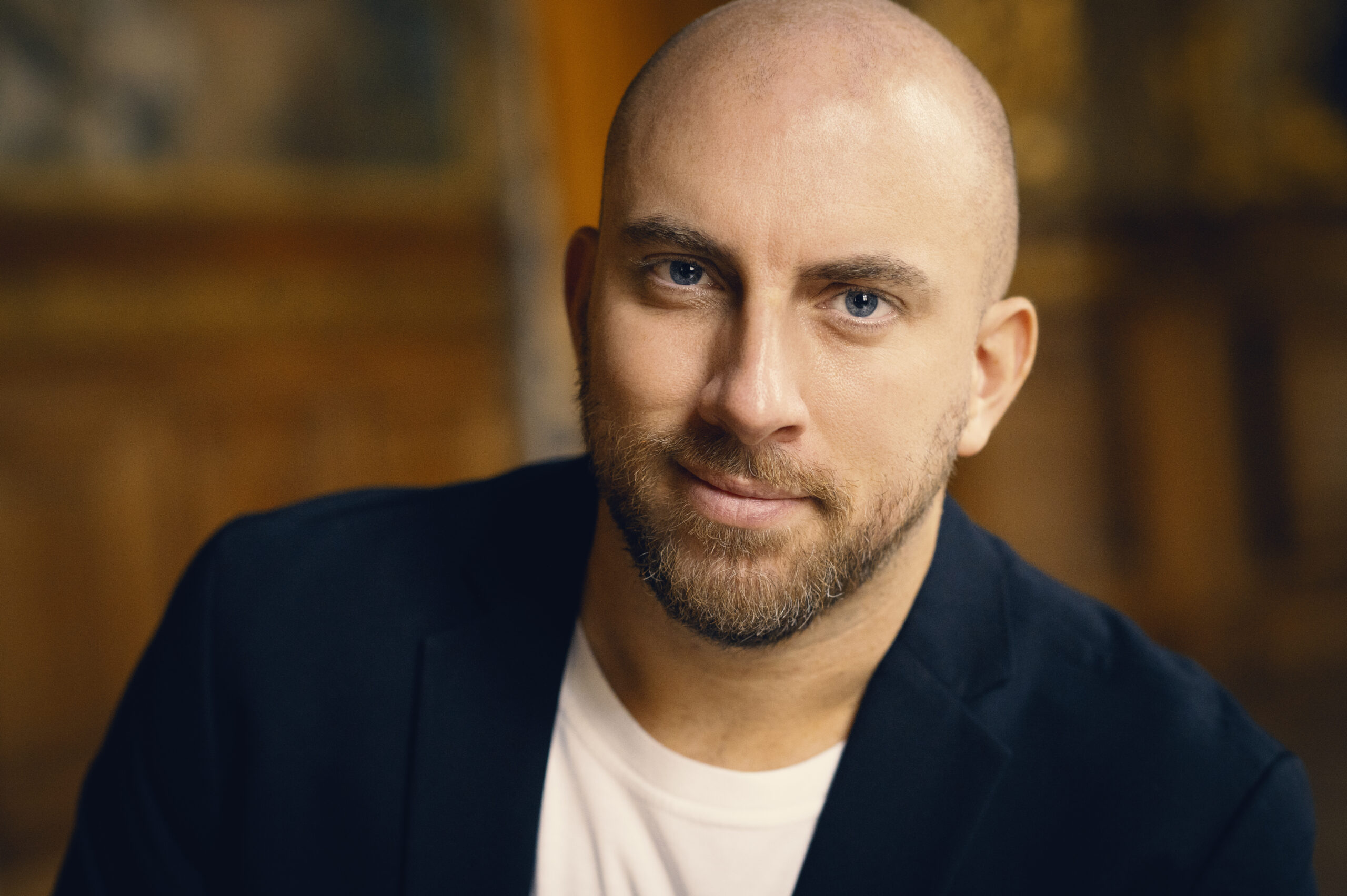
Renato Dolcini. Photo © Jean-Baptiste Millot
Programming the concert has been “a conversation”, he says. “It was Paul’s idea, born of our first collaboration with Circa four years ago.” Titled Italian Baroque with Circa, that concert was also framed by the cities of Naples, Florence, Rome and Venice.
“We wanted to give people an idea of Italian music, and that was a quite brilliant idea, because otherwise it’s very easy to get stuck in a corner and do a concert program about a particular composer or singer. In Italy, it’s very different from north to south. We have a lot of different cultures and musical inspirations, and choosing these four cities gave us the possibility to really make a big deal of showing all the different tendencies that we [Italians] had, musically speaking.”
Dolcini says Italian Seranatas, was inspired by that experience. “We wanted to have a second chance at it, because back then, it was a peculiar moment of our lives. We were coming out of COVID, and we weren’t able to tour. We only performed in Sydney, and of course, the acrobats had their specific needs. This time, since it’s only ourselves, we have more freedom to choose whatever we feel we want to explore.”
The program spans sacred, operatic and folk traditions, and Dolcini says audiences can expect to dive deeper into the distinct musical identities that can coexist within a single country.
Florence, he explains, “was the birth of everything and really where opera was born.”
“It was literally speaking through music more than singing, though music and the words had such a predominance, so the style is much more spoken and, one could say, archaic. You had to paint with your words – which is generally my attitude towards opera – but it was really the case in Florence, and so we wanted to start the concert there.”
“We chose a piece which has some recitative as well as some coloratura, because Florence was known for the Renaissance and their spectacular use of diminuzione, so the voice was required to have an instrumental way of approaching the coloraturas.”
Rome, by contrast, was a meeting point of styles.
“Composers all over Europe came to Rome to study. There was a moment when Handel, Corelli, Caldara and Scarlatti could confront each other, and you could find so many different styles.”
As Dolcini explains, counterpoint emerged from polyphony and influenced the Roman style of opera (as opposed to the early Florentine tendency toward monody), and he adds, “You had the virtuosity of the castrati, who were the big stars of the time.”
Moving to Naples, we encounter oratorios and operas whose melodies stem from local tradition.
“In this concert, we have the Pizzica di San Vito, which is a traditional piece from South Italy. In the smaller cities, people have always recognised these melodies, but we don’t know where they come from or who composed them.”
And finally, the concert returns north to Venice, represented here by Gelido in ogni vena from Vivaldi’s opera Farnace.
“We chose Vivaldi because he is very emblematic of the city and more modern than all the other composers. [Vivaldi’s] Baroque was already projecting towards the stile galante, still with plenty of virtuosity and coloratura, but the writing was more modern than, let’s say, Handel, who [represented] the older style with counterpoint and so on, while Vivaldi was really going towards the second part of the 18th century” – a style that favoured homophonic simplicity and accessibility, paving the way to the Classical era.

Renato Dolcini with Australian Brandenburg Orchestra & Circa in 2022. Photo © Keith Saunders
For Dolcini, this progression underlines the flexibility of the Baroque and the way it constantly reinvented itself.
“The melodies and the rhythm are clear and pop-like, so they speak to younger generations,” he says, also noting that as the starting point of the operatic art form, it didn’t come laden with centuries-old traditions like the melodramatic repertoire that followed.
“We can have a fresher take, because there isn’t this idea of a masterpiece that shouldn’t be touched and has to be presented in a pristine, respectful way.”
“And the music itself was always a work in progress. ‘We’re doing this opera, but we don’t have a tenor; let’s have this part sung by a contralto, instead. We don’t have a contralto; let’s have it sung by a tenor. We don’t have violins; let’s put in flutes.’ It’s very pragmatic.”
Dolcini believes this lends itself directly to modern interpretations like ABO’s collaborations with Circa, or indeed the productions of Orpheus & Eurydice and Dido & Aeneas by Circa’s Artistic Director Yaron Lifschitz, both of which were created with Opera Queensland and have since played the Edinburgh and Spoleto Festivals respectively.
“Nowadays, we are used to the cinema and Netflix,” Dolcini says, “and inevitably people coming to the opera expect to be entertained visually and not only musically, so you have to offer something that is comparable … and staging-wise compelling.”
Meeting such expectations may reshape performance practice, but Dolcini has long proven himself to be a dab hand when it comes to balancing the singing and acting demands placed on him, and concerts like the upcoming Italian Serenatas with ABO still afford him ample opportunity to focus more on the music.
Dolcini’s own discovery of the Baroque came as something of a surprise.
“When I was a kid, back in the Nineties, I was in love with Mozart and Rossini. In Italy especially, there was hardly ever any Baroque – at least not in Milan – and then, all of sudden Cecilia Bartoli did the Vivaldi album, and I started following her.” [Dolcini and Bartoli finally performed together this year in Giulio Cesare with Opernhaus Zürich.]
“I was 10 years old or something like that, and I had no notion at all of what came before Mozart. I mean, I’d heard of Vivaldi because of his Four Seasons and Handel because of the Fireworks and Water Music, but now I found out there was all this history of music, with this crazy coloratura and huge display of emotions, and coming from [a background listening to] Rossini, it was shocking.”
He continues, “I had always been interested in the theatre, and I loved going to see Shakespeare and Chekhov, etc. Therefore, the attention to the text that the Baroque allows you, because you don’t have to worry about [singing over a huge] orchestra, was very interesting to me.”
That foundation in Italian repertoire later expanded into the French Baroque through Dolcini’s work with conductor and harpsichordist William Christie, whom he affectionately calls Bill, firstly as a member of the Le Jardin des Voix academy and then with the ensemble Les Arts Florissants.
“My instinct is to do what you know best and, of course, in my case that was the Italian Baroque, and I didn’t know much about the French repertoire.”
Initially, the transition was not straightforward.
“There is this sort of aura about the French Baroque that it really has to be done by French people, because the style is very complex, you have to know the rules and you don’t find everything written on paper.”
The language barrier posed a particular challenge.
“There’s the big issue of the text and the pronunciation, especially when you do French repertoire in France with a French ensemble and French colleagues. It’s very demanding. I know how I feel when I hear Italian text torn apart by people who cannot pronounce it, so I really wanted to do my best.”

Renato Dolcini with Australian Brandenburg Orchestra & Circa in 2022. Photo © Keith Saunders
Fortunately, Christie gave Dolcini the encouragement he needed.
“Bill pushed me to take the chance. He always chooses [the best] people, so you will find the best musicians in the continuo and have the best language coach, and you can really flourish when you work with him. That allowed me to focus on the style and text, but it was stressful, because I think I was the only non-French performer when we did the Rameau in Paris [Les Fêtes d’Hébé – available on medici.tv].”
Not only did Dolcini feel under pressure, but he says Christie tends to worry about his own performances too.
“That’s the way you grow, putting yourself on the spot, and there is always a sort of thrill when I’m doing the French repertoire, because it’s not my native tongue or style. You have to be clever enough not to think you know everything, and to be constantly open to advice and critiques from your colleagues, your Chef de chambre, your conductor, everybody.”
Does Dolcini think Christie recognised an aptitude in him for expanding his repertoire?
“Yes, and to be honest, while the category of baritone was created later during the Romantic era, the tessitura of the male voices in French opera sits higher than the average basso role in Italian opera, so it suits my voice.”
He adds, “Since Bill is not a French native, he is more open than other conductors to working with foreign singers, even on the French repertoire, and he’s one of the few conductors still in the position to say to an opera house, ‘I want that guy for this role,’ and the opera house has to comply.”
Like Christie, ABO’s Paul Dyer is another founding Artistic Director with whom Dolcini enjoys a strong working relationship, even if it began somewhat unexpectedly.
“Paul saw me for the first time when I was brought to Australia by Bill, but we met in Europe when he popped by after a concert in France and said, ‘I would love to bring you to Australia.’”
At the time, Dolcini says he didn’t believe anyone would put him on a plane and fly him halfway around the world, but Dyer came good on the promise.
“We were coming out of COVID, and after nearly two years with almost no work or the possibility to travel, I suddenly found myself in Australia. Everybody was so extraordinary and open-hearted, and you could really feel their enthusiasm and joy at making music together. I was really shocked and moved by that.”
That sense of connection left a lasting impression.
“We worked together for one month, and I bonded with so many people – with Paul, with the other musicians in the orchestra. Being on the other side of the world, it’s hard to say we developed a friendship in that time, but I think it was something very close to that, and I was so happy when Paul asked me back.”
“I know the fun [we’ll have], and there’s this sort of Australian happiness, enthusiasm and openness that the audience can easily read when you play music with such passion.”
The Australian Brandenburg Orchestra presents Italian Serenatas at Melbourne Recital Centre, 18–21 June; City Recital Hall, Sydney, 24–30 June; and QPAC Concert Hall, Brisbane, 2 July.

Comments
Log in to start the conversation.