In the digital age of sealed boxes, there is something spookily visceral about an old radio. The soft glow of the dials, the humming vacuum tubes … an old valve set seems comparatively alive. As you wander through the zones between broadcast stations, static can feel less like interference and more like a threshold.

Listen hard enough and long enough and you might hear something unexpected.

That possibility lies at the heart of The Enormous Radio, a new work by documentary theatre-maker Roslyn Oades and sound artist Bob Scott (The Nightline), which receives its world premiere at The Substation in Newport this September.
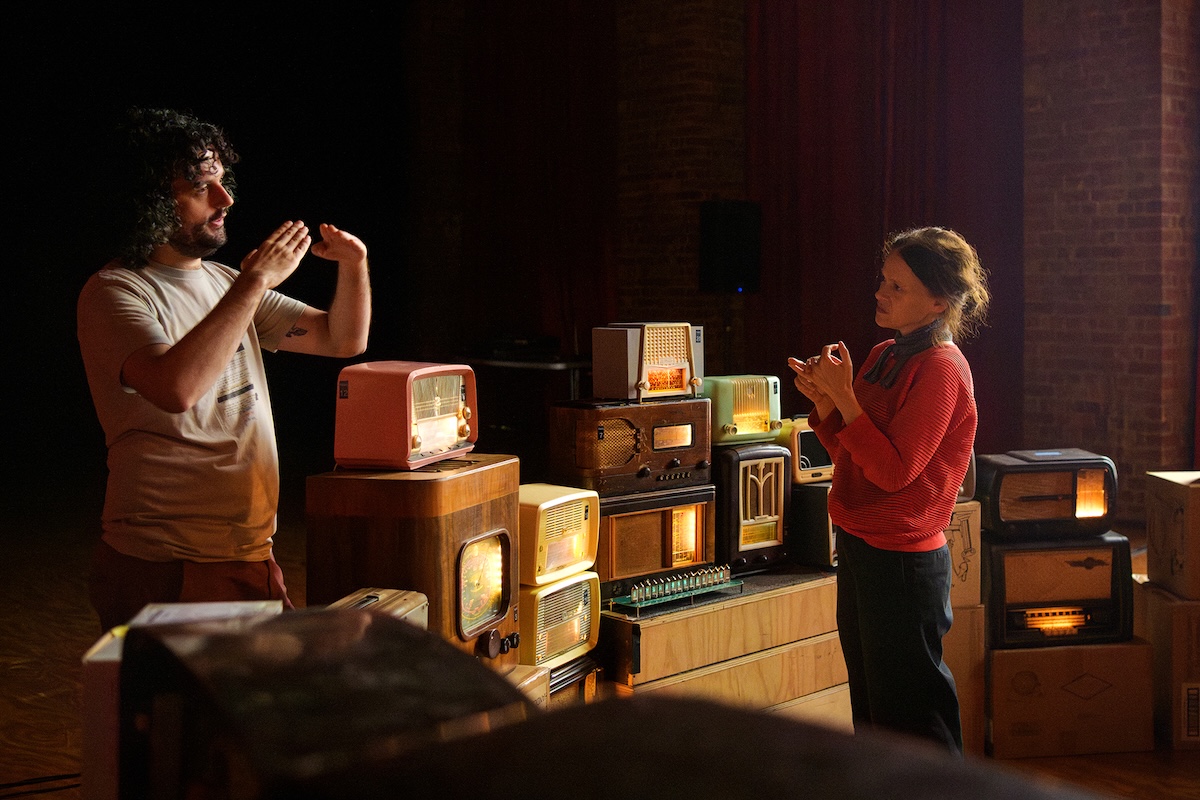
The Enormous Radio: Creative Technologist Kevan Atkins and project co-leader Roslyn Oades. Photo © Sarah Walker

The starting point for the project is a constellation of around 70 vintage radios, old test equipment and oscilloscopes, arranged in a circle. The atmosphere will deliberately echo that of a séance, says Scott, adding that one of the inspirations for the work is EVP (Electronic Voice Phenomena), purported voices or messages detected in recordings where no voice was consciously being recorded at the time.

“I’ve been fascinated with EVP for a while,” Scott tells Limelight.

He’s not a believer in EVP as such, but that does not stop the idea of it being a seductive one. Genuinely eerie things can happen when one listens closely and deeply. “You start hallucinating,” he says. “You get that real feeling of air and spirits and dark, mysterious kind of stuff.”

That tension between rational explanation and irrational belief provides the conceptual atmosphere of The Enormous Radio, a work asking what happens when the old machinery of radio is tuned to the hidden frequencies of the natural world.

“Maybe its the frequencies of the animals. Maybe that’s the Earth itself, and all its inhabitants,” Scott says. “There’s all this collective unconscious, unspoken communication.”

The Enormous Radio: Roslyn Oades. Photo © Sarah Walker

Oades has supplied the project with an extraordinary archive of animal field recordings through her connection with the Australian Wildlife Sound Recording Group. Together with text dramaturg Sarah Walker, the artists have been experimenting with ways of feeding those recordings into voice-enhancement and translation software, asking machine-learning systems to interpret animal sounds as though they were spoken English.

The results are deliberately ambiguous. Rather than claiming to have cracked the code of animal communication, The Enormous Radio plays with our profound desire to believe that we might.

Scott describes the process as being “like a bad lip reading of animals” – an apt description of a project in which technology appears to offer translation while simultaneously reminding us how little we actually understand.

Bob Scott. Portrait supplied

The radios themselves are crucial. Scott’s initial conception was of an abandoned television repair shop, filled with obsolete equipment left behind by a deceased owner. Gathering dust and still plugged in, the machines have somehow acquired a life of their own.

“The electricity hasn’t been fully domesticated,” Scott says. “And while it’s been sitting in this dusty old shop, unsupervised and unloved, it’s sort of turned into something else.”

That idea of technology becoming sentient is given a very literal twist in the finished installation. Refitted with contemporary electronics by creative technologist Kevan Atkins, the machines may look as though they belong to the 1940s, but most sport Ethernet connections.

“They all have little computers in there, and they can do all sorts of magic,” Scott explains. “The show has a very digital brain, but it’s a very analogue look and feel.”

The physicality of those old machines matters. Scott has spent much of his career working at the cutting edge of sound, including immersive mixing and spatial audio, but he remains drawn to the unruly qualities of analogue equipment.

Radio, in particular, has an organic quality that contemporary digital streaming lacks.

“We don’t really do it anymore. Everything’s online and digital,” he says. “But listening to radio is … you can hear the Earth and the ionosphere, and it’s really organic and alive.”

The Enormous Radio. Photo © Sara Walker

Scott’s role as a sound designer is inseparable from the work’s larger philosophical questions. Sound, he says, is particularly good at conveying emotion without necessarily telling a literal story.

“My job, if you like, is kind of telling people how to feel for a living,” he says. “It’s done through sound.”

His long collaboration with Oades is central to that process. The two bring different sensibilities to the work: Oades’ attention to detail and documentary practice alongside Scott’s more abstract, instinctive approach to sound.

“She’s really good on details, and I’m a very bad ,” he laughs. “I’m a more feeling and abstract person.”

That yin-and-yang relationship has produced a work that is neither conventional theatre nor sound installation. Instead, The Enormous Radio asks its audience to enter a world in which technology becomes a medium for uncertainty. What if, beneath the static, something really is trying to get through and tell us something we need to hear?

For Scott, that question has become increasingly charged by the plight of the natural world. The project emerges at a moment when we are confronted daily with the consequences of environmental destruction.

“Maybe its the animals you can hear,” Scott says. “Maybe it’s the Earth itself.”


The Enormous Radio is at the Substation, Newport, VIC from 30 September – 10 October. A Melbourne Fringe Festival event. 

Contribute to Limelight and support independent arts journalism.