Curated by Damian Barbeler, BackStage Music is about to present what it describes as a “retro-futurist hootenanny of experimental electronic music” – works by sound artists expresing their individual practices through the fusion of technology, machines and objects.
Visual musician Tim Gruchy is working alongside cellist Freya Schack-Arnott for the event. Gruchy’s sound work The Breast Stupa Suite forms the “musical bed” for their set, allowing Schack-Arnott to improvise above the ambient track.
“It gives me lots of creative license and liberty to do what I love doing… improvising over this very beautiful language” says Schack-Arnott.
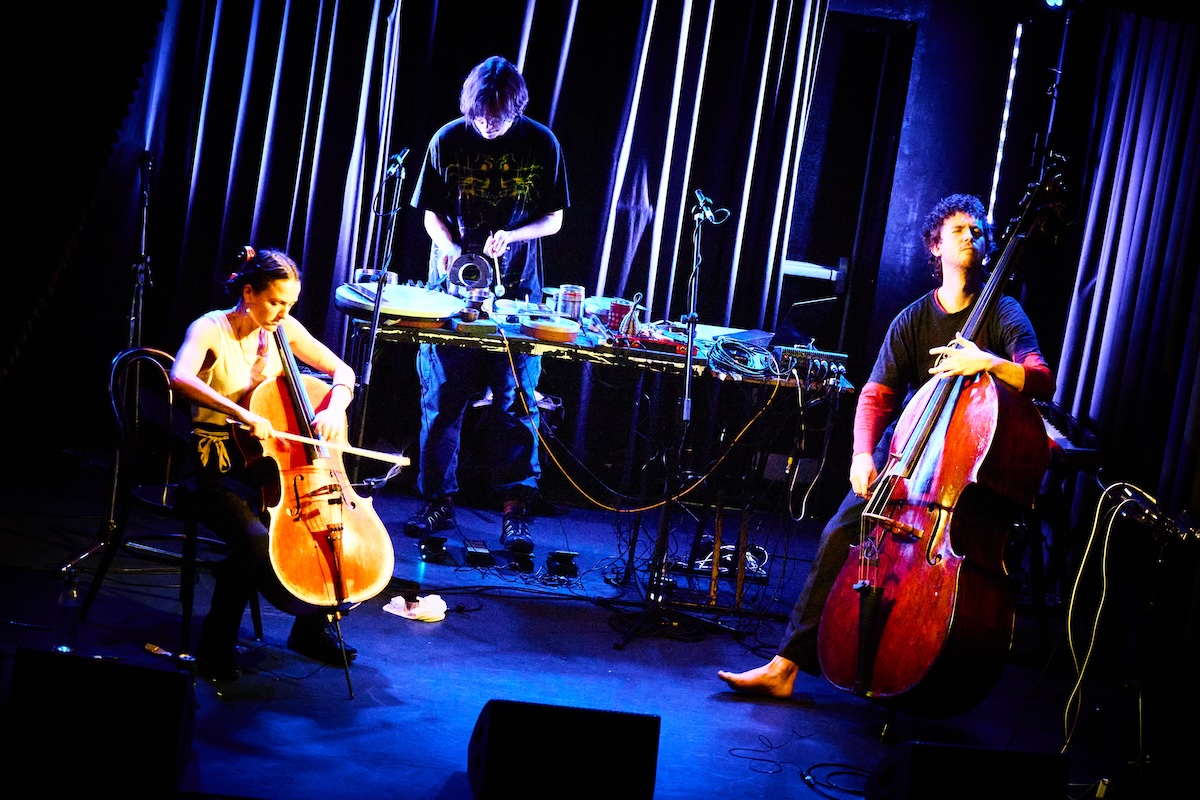
Freya Schack-Arnott, Matthias Schack-Arnott and Ben Ward for SIMA’s Jazz:NOW Ep.2. Photo © Shane Rozario.
In a 50-minute set, both artists aim to emulate the tangibility of sound through texture and space. Speaking to Limelight, Gruchy talks about the performative element of electronic music, explaining how his use of hand movement and gesture to trigger sounds brings a tactile quality to his work. “It very much is trying to approach that level of expressiveness you get working with classical instruments.”
Using non-interactive visuals for this work, Gruchy creates abstracted footage of algal blooms that embrace the textural state of the music to “bring us sort of an immediacy and aliveness and an absolute connection to what we’re doing musically on stage.”
Schack-Arnott describes how she uses these visuals as a graphic score, drawing on her experience of improvising in natural landscapes to connect with both the visuals and her performance.
“It’s not just a graphic score, but it’s a graphic score that is reacting to me and to us. There’s a bit of a feedback loop, and it gives us guidance and structure, but it can also be manipulated and kind of ebb and flow with the direction we go, which is super interesting.”
Expanding perceptions of sound-based music in contemporary society, Gruchy and Schack-Arnott seek to create an immersive sound work that emotionally engages the audience. Says Gruchy: “In a world where blandness is proliferating, it’s good to try to counter that.”
On the same bill is Hirofumi Uchino (Defektro) and his 近未来実験音楽研究室 (Retrofuture experimental music laboratory). It is, he says, “like three mad scientists from the past dreaming of the future and creating experimental music.”

Hirofumi Uchino (Defektro). Photo Supplied.
Collaborating with Riki Wells and Aidan Eccleshall, Uchino uses electronic instruments including a theremin, synthesisers and reverb machines alongside three metal sheets – aluminium, stainless steel and tantalum.
“When I was a kid, I just really didn’t like music, because I was born in the countryside of Japan,” Uchino explains. “Then somehow, well, my favourite sound was from metal, from industrial factories. I was fascinated by those sounds, so I just keep creating using metal.”
Discussing how the concept of retro-futurism applies to this set, Hiro explains that the liminal space between future and past is one where artists can imagine a musical space that has never existed. Again, the idea of the mad scientist is mentioned: Hiro describes his craft as one that is other-worldly, exploratory, and one that has never existed before. “It’s about a future which we would never actually reach, never be there.”
Children of the Resistors is playing at the Oxford Art Factory on 1 February. More information can be found here.


Comments
Log in to start the conversation.