From the moment she walks on stage, Cheng Lei conveys warmth, vitality and strength. All of these qualities were needed in 2020–23 when, while working as a journalist in China, Lei was blindfolded, arrested and locked up for reasons she is yet to fully understand, but which it is speculated may have had to do with her having released an embargoed document to a fellow journalist.

1154 Days is the story of this time, during which Cheng Lei was held by China’s Ministry of State Security in Beijing. At first, Cheng Lei spent six months in detention, where two guards watched her night and day, including when she went to the toilet.
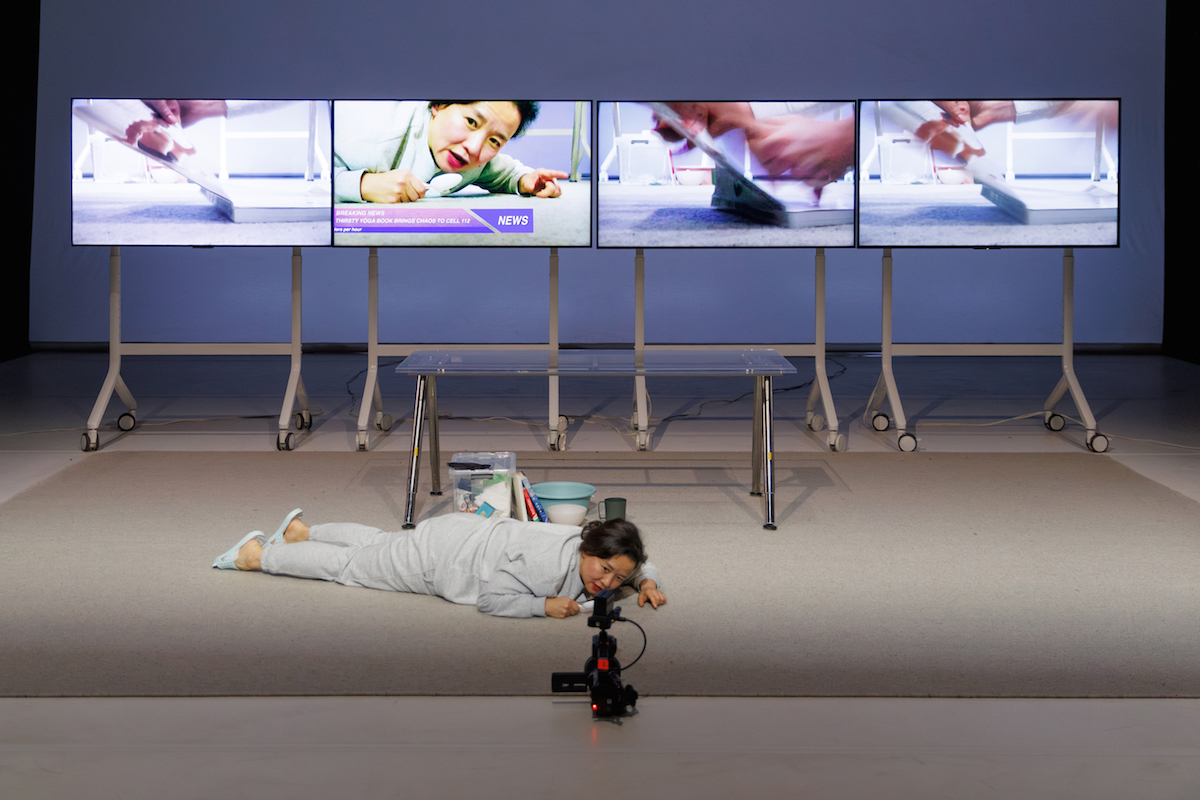
Cheng Lei in 1154 Days. Photo © Sarah Walker

Lei has since described her time there, in what the Chinese call Residential Surveillance at a Designated Location (RSDL), as mental and emotional torture.

After this initial six-month period, Cheng Lei shared a cramped cell with three other women before eventually learning that she would be released in 10 days. Representing the number of days she was away from her children, the sunshine she didn’t see, and the books she couldn’t read, her play, 1154 Days, gives painful insight into her experiences of deprivation and resilience.

The scenes in which Cheng Lei is in detention are almost too real. As we watch her walk to and from the toilet, or “exercise” by walking up and back in a 1.5-metre cell and seeking permission from the guards every time she does so, the mind-numbing boredom is readily apparent.

While this was effective for a time – and certainly conveyed the point – the scene was overplayed to such an extent that Cheng Lei risked losing her audience by asking us to bear too much boredom ourselves. Perhaps this might have been acceptable, except for the fact that the approach mostly continued when she was moved to the shared cell.

Though repetition, despair and boredom are by no means easy experiences to render interesting on stage, as a first-time playwright Cheng Lei might have been better supported through workshopping and editing by the play’s co-directors, Emma Valente and Clyde White. These shortcomings notwithstanding, the play made effective use of simple staging and props in what was, for the most part, a one-woman show.

Cheng Lei in 1154 Days. Photo © Sarah Walker

Cheng Lei’s joie de vivre was another redeeming factor in 1154 Days. Whether celebrating the idiosyncrasies of the women with whom she shared the cell, recounting her efforts to teach them songs without the guards finding out, or describing her triumphant attempts to orgasm in a cell while not being allowed to put her hands under the covers at night, she comes across as a person possessed of bright determination.

The remarkable relationship she develops with a male prisoner in a neighbouring cell is a case in point. By inventing a system of communication that involved tapping out words, the pair formed a bond that transcended the significant limitations imposed by their imprisonment. In such transcendence lies the message of the play – one that echoes Viktor Frankl’s famous observation that the greatest human freedom is to “choose one’s attitude in any given set of circumstances”.

On the night of this performance, the play was being filmed because Cheng Lei is to be the subject of the ABC’s excellent documentary series, Australian Story. This is pleasing because, while the play tells an important and compelling story, it falls somewhat short artistically, suggesting that Lei’s experiences may ultimately prove more powerful in other formats.

Contribute to Limelight and support independent arts journalism.