




The Brodsky Quartet began in 1972, when four Middlesbrough 10-year-olds decided to play on after youth orchestra finished on Friday nights.
Fifty-four years later, violinist Ian Belton and cellist Jacqueline Thomas are still on board, while Cassidy has notched up more than 40 years.
By that yardstick, Barton and Brodsky is a relatively recent collaboration, but both Barton and the quartet have a long history of engagement with music across the cultural spectrum and they clearly enjoy each other’s musical company.
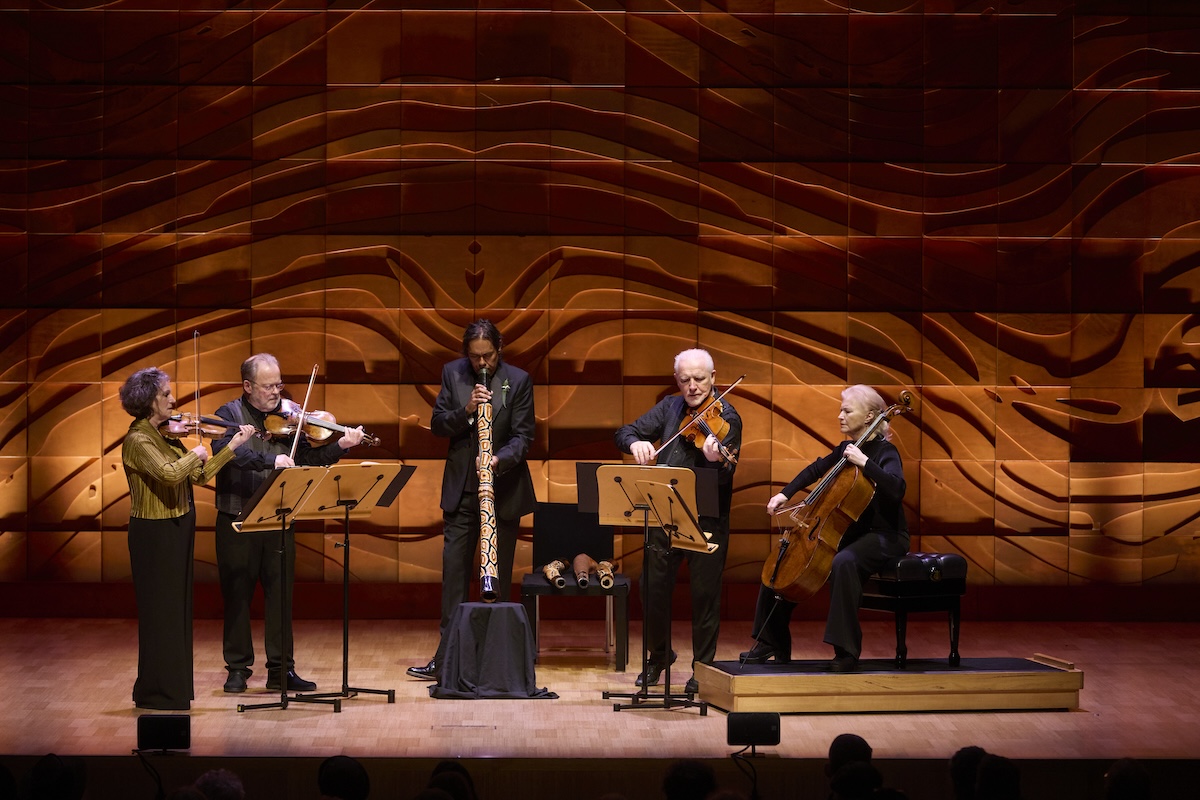
The Brodsky Quartet and William Barton. Photo © Laura Manariti
Barton opened the program with an improvised solo, which led directly in Henry Purcell’s Fantasia in D minor. The sweet, soft opening notes had a magical quality and the hall was still.
Barton then re-joined the quartet for two musical soundscapes: Peter Sculthorpe’s Jabiru Dreaming and Robert Davidson’s Minjerribah (Stradbroke Island). Hearing the two works together highlighted the yidaki’s tone, and rhythm and dramatic heft, and the many ways in which the string sounds could be manipulated to create musical images of the land.
Leader Krysia Osostowicz introduced Janáček’s first string quartet, subtitled The Kreutzer Sonata, explaining that it was inspired by Tolstoy’s story of a jealous husband’s violent reaction to an incendiary performance of Beethoven’s sonata by his wife (a pianist) and her supposed lover (a violinist). The lyrical conversations between the viola and cello were compelling, with both instruments resonating in the hall.

The Brodsky Quartet and William Barton. Photo © Laura Manariti
After interval, the quartet came out twirling as they played (kudos to the cellist) a merry peasant dance from Stravinsky’s Three Pieces for String Quartet, followed immediately by Andrew Ford’s Eden Ablaze. This was written in the aftermath of catastrophic fires in southeastern Australia. Ford’s score builds and expires like the fire, and the quartet’s sensitive rendition of this scene was a highlight.
Tōrino, a string quartet by New Zealand composer Salina Fisher, was inspired by the pūtōrino, a Māori wind instrument capable of producing a wide variety of tones. The strings slithered through quarter-tone melodies and used their bows to simulate the vibrations of a deep breath.
The finale was Barton’s own composition, Square Circles Beneath The Red Desert Sand, drawing on his connection to his own country, Kalkadunga (Mount Isa), and illustrating, through sound, the confluence of indigenous and western musical traditions. The audience loved this performance and was reluctant to let Barton and Brodsky go. As an encore, Barton and Brodsky played another work by Sculthorpe, From Nourlangie, in homage to their beloved mutual friend.
William Barton and the Brodsky Quartet perform at Elder Hall, Adelaide on 28 February, part of the 2026 Adelaide Festival




Comments
Log in to start the conversation.