




Malthouse opens its 2026 season with a world premiere written and directed by Jada Alberts, who identifies as Yanyuwa, Bardi and Wardaman.
Black Light is set on the outskirts of Darwin, where three generations of Larrakia women gather to avoid the worst of what seems to be a slowly unfolding apocalypse. On their porch by the sea, sisters identified as Mum and Aunty bicker, Bub argues with their ex on the phone about the kids, while Nan, who has dementia, reminisces, forgets, frets, cracks jokes, is lucid and wise.
The depth of their relationships are slowly revealed in the moments of tension and care between them. We also learn of another sister who has disappeared, and the white man they hold responsible. That’s the story’s centre of conflict and one of its few somewhat clear narrative elements.
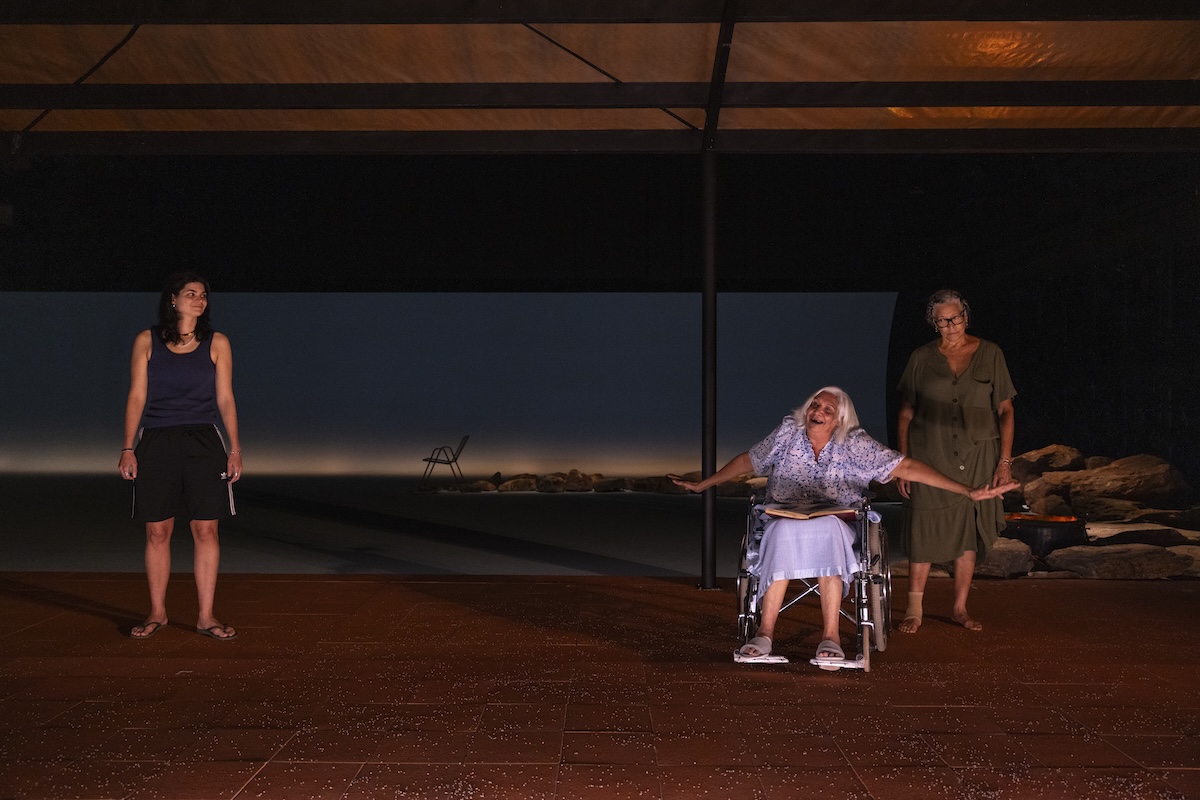
Tahlee Fereday, Trisha Morton-Thomas and Rachael Maza in Malthouse Theatre’s Black Light. Photo © Pia Johnson
This 90-minute play is more often than not a meditation in a dream-like netherworld. The apocalypse feels remote, essentially a metaphor for colonial destruction, while Nan’s words draw the women back to Country. Sometimes Black Light is poetic or funny; sometimes it’s meandering or obscure – though as a non-Indigenous person I’m keenly aware that assessment may be due to my cultural background.
The cast of four are in tune with Alberts’s script and each other. Trisha Morton-Thomas effortlessly switches between Nan’s varied states of mind, conveying much with softly spoken words and subtle movements, mostly from a wheelchair. She is the main source of humour, deftly delivering quips like Google being “all rabbit holes, no Wonderland.”
There’s strong tension between real-life siblings Lisa and Rachael Maza as Black Light’s sisters. Lisa Maza’s hard-working Mum is the polar opposite of Rachael Maza’s easygoing Aunty, who quietly struggles with addiction. The way they look at each other hints at the characters’ feelings of resentment, stemming from their self-sacrifice that we gradually become aware of.
Tahlee Fereday’s Bub is somewhat like a child among these older women, loose-limbed and uncertain, but she also shows maternal care and affection for Nan.
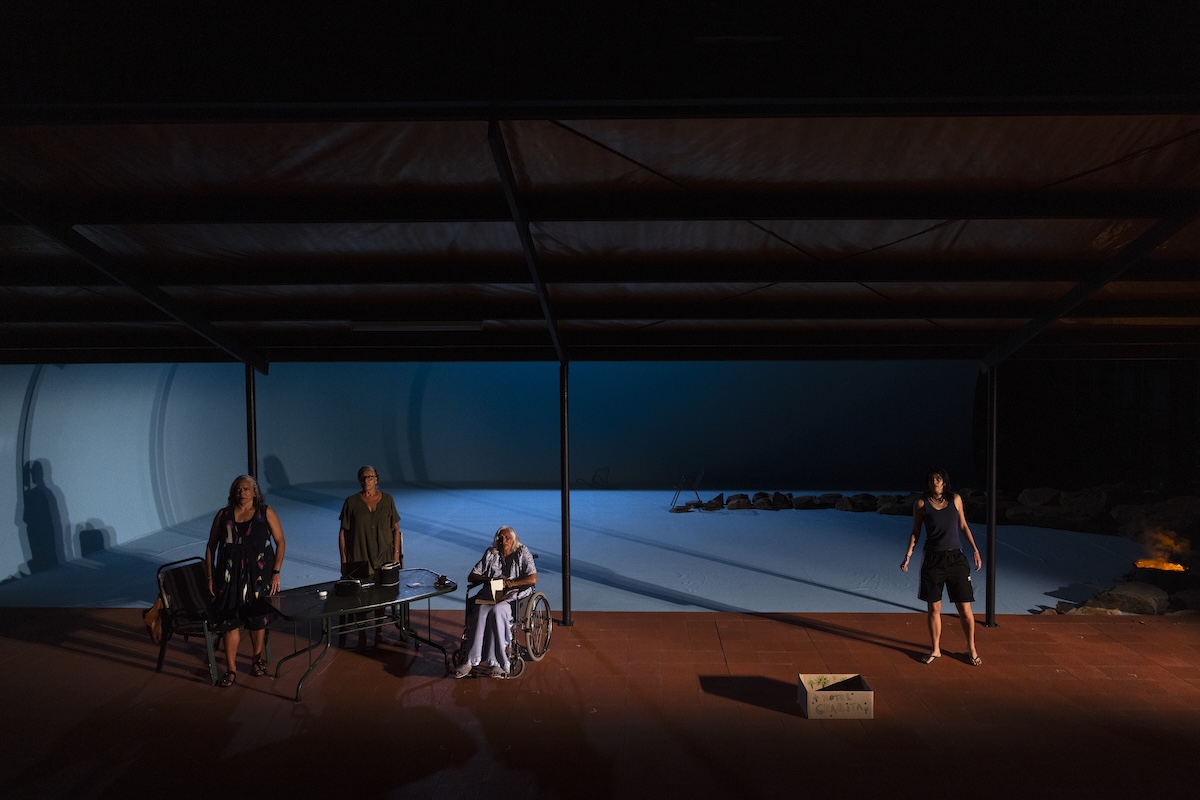
Malthouse Theatre’s Black Light. Photo © Pia Johnson
Dale Ferguson’s set and Jenny Hector’s lighting beautifully evoke that dream-like netherworld. Most of the Merlyn Theatre’s large performance space is transformed into blue sea and a curve of massive rocks, with a wide horizon sometimes transpositively lit like sunrises or sunsets. This scene looms large behind a long porch roof under which the play unfolds.
Kelly Ryall’s soundscape evolves from atmospheric cicadas and gecko barks to strained metallic sounds, which mostly enhance the tension but are distractingly persistent. Early on, Ryall and Hector combine to create an incredible, visceral moment suggestive of an atomic blast.
Black Light is not in a hurry, despite its modest length. It’s not overly concerned about clear narrative driven by conflict. Alberts invites us into uncertain territory, where love and resentment are largely unspoken, time drifts and mysteries are unresolved. That may not satisfy everyone.
Black Light plays at the Merlyn Theatre, Melbourne, until 7 March.








Comments
Log in to start the conversation.