


For the Welsh community, October 21, 1966, is tragically memorable. On that day, a glistening black avalanche of slurry from a nearby colliery tip poured through Pantglas Junior School and neighbouring houses in the small Welsh town of Aberfan, taking the lives of 116 children and 28 adults.
The Aberfan disaster profoundly affected the Welsh community and resonated around the world. Karl Jenkins wrote his Cantata Memoria: Er mwyn y plant for the disaster’s 50th anniversary, in particular to commemorate the children who perished that day.
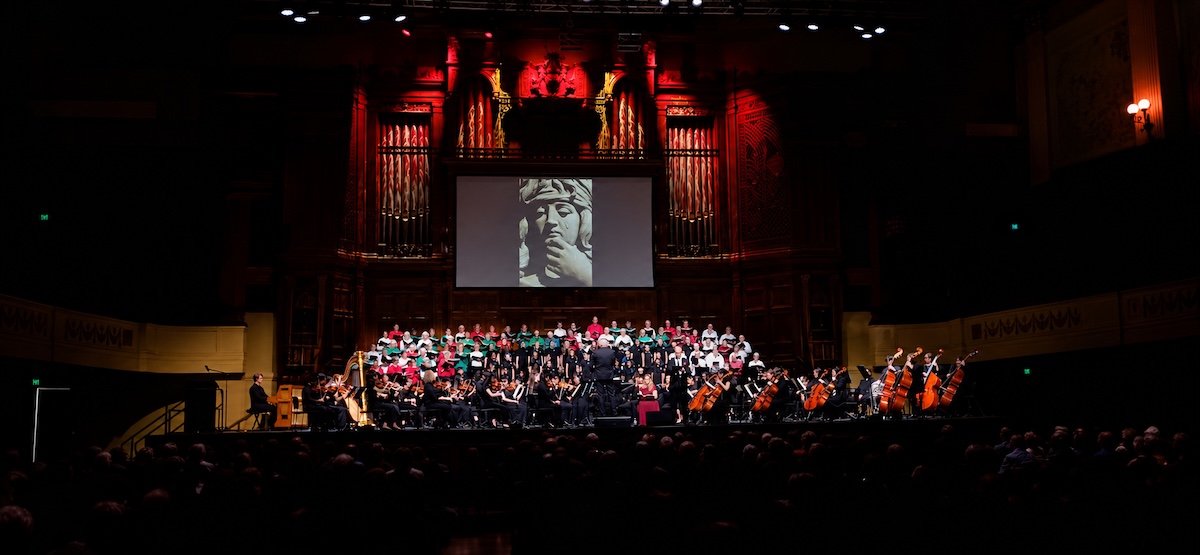
Cantata Memoria. Melbourne Town Hall. Photo supplied
On October 25 this year, Melbourne marked the 60th anniversary with the first Australian performance of the full orchestral version of the Cantata. The event was the brainchild of artistic director Mitch Meyer, who enlisted Victoria’s five Welsh choirs, The Gisborne Singers, the Melbourne Youth Chorale, the Flagship Melbourne Youth Orchestra and conductor Brett Kelly for this commemorative performance.
The first half of the program presented the combined adult choirs, sensitively accompanied by Jodie Lockyer. The Combined Ladies Choirs, under Rushan Hewawasam, performed two Welsh hymns and A Flower Remembered by John Rutter, written to commemorate the Fukushima victims. Meyer then led the Combined Men’s Choirs in three hymns: Parry’s Aberystwyth, Hartshough’s Gwahoddiad and Caradog Roberts’ Rachie. Hewawasam and the Ladies Choir then joined the men for a heartfelt performance of Robat Arwyn’s Benedictus.
The hour-long Cantata occupied the second half of the concert. Jenkins and Welsh poet Mererid Hopwood collaborated to create a work that blended local sounds and words into a Requiem Mass that was both personal and universal. A video behind the choirs displayed images of the rain, birds and children conjured by the music.
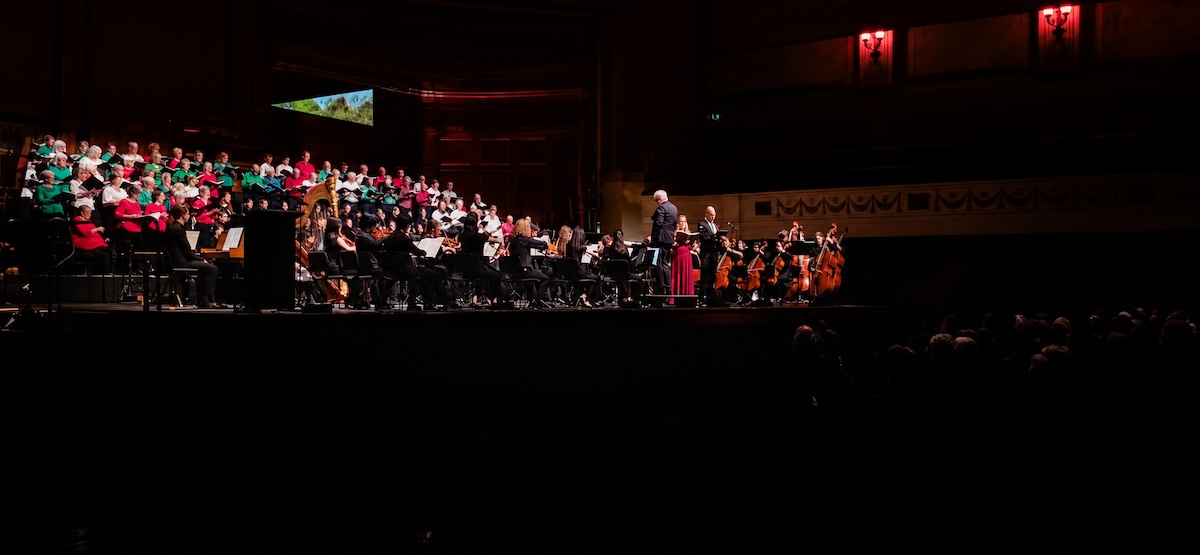
Cantata Memoria. Melbourne Town Hall. Photo supplied
The first part of the Cantata tells the harrowing story in a series of sonic montages. In Pitran, patran, plucked strings, a harp and percussion evoke the ever-intensifying rain, while children sing ‘All things bright and beautiful’ until they are overwhelmed. Then Silence depicts the preternatural ‘black silence’ in a heart-rending baritone solo, with a chorus asking ‘Why?’ in multiple languages.
In Cortege, the choirs sing the victims’ names; Welsh band culture is recognised with a beautiful euphonium solo (Quinn O’Neil); and a baritone solo reprises the popular song Myfanwy before bringing Cortege to an end with the words “Buried alive by the National Coal Board”.
Birdsong (and the lack thereof around the time of the landslide) formed an important part of the Cantata. Soprano Heulen Cynfal gave an inspired performance of her bird-like solo Satin Feathers and combined empathetically with baritone Adrian Tamburini, who gave an exceptional performance throughout.
Jenkins wrote the Cantata for the children, and his score deftly captured the natural lilt of their voices and the playful joy of their chatter. Trained by director Caitlyn Bosch, the Melbourne Youth Chorale gave a touching performance of the children’s choruses.
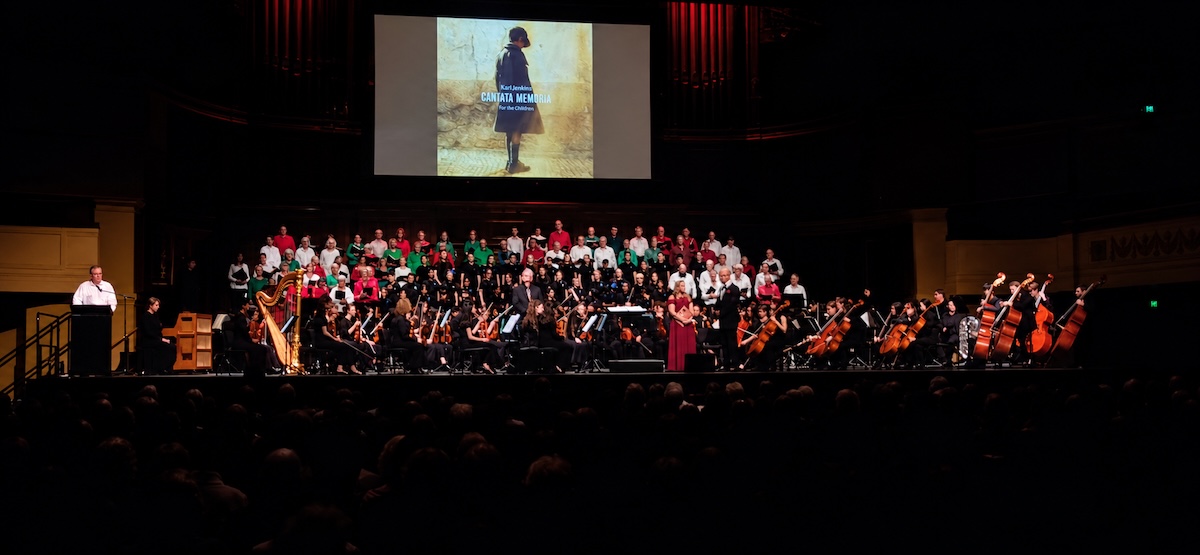
Cantata Memoria. Melbourne Town Hall. Photo supplied
The Flagship Melbourne Youth Orchestra gave a professional performance. Concertmaster Jasmine Milton gave a stellar interpretation of the soaring violin solo in Lament for the Valley.
In the final movements, the solo, choral and orchestral parts seemed to coalesce, and conductor Brett Kelly generated a warm and deeply satisfying conclusion to this musical experience.
Meyer wrote that he hoped audiences would be uplifted and filled with a deep appreciation of the healing power of music, children and a sense of community. Judging by the length of the standing ovation, Meyer’s wish came true.







Comments
Log in to start the conversation.