To the uninitiated, the fourth level of a car park may seem an unlikely location for a contemporary dance performance, however, in this third chapter of his car-park series titled Clouds Still Know Our Names, choreographer and NON (New Old Now) founder Davide Di Giovanni is very much at home.
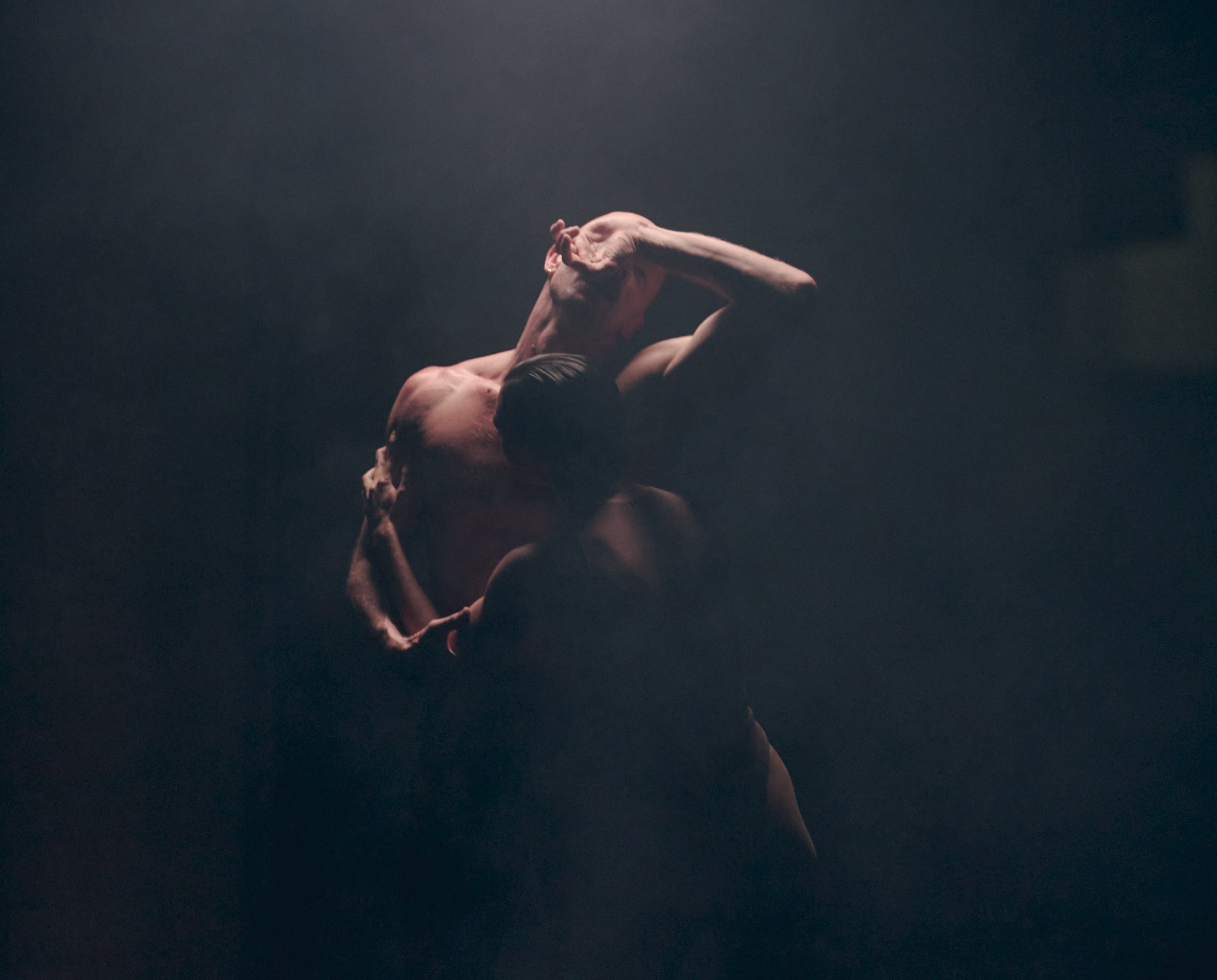
NON’s Clouds Still Know Our Names. Photo © Myles Kalus
Set against the setting sun, with occasional tyre squeals below and screeching go-karts above, it is a surprisingly tranquil space – even the cheers from the adjacent Sydney Cricket Ground are lost in an ambient white noise that blends seamlessly with the soundscape of composers Sandro Tzicoridze and Dan Lywood.
As darkness slowly falls, the gathering audience is held at bay while the performers warm up, some in isolation – the juxtaposition of the dancers’ meditative movements and the rising clamour of the expectant capacity crowd fills this found space with an almost ritualistic atmosphere that suggests, in part, Allan Kaprow’s Happenings, Jerzy Grotowski’s paratheatre and its further development by Antero Alli.
The din subsides as a disembodied voice delivers an Acknowledgement of Country, after which the audience members are instructed how to take their seats in the half-light. A request to proceed in an orderly fashion is met with laughter, suggesting an inside joke shared by those who’ve attended Di Giovanni’s previous car-park performances.
Sure enough, they make a mad dash for the rows of seats arranged on all four sides of a makeshift stage covered in Marley flooring and anchored on each corner by the car park’s raw concrete columns.

NON’s Clouds Still Know Our Names. Photo © Myles Kalus
All the while, two semi-clad dancers – Benjamin Behrends and Chloe Leong – stand in a constant embrace as plumes of smoke repeatedly engulf them. Jesus Christus schwebt am Kreuzel (Jesus Christ hangs on the Cross) from Schubert’s Stabat Mater is heard over the loudspeakers, and its emotional intensity quickly compels the audience to fall silent.
A suited man (singer and actor Mitch Riley) voyeuristically approaches Leong and Behrends through the smoke, finally reaching out to touch them. All around us, the world is turning, but here, for a brief moment, time stands still.
Then, heralded by sudden changes in lighting, we are treated to one masterful choreographic display after another. Pieces that begin as seemingly improvised solos quickly expand into perfectly synchronised pas de deux, trois and quatre – Tiana Lara Hogan and Di Giovanni joining Behrends and Leong in a series of vignettes that showcase their individual strengths and perfect synchronicity.
Di Giovanni’s choreography resonates strongly with the paratheatrical practice of ‘Rises’, embracing its use of gravity as a propelling force to produce movement with an economy of effort rather than through overt muscular exertion. Where Antero Alli often embraced grotesquerie, Di Giovanni refines and extends this gravity-defying logic into a corporeal aesthetic of ascent and return, yielding movement that is consistently beauteous – lucid, unforced and quietly radiant.

NON’s Clouds Still Know Our Names. Photo © Myles Kalus
Through choreographic sleight of hand, Di Giovanni even creates the breathtaking illusion of single-handedly lifting his partner by the ankle so she can touch the ceiling. At other times, dancers are flipped upside down, making it easy to forget which way is up.
This notion of an amorphous space is accentuated by Mark Dyson’s inspired use of smoke and light to create mutable shadows that reconfigure our concrete surrounds. Some effects are simple, achieved with the neon lights of the car park, or by Behrends, who slowly pulls a large Fresnel light on wheels around the stage area. Other effects are more sophisticated, resulting in luminous, immersive states that extend beyond the audience and reach the deepest recesses of the car park. Do they represent the Gates of Hell, or the divine light atop Mount Purgatory?
Di Giovanni draws inspiration from Dante’s Divine Comedy and the eternal lovers Paolo and Francesca but leaves it open to the audience’s interpretation. Certainly, for those who want to go down that path, all the cues are there. Mitch Riley is a shoo-in for Dante, his spoken words lingering in the air; Robert Beaver, who emerges from and retreats into the distant light with his white hair and shirt, could just as easily be Virgil.
Di Giovanni’s moments of inverted choreography even recall the topsy-turvy figures in Giotto’s Last Judgment, though it is the sinuous majesty of Rodin’s later Gates of Hell that NON’s dancers evoke here.

NON’s Clouds Still Know Our Names. Photo © Myles Kalus
After the initial Schubert, Tzicoridze and Lywood’s score is a mashup of styles, drawing upon both classical and contemporary sources and culminating in a startling a capella moment as a vulnerable Behrends sings excerpts from Sometimes I feel like a Motherless Child while still dancing in his grey underpants and socks. It is yet another hypnotic moment in a work that never ceases to amaze.
Like everything else here, Bridie Gilbert’s minimalist costume designs are on the money – providing maximum flexibility and silhouettes that allow each dancer to be easily recognised in Di Giovanni and Dyson’s kaleidoscopic display.
The use of found spaces as performance venues is hardly new. Brith Gof’s site-specific performances in the Eighties and Nineties and Graham Vick’s abridged Ring Cycle in the car park of the Deutsche Oper Berlin are two fine examples, as are Morrie Ender’s “parking lot plays” at Nebraska’s Lincoln Community Playhouse, Stephanie Martinez’s Kiss for PARA.MAR Dance Theatre, and Yuval Sharon’s drive-thru version of Götterdämmerung (Twilight: Gods) staged for the Detroit Opera and Lyric Opera of Chicago during the COVID-19 pandemic.
Di Giovanni’s Clouds Still Know Our Names deserves a place alongside them, not only as a brilliant example of tactical urbanism, but also for its utilisation of space to engage the audience and create a superb dance work that warrants the title Gesamtkunstwerk.
Further information about NON can be found here.


Comments
Log in to start the conversation.