Thirty-six years after composer Jonathan Dove and director Graham Vick created their abridged version of Wagner’s Ring Cycle, the first part – Das Rheingold – has finally had its Australian premiere. But was it worth the wait?
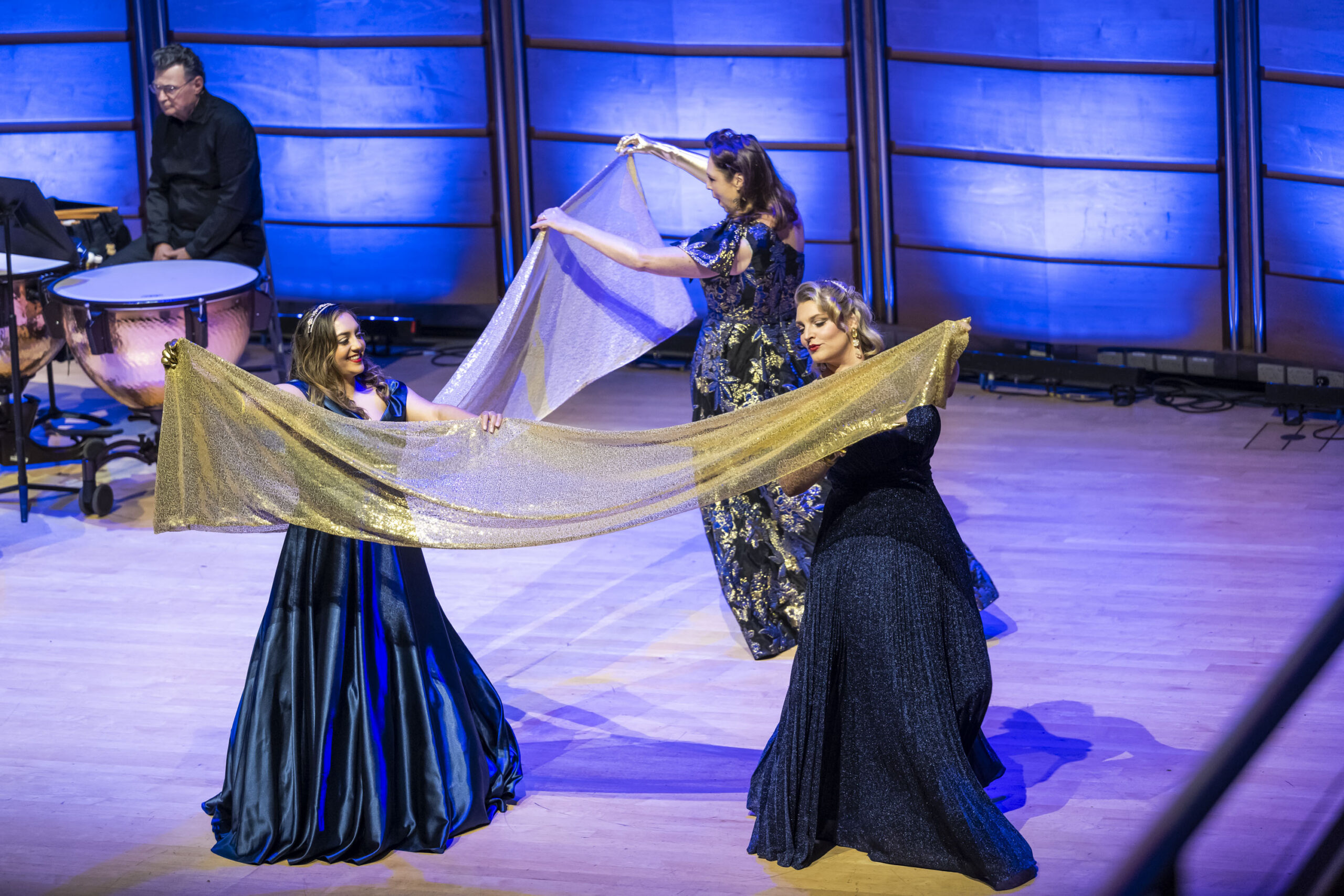
Angelique Tot, Katrina Waters and Camilla Wright in Shaumet Music’s Das Rheingold. Photo © Cassandra Hannagan

One should always listen to what an audience is saying after a show. In this case, after a good third of the hall had risen to its feet in a euphoric ovation, many in attendance gathered outside to congratulate their friends in the cast.

“So, how did you like your first opera?” one of the singers asked.

“It was awesome!” came the eager reply.

Such reactions speak to the production’s central achievement: it clearly resonated with first-time operagoers.

Purists may consider the star rating for this semi-staged concert generous, but for those experiencing Wagner for the first time, it won’t be high enough.

The question, then, is how this version should be judged at all. One cannot and should not compare a performance of the Dove/Vick reduction to a full-scale performance by a subsidised, fully professional opera company or symphony orchestra.

Created in 1990 for the City of Birmingham Touring Opera (now Birmingham Opera Company), it was intended to promote accessibility, community engagement and participation by performers and musicians of mixed abilities, as well as allowing companies with smaller budgets to bring this usually costly behemoth to the people in non-traditional locations such as the Stockland Green Leisure Centre where it first premiered.

Simon Lobelson in Shaumet Music’s Das Rheingold. Photo © Cassandra Hannagan

Judged on its own merits, this presentation by Shaumet Music does what it says on the tin, although one might have wished it had been staged in a disused carpark or industrial space conducive to Dove and Vick’s original intentions, rather than Sydney’s refined City Recital Hall, which is slightly at odds with the rough-and-ready staging of director Anke Hoeppner-Ryan.

Vick was keen to make the characters of the Ring relatable, portraying them as contemporary, everyday people instead of giants and gods. Hoeppner-Ryan’s come-as-you-are approach reinforces this, with most of the singers donning their own recital attire, and as we zoom in on the plight of Freia (soprano Xiaoxu Aleta Shang) and Fricka’s anger at Wotan’s willingness to trade her sister for Valhalla, the production begins to resemble a domestic scene.

Curiously, however, Hoeppner-Ryan’s staging is not entirely consistent in its commitment to immediacy and demystification, with a large projection screen above the performers’ heads displaying imagery from Nordic mythology, undercutting the finely rendered human drama below.

As Wotan and Fricka, bass-baritone Shane Lowrencev and Livia Brash excel – Lowrencev possessing the necessary vocal stamina for Wotan’s prolonged onstage presence, while Brash treats us to the rich and polished Wagnerian soprano for which she is renowned.

Xiaoxu Aleta Shang, Charles Cole, Raphael Hudson, Jill Sullivan, Livia Brash, Shane Lowrencev and Bernard Leong-Lokman in Shaumet Music’s Das Rheingold. Photo © Cassandra Hannagan

The impressively voiced contralto Jill Sullivan cuts an imposing figure as Erda, who orders Wotan to hand over the ring to Fasolt and Fafner, sung here by basses Tristan Entwistle and Charles Cole. Entwistle is, as always, vocally secure and fully ensconced in his character, while Cole makes up for some minor inaccuracies in his upper register with a luxurious, chocolatey tone.

Simon Lobelson dominates the stage in the pivotal role of Alberich. Recovering from a bout of flu, he initially paces himself, unleashing the full force of his bass-baritone for the all-important curse.

With his refined phrasing, tenor Raphael Hudson brings lyrical beauty to the role of Loge, and together with Lowrencev and Lobelson, he provides comic relief in the scene where Alberich uses the Tarnhelm to transform himself into a toad. Hoeppner-Ryan’s simple staging of this scene is inspired, Lobelson’s descent into a squat achieving the transformation more effectively that many big-budget productions.

Baritone Bernard Leong-Lokman offers a robust take on the role of Donner, while mezzo-sopranos Katrina Waters and Angelique Tot are delightful as Rhinemaidens Wellgunde and Flosshilde along with the Woglinde of Camilla Wright, who shows real promise as a Wagnerian soprano.

Raphael Hudson, Simon Lobelson and Shane Lowrencev in Shaumet Music’s Das Rheingold. Photo © Cassandra Hannagan

Navigating this abridged version of Das Rheingold, conductor Toby Wong faces the biggest challenge.

During rehearsals he gave a speech before the production’s principal sponsor, the Wagner Society in NSW, in which he highlighted the inconsistencies he had uncovered across the various parts in Jonathan Dove’s handwritten score – some with extra bars, others with bars missing.

Wong deserves a great deal of praise for piecing it all together, and the finished product proves it was well worth the effort.

Cutting about an hour from Wagner’s original, Dove makes judicious cuts and seamlessly splices together sections that are harmonically compatible. Reduced to 18 players (here 19), it also gives lighter voices an opportunity to tackle parts usually reserved for their Helden counterparts.

Apart from cutting the roles of Mime and Froh, Dove’s two major innovations include combining a tenor sax (Chelsea Fu) with the horns and trombone to approximate the sound of the Wagner tuba, and the use of an organ to fill the missing harmonies caused by the orchestral reduction. Bailey Yeates’ toccata-style playing is a particularly welcome addition to the score, the horror trope providing a relentlessness and rhythmic momentum to Alberich’s curse and Donner’s invocation.

Occasionally, the strings sound anaemic, especially against the dominant brass and percussion, but this is unavoidable given the size of the reduced section, and overall, the entire orchestra does Dove’s score proud.

It’s not perfect, but that was never the point. It is, however, a perfect introduction to Wagner’s Ring, and hopefully the rest of the tetralogy will follow.

Contribute to Limelight and support independent arts journalism.