Just as intriguing as piecing together a shattered vessel from an ancient civilization is the musical archaeology practiced by Rusell Blacker. Having reconstructed works by Monteverdi and others, Blacker has, since the solitary days of COVID, laboured on bringing back to life the fragmentary works contained in the Eton Choirbook, the “Rosetta Stone” of English polyphony at the turn of the 16th century, a remarkable survivor of the ravages of the Reformation. Blacker has entrusted the first modern performances of these pieces to Selene, a consort of young English singers under the direction of Daniel Gilchrist, himself a tenor.
Heavenly Light, the first volume of these resurrected works, containing compositions by Robert Fayrfax, Robert Wylkynson, Nicholas Huchyn, Richard Davy, William Horwood and Robert Holyngborne, is full of ecstatic singing, reflecting the joy of rediscovery.
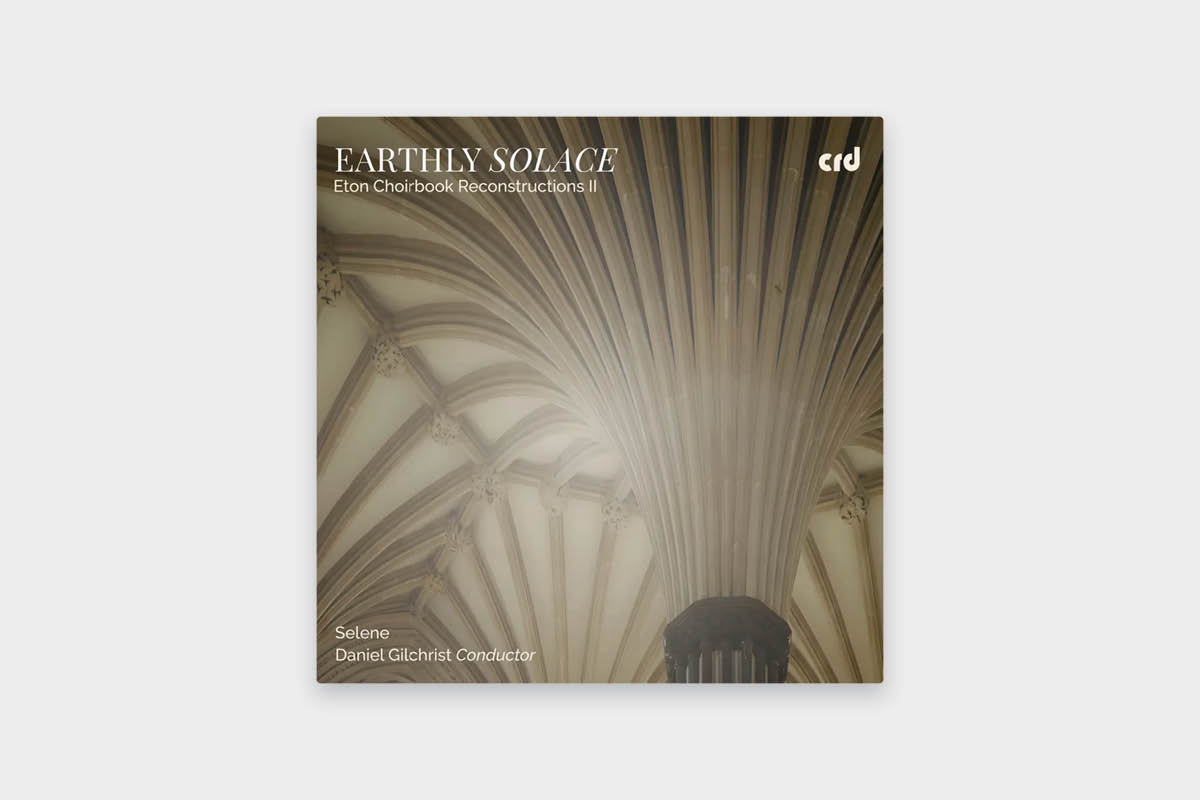
This completion of Blacker’s project, Earthly Solace, devotes much of its program to music celebrating the life of Arthur, Prince of Wales, the eldest son of Henry VII who died tragically in 1502, aged 15. Ironically, Arthur’s marriage to Catherine of Aragon laid the seeds for the English Reformation and for the destruction of most of the sources of church music of the period. Catherine, who subsequently married Arthur’s younger brother (later Henry VIII), insisted that her marriage to Arthur had not been consummated. The politics around Henry’s first marriage (whose only surviving child became Mary I) led to the split between England and the papacy.
Arthur’s birth was celebrated by a lengthy motet by court composer Giles Banester, O Maria et Elizabeth, comparing the royal birth to the visit of the Virgin Mary to her cousin Elizabeth when John the Baptist leapt in his mother’s womb. Set for five voices and cast in three instalments, Banester’s music deftly weaves its way around a cantus firmus, alternating solo and full sections. It is music (like much of the music in the choirbook) that gives credence to the composer-theorist Tinctoris’ observation that in comparison to the singers of other countries “the English rejoice”.
By contrast, John Browne’s Stabat Iuxta Christi Crucem, written in the wake of Arthur’s death, exploits the dark sombreness of six-part male voices. The rawness of emotion that motivated the composition is to some extent mirrored by the performance. From the start, Gilchrist seems content to allow individual vocal characteristics a certain amount of free rein. Presumably, for music that had its roots in improvisation, homogeneity was not such a highly prized virtue in a pre-Enlightenment world.
Earthly Solace also presents the only known works of John Sygar and William Brygeman, both of whom had connections to King’s College, Cambridge. Brygeman’s serene Salve Regina is a splendid foil for Sygar’s extraordinary, florid Magnificat, the latter remarkable for what can be achieved with just four voices.
To complete the offering there are two six-voice works: William Cornysh’s Gaude Flori Virginali and Walter Lambe’s O Regina Caelestis Gloriae. Selene’s sopranos revel in the full-voiced sections of both these exultant scores, enticing the listener to wonder at the extraordinary musical life that must have existed before one of the most far-reaching flashpoints in British history.
Title: Earthly Solace
Works: Eton Choirbook Reconstructions Volume 2
Performers: Selene/Daniel Gilchrist
Label: CRD CRD3569

Comments
Log in to start the conversation.