




When Kasper Holten unveiled his staging of Eugene Onegin at Covent Garden in 2013, it divided critics, many of whom were scathing about his use of dancers doubling as the young Tatyana and Onegin.
It seems odd that this particular theatrical device should have incensed them so much; it’s been around in one form or another since at least the 18th century, when Lully and Rameau had dancers alternating as body doubles with singers in the divertissements of their operas.
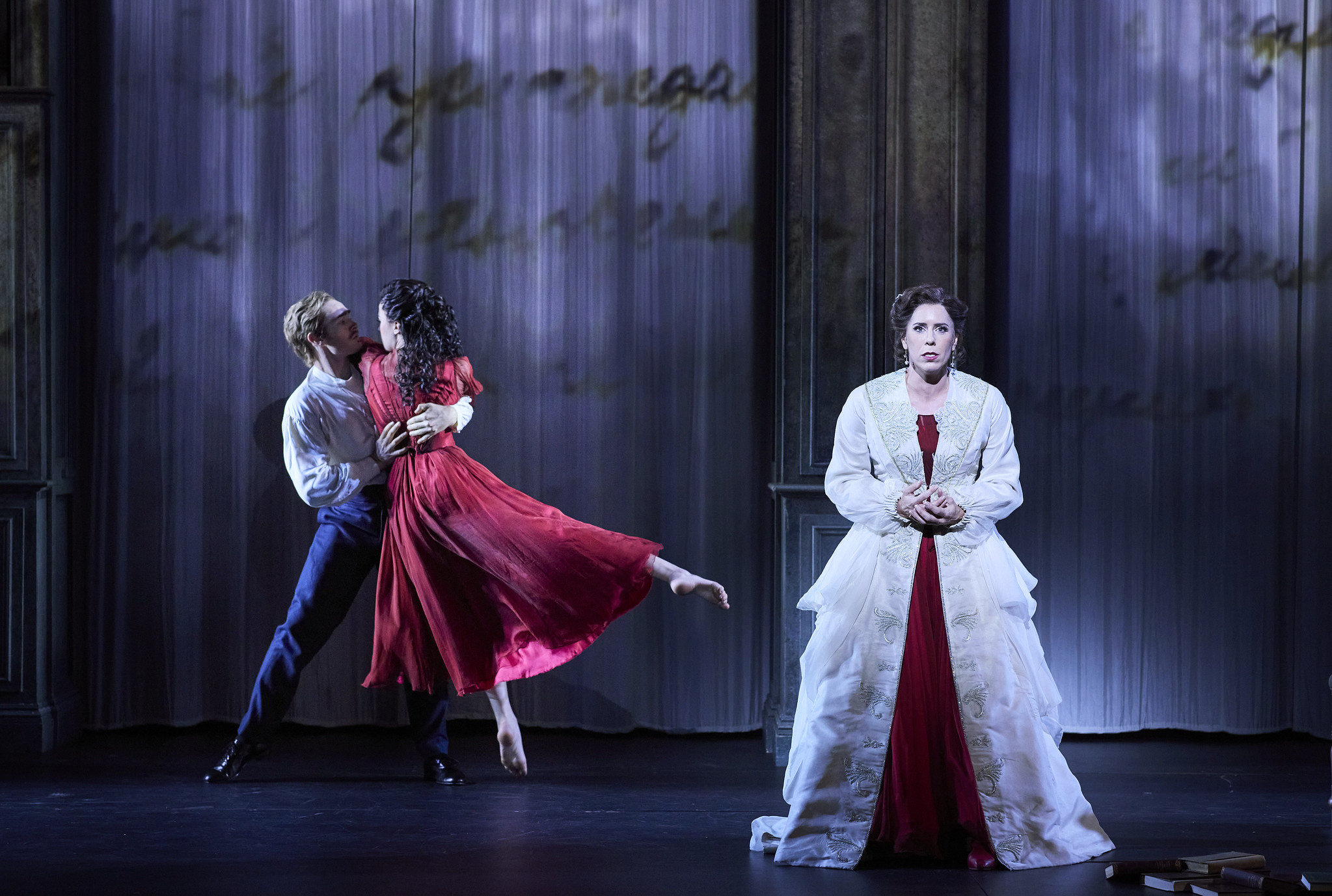
Brayden Harry, Keeley Tennyson and Lauren Fagan in Opera Australia’s Eugene Onegin, 2026. Photo © Keith Saunders
The response was warmer when Eugene Onegin premiered in Australia the following year – perhaps we were already accustomed to Graeme Murphy’s frequent use of dance doubles in works such as An Evening for Sydney Dance Company and The Trojans for Opera Australia.
Nevertheless, the negative response in the UK was enough to persuade Holten to tone down the use of dancers in a subsequent remount, and it is this version that is helmed here by Revival Director Heather Fairbairn.
Its basic premise remains. During the overture, Tatyana and Onegin are reunited at a ball in St Petersburg (this usually occurs during the penultimate scene of the opera) and they relive the events of years gone by in flashback.
It’s a fine production, with a captivating design by Mia Stensgaard that intentionally thrusts the performers to the edge of the stage so every emotion is exposed and a close bond is forged with the audience – something that was of vital importance to Holten.
It is a Chekhovian space, in which doorways open onto an ever-changing psychoscape, mouldings morph as locations change, and memories accumulate with Tatyana’s books, a tree branch and Lensky’s corpse eventually strewn across the floor.
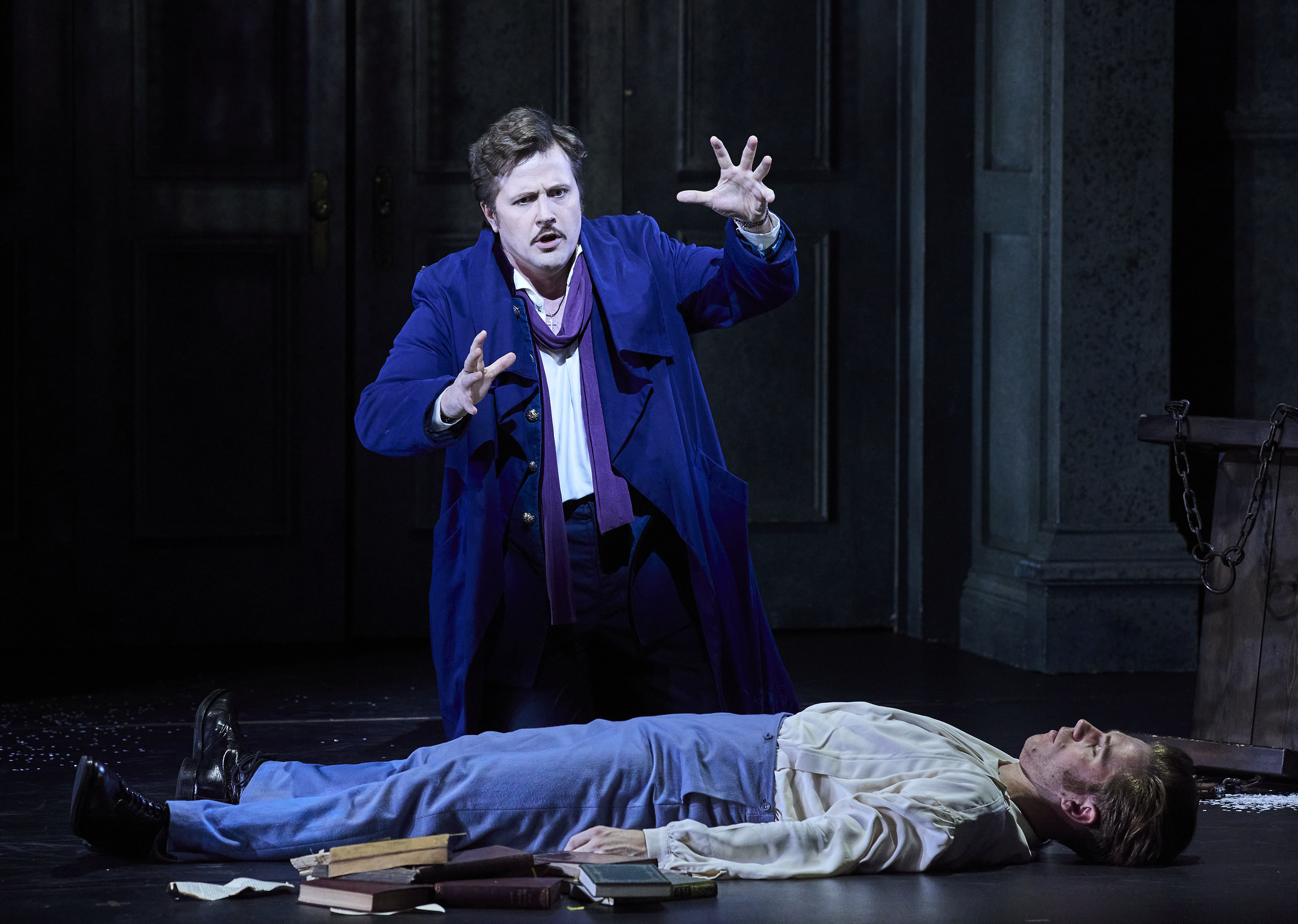
Andrei Bondarenko and Nicholas Jones in Opera Australia’s Eugene Onegin, 2026. Photo © Keith Saunders
If the production has one inherent shortcoming, it is that Tatyana (Lauren Fagan) and Onegin (Andrei Bondarenko) have less scope for character development than usual. They step in and out of each scene as we find them at the ball – mature and already affected by the events unfolding around them.
Fagan’s Tatyana has long come to terms with Onegin’s rejection of her and is now married to his distant cousin, Prince Gremin (David Parkin); Onegin is morose and guilt-ridden, having killed his friend Lensky.
The only real glimpses of their younger selves are provided by dancers Keeley Tennyson and Brayden Harry, primarily in Tatyana’s letter-writing scene, during which they come together in an erotically charged pas de deux, and the duel between Onegin and Lensky. In a particularly harrowing departure from Pushkin’s original, Holten has the young Onegin unsuccessfully try to shoot himself while still clutching Lensky’s lifeless body.
Resigned to her fate, Fagan’s Tatyana remains resolute throughout, however with no blood on her hands, she can still empathise with her younger self and lends her rich, radiant voice to a heartfelt rendition of “Puskay pogibnu ya (Though I may perish)” as she writes her letter to Onegin in Act One.
As the titular anti-hero, Bondarenko is more fettered. His mournfulness and growing apathy taint even his earliest memories of Tatyana, and his rejection of her – “Vy mne pisali … Kogda by zhizn domashnim krugom (You wrote to me … If my life were restricted to a domestic circle)” – barely captures any sense of the cynical yet urbane ‘bad boy’ she found so irresistible.
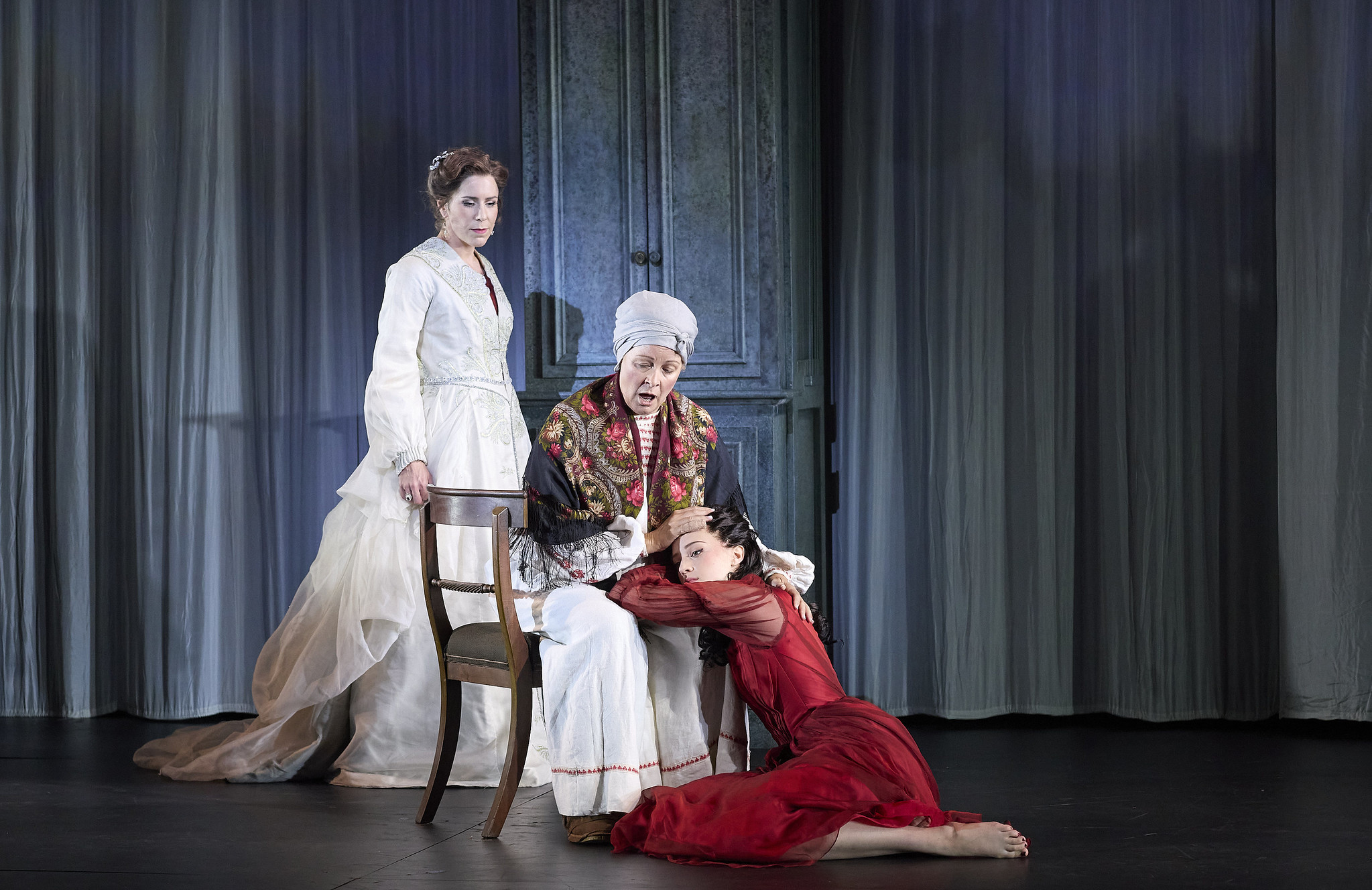
Lauren Fagan, Angela Hogan and Keeley Tennyson in Opera Australia’s Eugene Onegin, 2026. Photo © Keith Saunders
Fortunately, Fagan and Bondarenko are let loose after their surprise reunion at the ball, and their final scene is worth the wait.
Fagan plumbs the psychological depths of Tatyana, and her emotional range is impressive – Tatyana’s final blood-curdling cry in sharp contrast to her sustained legato throughout the rest of the opera.
Likewise, Bondarenko reveals an intensity we haven’t previously seen, his baritone taking on a Wagnerian quality as he falls to his knees and begs Tatyana to take him back.
As the feisty and flirtatious Olga, Sian Sharp is technically precise, her voice blending beautifully with Fagan’s during their opening duet, “Slïkhalil´ vï … vdokhnulil´ vï´ (Have you not heard … have you not sighed)”.
The evening, however, belongs to Nicholas Jones as her suitor Lensky. In recent years, the benchmark for the role has, in this writer’s opinion, been set by Pavol Breslik and Piotr Beczała. Jones matches them vocally but also imbues the lovesick poet with a youthful passion that evokes a time when life was short and the stakes were high.
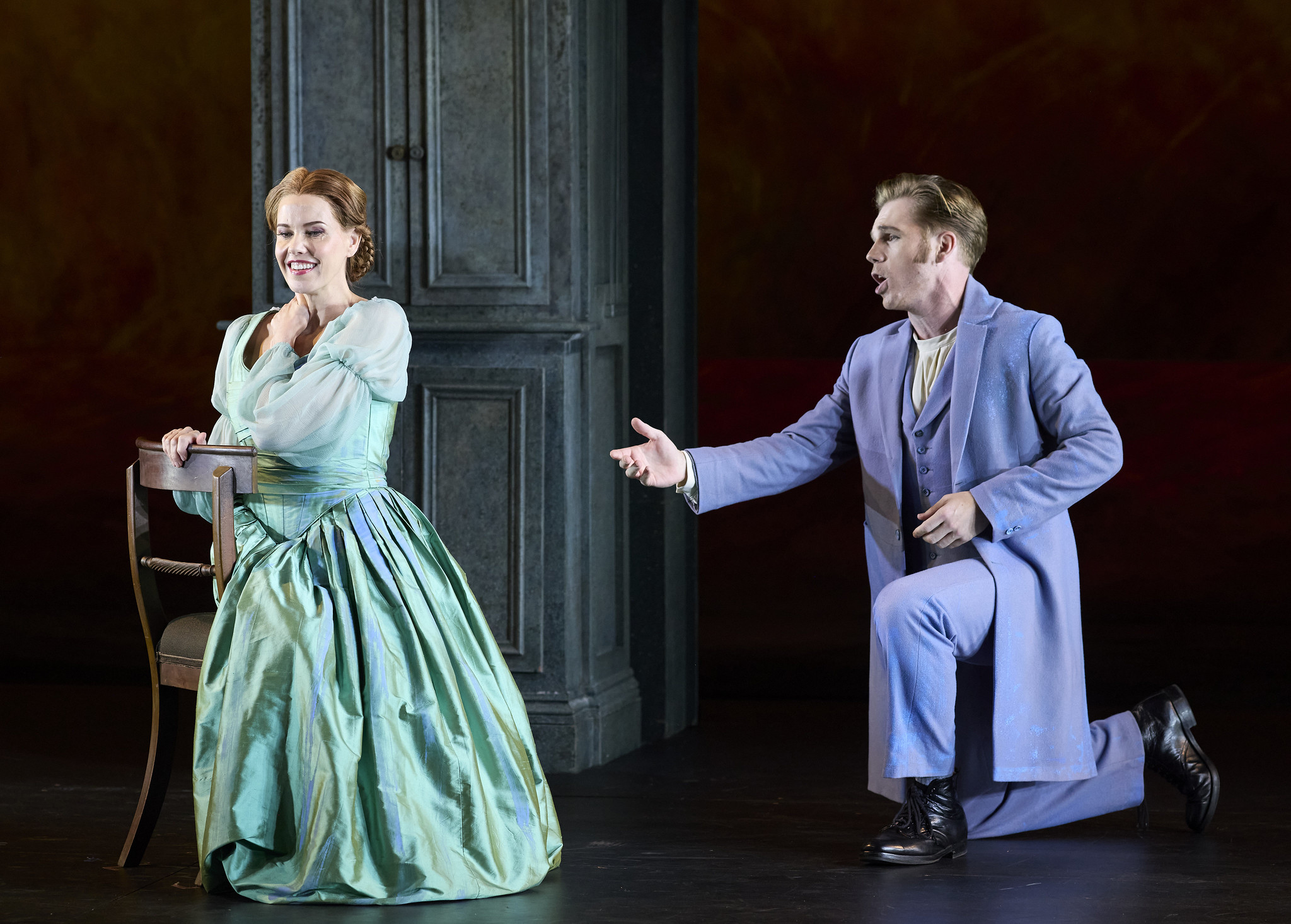
Sian Sharp and Nicholas Jones in Opera Australia’s Eugene Onegin, 2026. Photo © Keith Saunders
His arioso “Ya lyublyu Vas, Olga (I love you Olga)” has the audience swooning, and his Act Two “Kuda, kuda, vy udalilis (Whither, whither are ye fled)” is a wonderfully poignant reading of arguably the most beautiful tenor aria in the Russian repertoire, deservedly earning the loudest cheers from the audience.
Jones’s exceptional breath control underpins a sustained cantabile and superb dynamic shading, allowing for moments of intense passion that are never strained. His pitching is precise, his tone consistently warm and his singing effortless, with diction to match. We simply do not hear enough of Jones in this country, though one could hardly begrudge him the career he has built in Paris.
The rest of the cast, including the aforementioned Parkin as Gremin, Helen Sherman as Larina, Angela Hogan as Filipyevna, Ryan Sharp as Zaretsky, Malcolm Ede as the Captain and Jin Tea Kim as the Peasant Leader, are all in excellent form, each doing justice to their carefully studied supporting roles and finely crafted lines, distilled so perfectly from Pushkin’s original by Tchaikovsky and Shilovsky.
Special mention has to go to Elias Wilson in his mainstage debut as Monsieur Triquet, his beautifully sung French couplets for Tatyana’s name day a testament to the quality of Opera Australia’s Young Artist program.
The OA Chorus under Paul Fitzsimon is in excellent voice, and the OA Orchestra led by Concertmaster Matthieu Arama delivers a sensitive reading of Tchaikovsky’s score. Conductor Anna Skryleva is clearly at home with its folk inflections and word painting, and despite the full forces at her disposal, she maintains the chamber-like quality the composer wanted to achieve.
Opera Australia presents Eugene Onegin at the Joan Sutherland Theatre, Sydney Opera House until 28 March.





Comments
Log in to start the conversation.