New interpretations of Ancient Greek Myths are certainly having a moment, from Malthouse Theatre’s stunning adaptation of Troy, to Netflix’s Kaos and Broadway’s Hadestown – a cult-hit in its own right.

Melbourne Shakespeare Company’s Eurydice – the 2003 play penned by acclaimed American playwright Sarah Ruhl, and the singular non-Shakespearean play in the company’s 2026 program – is a strange fever dream of a production that will lead you down the highway to hell and back via a grungy sex den and a junkyard strewn with broken things and broken people.
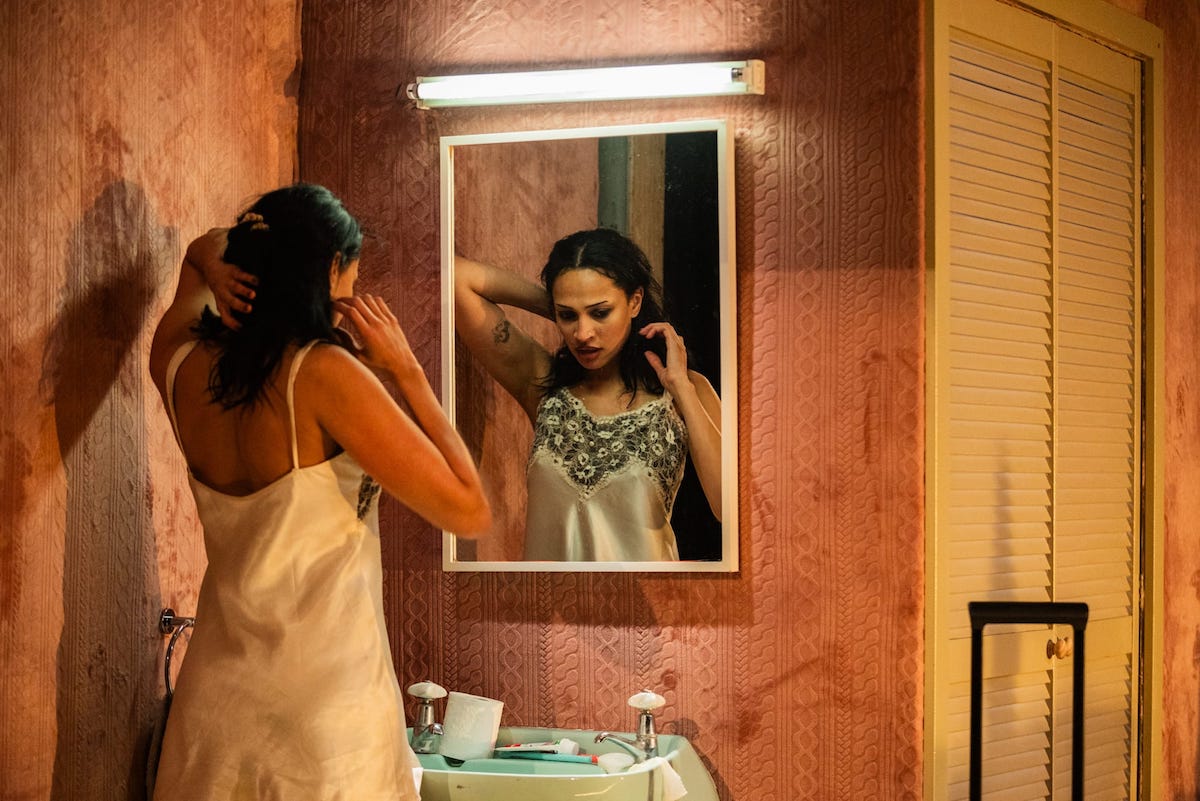
Aisha Aidara in Melbourne Shakespeare Company’s Eurydice. Photo © Nick Mick Pics

Eurydice (Aisha Aidara) is a young woman who is yanked carelessly between the veil of life and death. She is torn between an ill-fated marriage with a self-centred musician, Orpheus (Tomáš Kantor), her doting yet deceased father (John Voce), and the Lord of the Underworld (Devon Braithwaite) – a menacing, trickster-like figure who is determined to use her as his plaything, however clumsily.

Making several changes to the original myth, Ruhl’s writing is filled with dream-like prose, often prioritising poetry and absurdism over linear plot and coherent conversations. It’s a fine line to walk, but there is potential for this anarchic tact to lead to emotionally cathartic scenes that make revelations about the human condition.

However – from the shallow, almost child-like demeanours of the central couple, to a wild scene where our villain leaps out of a large chest freezer and proceeds to do a tap dance – the experience of this play is more baffling than profound.

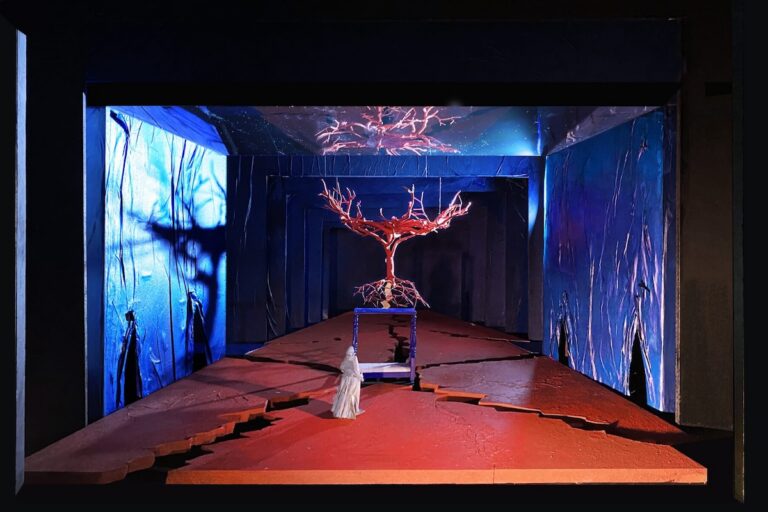
The script was explicitly written so as to be a playground for the designer of the sets, and director Gary Abrahams and set and costume designer Nathan Burmeister take this invitation and run with it, seasoning with a nod to the Australian gothic.

At the heart of the set, Orpheus and Eurydice’s dingy bedroom is complete with a used condom on the floor. A reclaimed Telstra telephone box stands to one side, operating as a sort of comms portal between the living and the dead. A moat of dirt and wood chips creates a border between two levels of staging. To the other side of the stage is what appears to be a pile of junk, most of its objects laying in wait to serve a purpose.

Among the litany of prop work, surprise entrances, and audio-visual interludes, sheets of translucent plastic come into play – often signifying a veil between the living and the dead, or the memory-wiping waters of the River Styx, and in one concerningly drawn-out scene, seeming to strangle and suffocate Orpheus as he attempts to reach his dearly departed wife.

Aisha Aidara and John Voce in Melbourne Shakespeare Company’s Eurydice. Photo © Nick Mick Pics

There are sparks of brilliance in the actors’ performances and ingenuity to the busy stage design, but neither is given much space to land as the play’s 90-minutes of action clips along unevenly. There are moments of unexpected comedy, but the audience is never sure when they should be laughing.

Much of the dialogue is delivered in yells and wails, with a healthy contribution coming from “the stones” – a chorus-like trio of underworld roaming figures (portrayed by Joshua Gordon, Fran Sweeney-Nash and Miles Paras) whose cries often overlap with discordant intensity. Amongst it all, Spencer Herd’s moody lighting design is the most steadying element – drawing us into the lurid, mythical setting.

This play is often spoken about as if it is told from Eurydice’s perspective. However, while she is at the centre of all the action, we don’t necessarily get to know Eurydice as a character with an embodied sense of self. Instead, we see a woman treated more like a prop than a person, as three different men yearn for her presence.

There is something to be said for the value of presenting non-aspirational relationship dynamics, so that we might learn to expect better. However, this meaning is counteracted by Eurydice’s final words – a letter penned to Orpheus and his future wife, which reads more like a mother’s instructions for a child’s new caretaker than a grown man’s partner.

There is, so to speak, a lot going on with this play. The creators of this show have clearly taken a “more is more” approach. While this may serve to heighten the dream-like quality of Ruhl’s prose, it also highlights that sometimes, as much as we scour them for meaning, some dreams just don’t make any sense.


Eurydice is playing at fortyfivedownstairs until June 14.

Contribute to Limelight and support independent arts journalism.