




Gloria – A Triple Bill contains works by New Zealanders Douglas Wright and Moss Te Ururangi Patterson, and New Zealand-born Raewyn Hill. Hill has recently become an Aussie, as she pointed out after the performance, apologising rather ruefully to the assembled New Zealand Dance Company.
The three pieces are an apt mix – all, in some way, connected to death. Patterson’s Lament was born out of the traditional Māori chant E Pa To Hau, composed during the 1860s land wars. It’s a hymn to ancestors, many of whom died in those wars, and praises the resistant spirit of its peoples and their connection to the land.
Hill’s A Moving Portrait touches on themes of fragility, grace and ageing – an indisputable precursor to death (well, maybe not always grace). Wright’s Gloria is one long, effusive fight against it. He claims we move because there is something larger than us; “we’re dancing,” he said, “holding our death in our bodies like a sleeping child – careful as we move not to wake it.”

Lament (Moss Te Ururangi Patterson). Photo © John McDermott
The engaging, 18-minute Lament is performed by six dancers from New Zealand Dance Company – ‘Isope ‘Akau’ola, Anya Down, Caterina Moreno, Eden Kew, Franky Drousioti and Maisie Bell – bathed in Mark Haslam’s soft yellow light and dressed in light clothing with loose, three-quarter-length trousers (Chantelle Gerrard).
Patterson’s choreography incorporates beautifully backward-leaning bodies with arms outstretched, moments of stillness, and linear, pleasing movement that propels dancers across the stage to the thumping rhythm of Shane P. Carter’s music.
Best of all is the recurring performance of the powerful, mesmerising Māori haka, which must put fear into the hearts of any enemy. This is no soft lament but a reminder of the chaos of devastating war.

A Moving Portrait (Raewyn Hill). Photo © © John McDermott
Hill’s A Moving Portrait (again 18 minutes) is more sculptural than the painting its title might suggest. The five Co3 dancers – Francesca Fenton, Millie Madden, Russell Thorpe, Ella-Rose Trew and Zachary Wilson – are dressed in long, copious, white flowing gowns, rather like designer shrouds – exquisite, as you might expect, when designed by Akira Isogawa. So garbed, the performers resemble famous Greek and Roman sculptures.
Hill’s choreography is in perfect sync with Arvo Pärt’s Tabula Rasa, with its meditative, shimmering, slow-moving chords. The dancers cluster in a single mass, coiling together in slow motion as though spinning a spider’s web. They gently fall and rise, cradle and lift each other with outstretched hands and splayed fingers, touch their companions’ cheeks and heads – and do not tremble at the thought of the awaiting, devouring insect.
Hill’s vision of acceptance of death could not be further removed from Dylan Thomas’s edict: “Do not go gentle into that good night.” During these 18 minutes, you find yourself hypnotised by the swirl of white cloth, the grace of the contrapuntal movement and the celestial resonance.
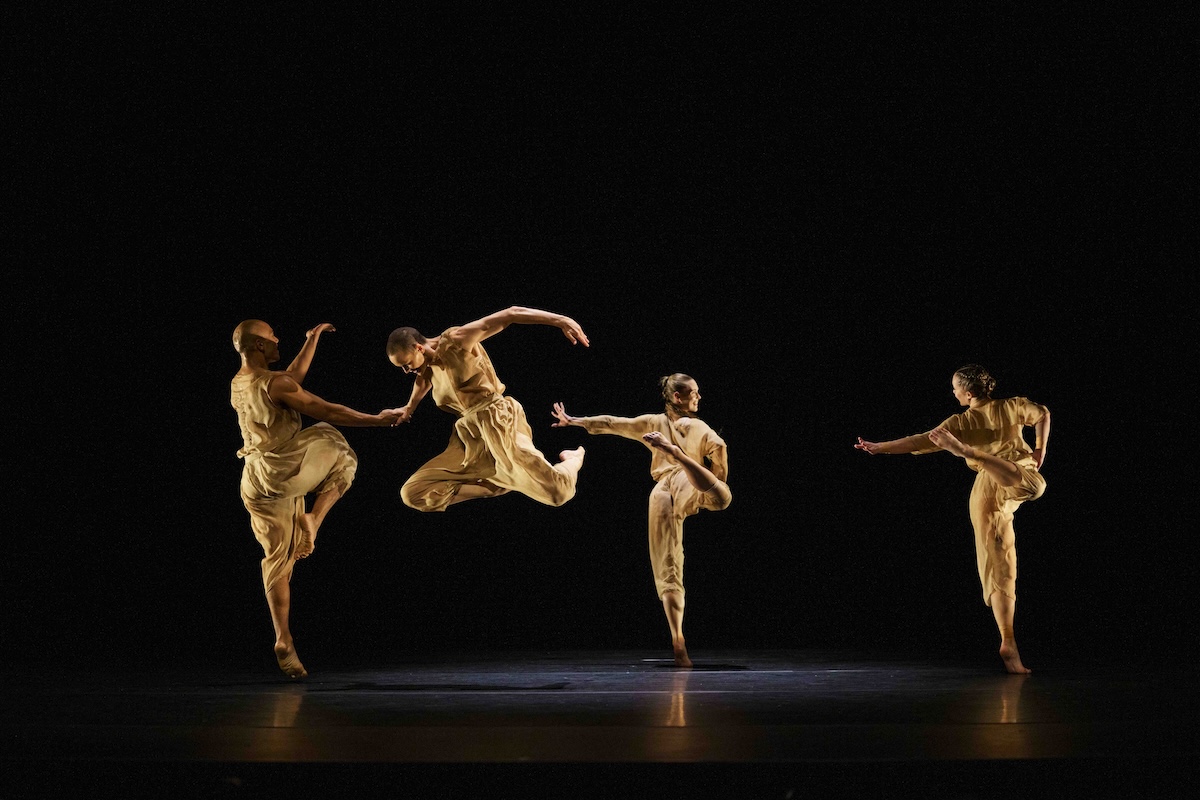
Gloria (Douglas Wright). Photo © John McDermott
Wright (1956–2018) is revered as one of New Zealand’s visionary artists. Apart from his success in the dance world, he was an author and poet, and exhibited drawings, paintings and multimedia sculptures. It seems fitting that such a talent would pit his vision of life and death against the brilliance of Vivaldi’s sumptuous Baroque creation, Gloria.
Gloria opens in silence, with dancers in a circle lit by Haslam’s side lighting. This chiaroscuro technique, beloved of the likes of Caravaggio, da Vinci and Vermeer, adds to the intense emotion and dramatic clout of Wright’s choreography.
During the opening minutes, seated quietly in the pit, are the West Australian Symphony Orchestra, conducted by Dr Joseph Nolan, and St George’s Cathedral Consort. They set the wheels in motion. Vivaldi’s divine music suddenly bursts forth; the dancers, dressed in loose, soft gold sleeveless pantsuits (Elizabeth Whiting), break their reverie, leap up and launch into ecstatic movement. It’s like watching a schoolyard of children – unencumbered, unpretentious and wildly energetic.
The combined Co3 and NZDC performers revel in their actions, smiling broadly, climbing over and under each other, making skipping ropes of their bodies and slipping dangerously beneath. Their energy is relentless, and the architecture of Wright’s choreography is entrancing. Plaudits to Megan Adams (stager) and Ann Dewey (artistic advisor), who have restaged this well-known and beloved work.
It’s perfectly obvious that Wright’s attitude to death – that it “is held inside us” – is akin to Thomas’s thinking. I’m not sure Wright was careful enough with the “sleeping baby,” though, as his dancers certainly throw caution to the wind. It would be hard to do otherwise with Vivaldi’s joyous music, coaxed from the WASO players by the dexterous Dr Nolan and enhanced by the Consort’s glorious singing.
It was a treat to witness the genial collaboration of these two celebrated dance companies – a brother-and-sister act, it seemed, with such a melding of ideas and similarity of histories, temperaments and laudable creativity. Let’s hope it happens again.
For more information on Co3 Contemporary Dance Australia, visit this link.





Comments
Log in to start the conversation.