




The West Australian Ballet’s opening season at The Quarry was conceived by David McAllister in 2025, during his last year as artistic director. It features four world premieres.
It opens with Australian Tim Harbour’s Once and Future and culminates with London-born Ihsan Rustem’s Incandescence. Both are nationally and internationally lauded dancers and choreographers, having danced in, and created works for, many of the world’s most renowned dance companies.
In between these works are pieces choreographed by WAB dancers Soloist Polly Hilton and Principal Chihiro Nomura. Both are light-hearted, humorous, shorter than Harbour’s and Rustem’s, and full of joie de vivre – a foil, perhaps, for the gravitas of the others, which explore more deeply issues of the heart and mind.

Adam Alzaim and Asja Petrovski in Polly Hilton’s Paper Moon for Incandescence Ballet at the Quarry. Photo © Sergey Pevnev
Hilton’s Paper Moon, created, says Hilton, from our strange and fantastic dreams as children, is danced to eclectic music such as Bobby Krlic’s Midsommar OST and Ryan Lott’s Counting Atomic, the tempo of which – together with some dashing about the stage – reminds me of the frantic fantasies of Alice in Wonderland.
It opens to the sound of a harp, while shadows of playing children feature behind a cream curtain. The cast includes a Baroness, a Huntsman, three beautiful Fates, and, of course, a Prince (Adam Alzaim) and Princess (Asja Petrovski). The latter spend much of the work grappling with a huge crown, which they carry, roll, and stand in and out of. It is ringed inside with a neon tube of gold light. At one stage, Alzaim, inside it, jerks his limbs so violently you’re unsure whether he has just remembered that “heavy is the head that wears the crown” or is having a fit.
The costumes (by Hilton) are a delight – the men wear sequins in their hair, no less, and the women hooped, transparent crinolines. Three of these, lit in gold from beneath, are worn by the Fates, who descend the stairs through the audience to stand before the stage in regal splendour. It is witty and pretty, but at times the stage looks bare – Hilton could enhance its magic with more characters and action.

Pamela Barnes and Charles Dashwood in Chihiro Nomura’s Night Symphony Colours for Incandescence Ballet at the Quarry. Photo © Sergey Pevnev
Nomura’s Night Symphony Colours realises a vision she has long held: to create “a night sky as a canvas where the dancers’ movements are strokes of vivid colour.” And where better to do this than in the expanse of The Quarry? The stage is lined on three sides with black fencing, pale eucalyptus trees swaying behind like beckoning ghosts, distant planets shimmering – a veritable made-to-measure canvas.
The aptly named “rising stars” she chose to perform her vision are Leading Artists Charles Dashwood and Ruben Flynn-Kenn, and Artists Pamela Barnes, Georgia Waite and Lincoln Conroy. Costumed by Nomura in pink, green, blue, purple and yellow, these five dancers certainly hit the mark through the beauty of traditional classical ballet, choreographed with style by Nomura to Alexander Glazunov’s Allegro vivace from Symphony No. 2. Dashwood flies impressively around the stage in a manner reminiscent of a ghost of Nureyev.

Nikki Blain and Juan Carlos Osma in Tim Harbour’s Once and Future for Incandescence Ballet at the Quarry. Photo © Sergey Pevnev
Speaking of ghosts, Harbour’s Once and Future, which opens the proceedings, includes the idea of spirits “wanting to be remembered,” for this creation, he says, came about by wondering “what if everything that exists has always existed, just waiting its time to appear?” A difficult concept – and one hard to envision – not only for the audience but for his dancers, who wander frequently, looking rather stunned, gathering to enclose one another in tight, protective clusters. The through-line is two young, twin-like women, Alexa Tuzil and Nikki Blain, wearing red modern dresses, who appear at times leafing perplexedly through a posse of beige-clothed, equally perplexed others, among whom Juan Carlos Osma appears to be a leader of sorts.
Harbour is a clever image-maker. His clumping together of pale, lethargic groups evokes stromatolites — living fossils among the oldest records of life on Earth (found further up the WA coast). When Osma and Blain rise from the ground in cream, skin-tight outfits splattered with brown patches, you think of Adam and Eve created from the earth. When the rest of the cast appears similarly dressed, you remember that Adam and Eve had little else to do when banished from Eden.
As inventive and thought-provoking as Harbour’s choreographic style is, it is a very slow beginning, and despite Ulrich Muller’s pounding music ramping up the sense of adventure, the work rather exhausts its enigmatic charm.
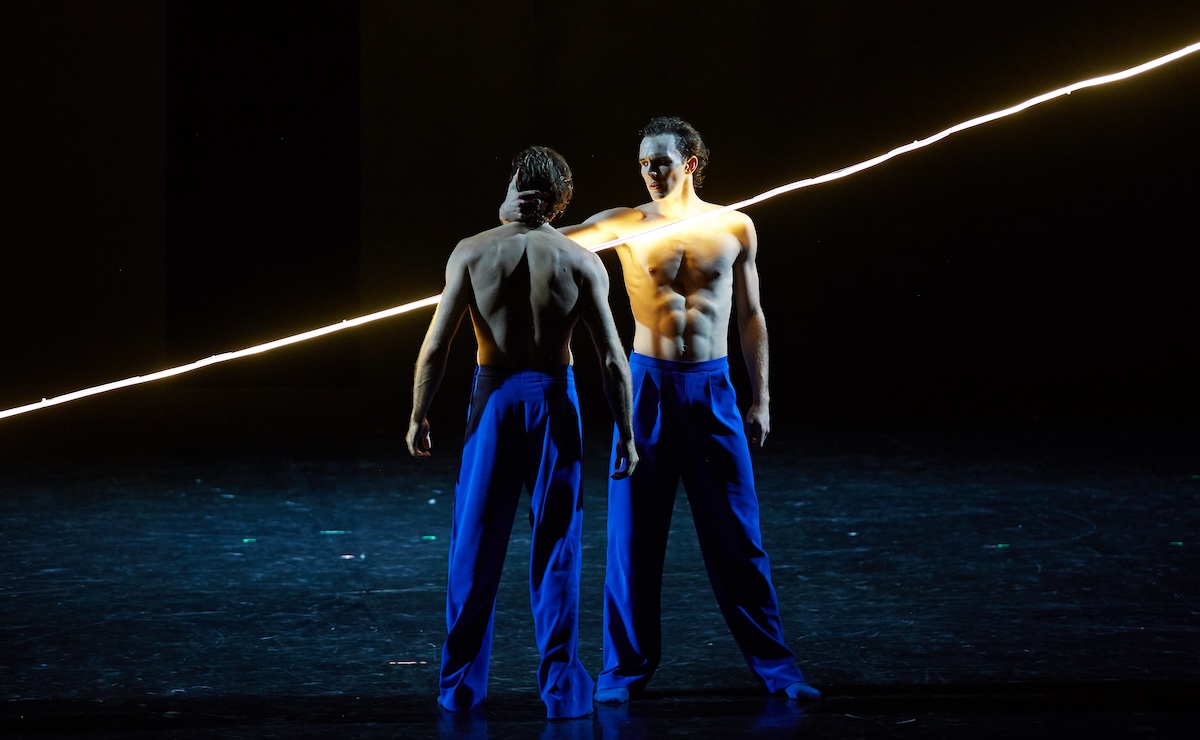
Ludovico Di Ubaldo and Charles Dashwood in Ihsan Rustem’s Incandescence for Incandescence Ballet at the Quarry. Photo © Sergey Pevnev
Rustem’s Incandescence is quite the opposite – like one of those books that, as soon as you finish, you want to start again.
The stage is partly divided widthways by a V-shaped neon pipe radiating golden light, beneath which dancers perform a series of demanding duets. They are accompanied by voices soaring into the surrounding blackness, singing Our Common Fate by David Lang.
Thereafter, music culled from Rustem’s youth – which he describes as Debbie Harry meets Philip Glass – never ceases, delighting the ear as the eye is charmed by his strikingly staged, magical choreography, none more so than when the 20 dancers suddenly stand in haphazard lines across the depth of the podium. They look stunning in simple blue outfits (Kate Ebsary).
Rustem says the challenge he set himself in Incandescence was to work with dancers en pointe. He succeeded. The ferocious intensity with which the dancers inhabit his richly textured and spectacular choreography is spellbinding throughout, yet the most stunning moment comes in a floor-based, passionate duet danced beneath the golden beam of light by Charles Dashwood and Ludovico Di Ubaldo to the heart-rending song Back to Black, sung by Sam Fender. It takes the breath out of the audience – and out of the Quarry air. All is silent and still in the face of such emotional perfection.
Finally, nothing but praise is due to lighting designer Damien Cooper, who has lit all four pieces with outstanding skill.
Incandescence – West Australian Ballet’s Ballet at the Quarry continues until 28 February.






Comments
Log in to start the conversation.