




You won’t find any references to the plot of Angus Cameron’s new play Luke in its program notes. Or you’ll find only oblique references: Luke is ‘a play of ideas, form, and people’, Cameron writes; it is about the ‘tension that exists between the individual, art, and reality’, the ‘theatrics of politics’.
I’ll defend every writer’s right to purply language in personal statements. But I was struck by how general these descriptions were.

Dion Mills and Will Lonsdale in Luke. Photo © Parenthesy
Created through Red Stitch Theatre’s INK Playwriting initiative, Luke is a story about storytelling. The core idea that connects these phrases is an interesting one: our identity is a narrative we fashion like any other. But to explore this idea, it tells another story not even implicitly referenced here: that of an English teacher, Damon (Dion Mills), who is accused of sexual harassment and grooming by an ex-student, Chris (Will Lonsdale), in a tell-all book that becomes a bestseller in 2007.
I would also not fault a writer for refusing to reveal the specifics of a plot like this at the risk of it appearing disingenuous or clickbaity. But it’s a setup well within Cameron’s wheelhouse all the same: a cerebral conceptualisation of a topical issue specifically associated with gay men that he presents with his now-signature style of tongue-in-cheek camp theatrics and tense duologues.
His 2022 show DIRT was a neo-noir thriller written in response to the kidnapping of queer people by the Chechen government; 2025’s Australian Open was a light-hearted comedy about non-monogamy. Luke, with its darker comedic style and ten-year jumps between its three acts, is closer in form to his 2019 play Cavemen.
But those shows committed to clear genre frameworks and specific contextual details in ways that sharpened Cameron’s rich conceptual questions to a finer point. Next to them, Luke feels notably unfocused: its characters are mouthpieces for abstract ideas rather than real people, while its ideas are blunted by non sequiturs and philosophical pontificating that ultimately sideline the heady questions the show asks about power, sex and education by repeating increasingly general versions of those same questions.
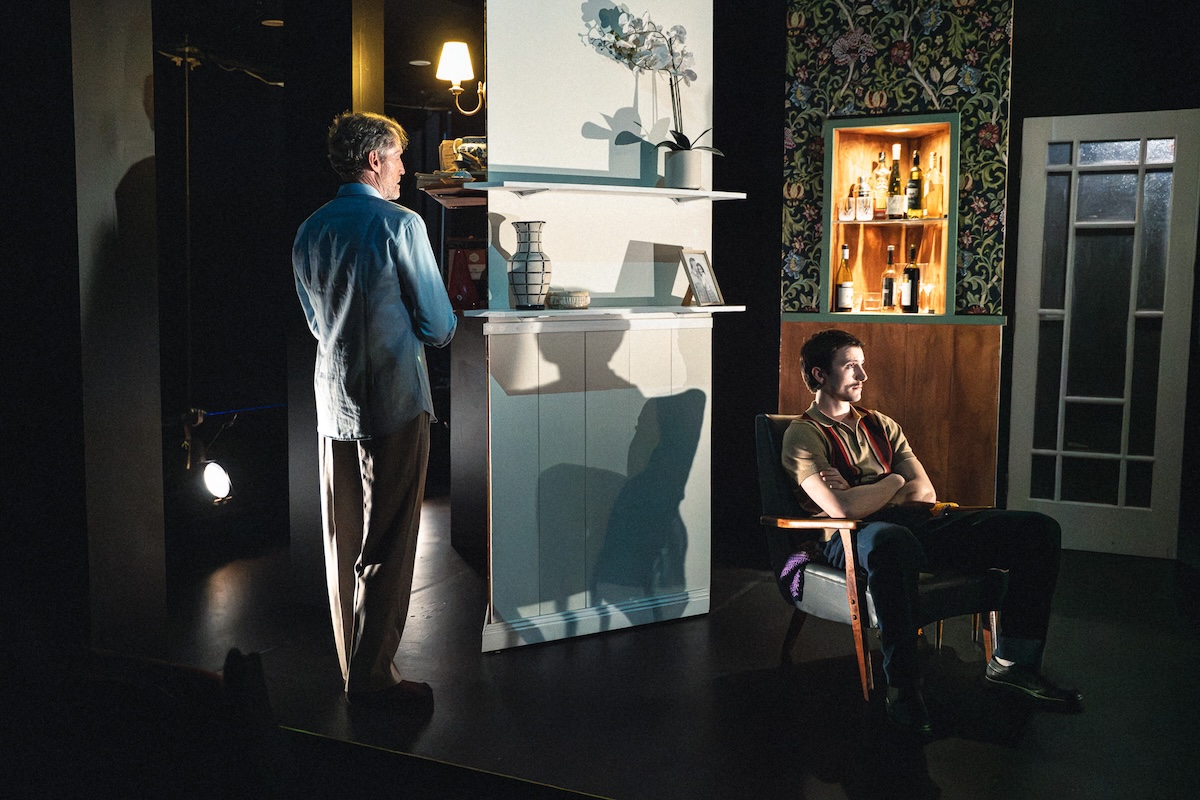
Dion Mills and Will Lonsdale in Luke. Photo © Parenthesy
We open in 2007: Kevin Rudd is Prime Minister; Queen Elizabeth is still kicking. Damon (Mills), a local royalist and dilettante, is having a drink with Olena (Olga Makeeva), a dryly witty Russian expat and his closest friend, after teacher-parent interviews at a high school somewhere in regional Victoria.
We meet them in the middle of a staple of Damon’s parties: a dramatic reenactment of the infamous assassination of the Russian princess Anastasia Romanov by the Bolsheviks. Mills, who takes to Cameron’s signature mode of camp exaggeration like a duck to water, gives us the show’s overarching thesis dressed as Anastasia’s mother: the reality of Anastasia’s death was lost when art – whether good movies or bad musicals – made her into a global myth. Stories are powerful, not because they tell us something real but because they reveal how much power we have to fabricate reality.
Chris (Lonsdale), an ex-student who joined the faculty as a rowing instructor, arrives soon after. After a flirtatious repartee with Damon, comprised of Whatever Happened to Baby Jane and Great Gatsby references, he reveals that a student, Luke, is leaving the school after unwanted attention from an unnamed teacher. It is clear that Chris believes Damon is that teacher. Damon denies the allegation. Chris reveals that he’s leaving town to become a writer.
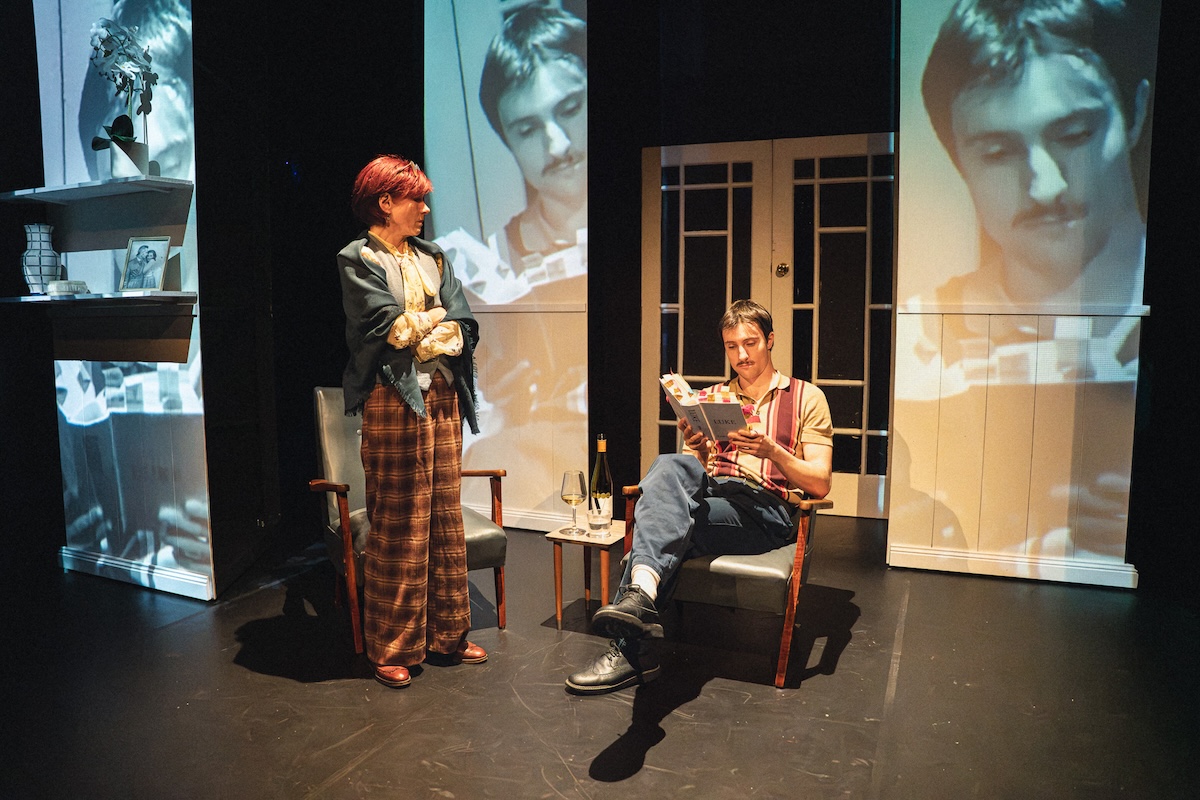
Olga Makeeva and Will Lonsdale in Luke. Photo © Parenthesy
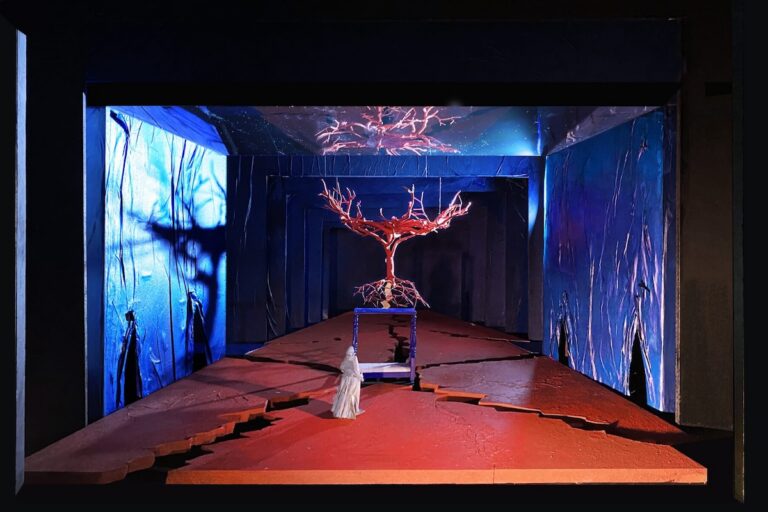
Act II takes place 10 years later, a time jump signalled evocatively by Nathan Burmeister’s set, which turns four towering columns fixed at each corner of the stage. It’s 2016: Rudd is gone, the Queen is still kicking, Donald Trump is campaigning for his first term, and Chris turns up at Olena’s house as a successful novelist ready to mine her for enough content to make a new book. He’s a self-described autofiction writer, working in a hybrid form that blurs what is real and what is fiction, that the worst person you’ve ever met at a party insisted on calling ‘radical’ in the 2010s.
We spend most of this act laughing at Chris as he masks his self-importance behind various Leftist aphorisms popular in 2016. He frames filming Olena as they speak as part of his ‘personal journey’ and attacks her when she pokes holes in the legitimacy of the accusations he stages in his novel as ‘triggering’.
Lonsdale’s woodenness was frustrating in Act I, but here it complements Chris’s bratty insincerity perfectly as he lingers on these lines with the perfect blend of annoying naivety and entitlement.
But by the tenth reference to the earnestness of 2016-era millennial Leftist politics, the point has been made. Laughing at Chris for his thinly veiled narcissism says less about his character and more about a 2026 mode of cynicism towards that era of tender queer politics. He feels unreal for that reason: a vessel for a contemporary perspective, or a static character retreading the same viewpoint again and again.
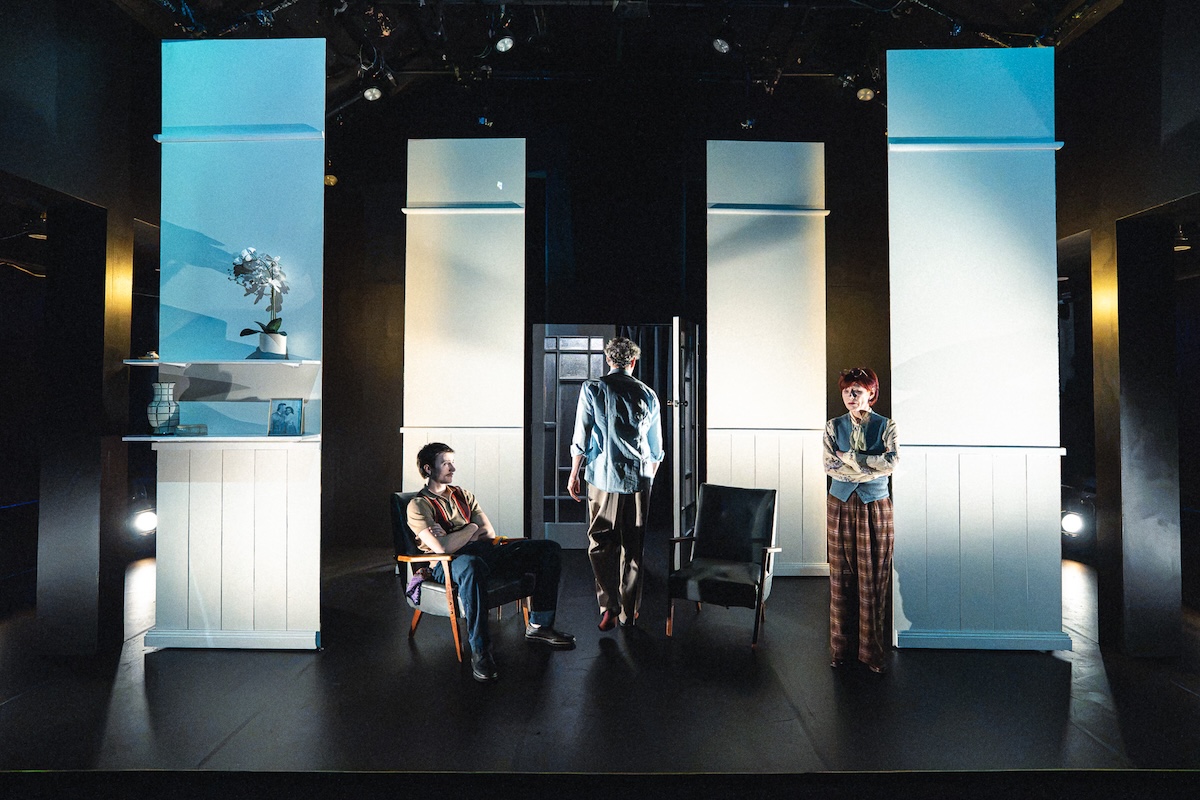
Will Lonsdale, Dion Millls and Olga Makeeva in Luke. Photo © Parenthesy
Meanwhile, Makeeva, who boasts an uproarious deadpan delivery style, is stuck reacting to Chris with short responses that become a backboard for his various rants rather than a way to develop her personal motivations or politics. She mostly serves to move the plot along while Chris prognosticates. When the show implies that the first act was Chris’s personal fabrication, the metatheatrical resonances of this reveal are muted by the fact that both acts have the same undergirding sense of unreality; neither of them feels real enough to be distinguishable from the other.
To draw a strong connection between the fabrication that made Anastasia into a near-mythological figure and Chris fabricating his personal story, we have to erase their specificity; we have to turn them into a generalisable idea about art and storytelling so that their particular versions of that idea can be accommodated. Luke insists on drawing similar comparisons throughout its three acts, and the effect is a loss of the specificity necessary for its plot to feel real enough to make us feel anything. What does it matter to us that a character is dying or that Chris is sleeping with 19-year-olds at 40 years old when reality has been so often sacrificed to make these characters representative of a general concept?
Another version of the show might find a way to use this distance between what is specific and what is general to twist the knife of its more intriguing reflections about the blurry distinctions between truth and art, personal politics and political revolution. But on opening night, these ideas and the characters that debate them never managed to feel real enough for their questions about reality – whether the reality of art or of abuse in high school education – to make an impact.
I had been teaching all day before I made my way to St Kilda for opening night of Luke. As a gay teacher, I’m familiar with conservative homophobes using the classroom to stage a faux concern for children with various fear-mongering dog whistles about paedophilia.
And as a gay man, I’ve also had plenty of discussions about older gay men grooming younger gay men. I didn’t need Luke to be a social realist play exposing the truth of these issues. But I did leave the play wishing it had made more of the questions of power that drove the story it told before using it as a backboard for an abstract reflection on storytelling itself.
Luke plays at Red Stitch Actors’ Theatre, Melbourne until 11 October.





Comments
Log in to start the conversation.