




The Chapel Royal at Versailles was the birthplace of the French Baroque grand motet. To describe the genre as ‘light relief’ would be misleading – Louis XIV put the ‘grand’ in the grand motet – but the works were a welcome diversion from the tedium of the High Mass, a daily event he inflicted on his courtiers as evidence of their loyalty.
The Chapel’s exceptional acoustic qualities, with its vaulted ceiling more than double the height of the rest of the palace, elevated the music to celestial levels, reminding all who heard it of the Sun King’s proximity to God.
In her introduction to the final performance of Lully and de Lalande: Grand Motets for Versailles, Melbourne Baroque Orchestra (MBO) co-founder and cellist Rosanne Hunt spoke of the acoustics of the venue, Our Lady of Mount Carmel in Middle Park, as the principal reason for its choice, likening its interior to that of the Chapel Royal.
She primed the audience for a unique program of rarely performed music whose genesis was the recent acquisition by MBO oboist Kailen Cresp of a quinte de cromorne, a period instrument similar to a bass oboe. Keen to find music written for it, Cresp came upon the motets of Lully and de Lalande and persuaded his MBO colleagues to program them.
De Lalande also composed music for the Royal Chamber, of which around 180 pieces survive. Sadly for Cresp, the inner parts (haute-contre, taille and quinte) did not. In stepped Polyphonic Voices member and music researcher Tim Willis, who meticulously reconstructed those parts, making Lully and de Lalande: Grand Motets for Versailles not just a musical collaboration between orchestra and choir, but a joint labour of love.
The result was a joyous combination of unaccompanied orchestral music and works for orchestra and voices, at times verging on the spine-tingling. The concert opened with a selection of de Lalande’s Symphonies pour les Soupers du Roy (the King’s Supper Music). Described as “Fantaisie ou Caprice”, it was a delightful introduction, heavy on the quinte, that more than justified its place in the program.
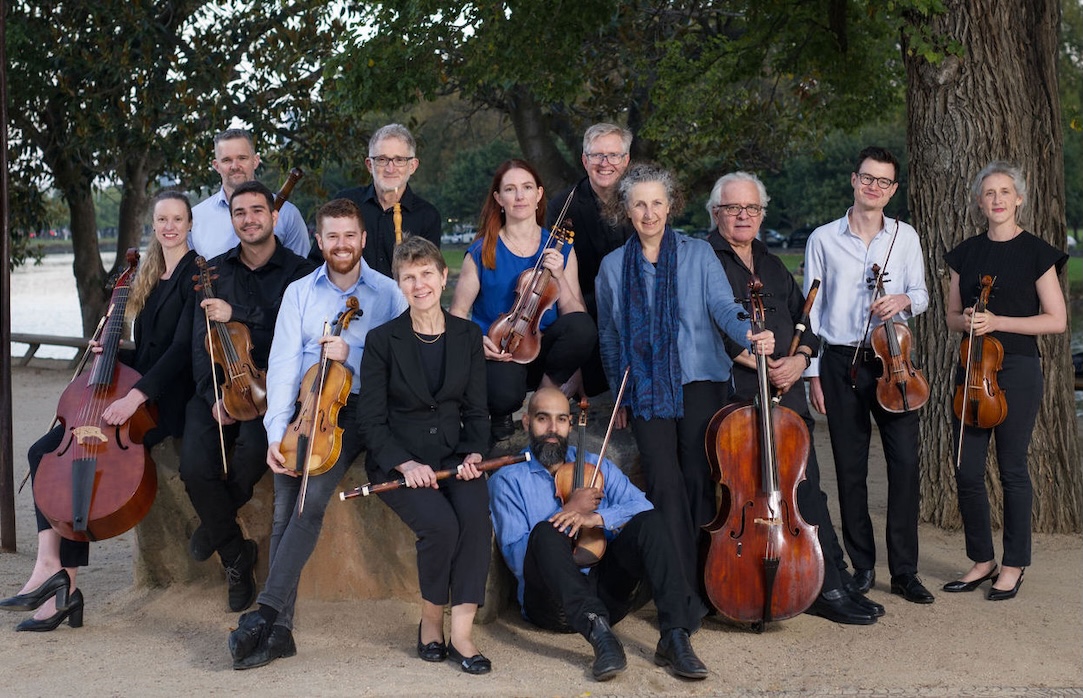
Melbourne Baroque Orchestra. Photo supplied
De Lalande’s Chaconne from Les Fontaines de Versailles brought to mind the waterworks of those fabulous fountains, its syncopation and playfulness evoking their movement. The uniquely ‘woody’ sound of the period instruments conjured up courtly life in the late 17th and early 18th centuries, enhancing the mood.
The Polyphonic Voices choir made its entrance for Lully’s Dies Irae, written for the funeral of Queen Marie-Thérèse in 1684. Originating in Melbourne and formed largely from the ranks of the University of Melbourne’s Trinity College Choir, it is a tight ensemble that works together to allow its soloists to shine.
The distance between the choir and the furthest pews was too great for this reviewer to single out individual soloists, but the overall effect was one of harmony and teamwork, enhanced by the church’s wonderful acoustic properties.
After the interval, the audience was treated to a piece by a ‘Mademoiselle Laurant’, whose identity remains unknown and who is thought to have been one of the well-connected women composers in Paris at the time. Her anonymity is a sad reflection on the status of women in the 17th century and beyond, but the inclusion of her work provided a welcome, lighter moment after the solemnity of Lully’s Dies Irae.
De Lalande’s setting of the epic poem began with a sombre introduction but picked up pace and drama with the entry of the voices. Chorus master Michael Fulcher did a fine job conducting from the organ, and the high notes in particular rang out to hair-raising effect in this acoustic setting.
It is refreshing, in this time of bottom lines and tiny margins, that MBO and Polyphonic Voices are prepared to encourage their members to come up with an idea and see it through. Hunt’s anecdote before the performance was a bonus. Such introductions are a welcome feature of classical concerts, particularly those staged in Melbourne, inviting audiences in and demystifying the program for newcomers to classical music.
More, please!
For information on Melbourne Baroque Orchestra events, visit melbournebaroqueorchestra.com






Comments
Log in to start the conversation.