A jam-packed day of nine contemporary audiovisual performances takes over the galleries, theatres and courtyard of the National Film and Sound Archive in Canberra on Saturday. Collaborative works by musicians, artists, performers and sound engineers explore how music both inspires and is inspired by motion.
Audience movement around performance spaces is encouraged in two of Saturday’s shows: Forever Changed by Nat Bartsch and MAPPA, directed by Fiona Hill.
Opening the day, proud AuDHD pianist and composer Nat Bartsch presents a collection of her most cherished “lullabies”. Breaking rigid, seated concert expectations and informed by clinical psychology, this neurodiverse-centred concert – complete with storybook-like motion picture, fidget toys, low lighting and moderately volumed music – soothes the nervous system.
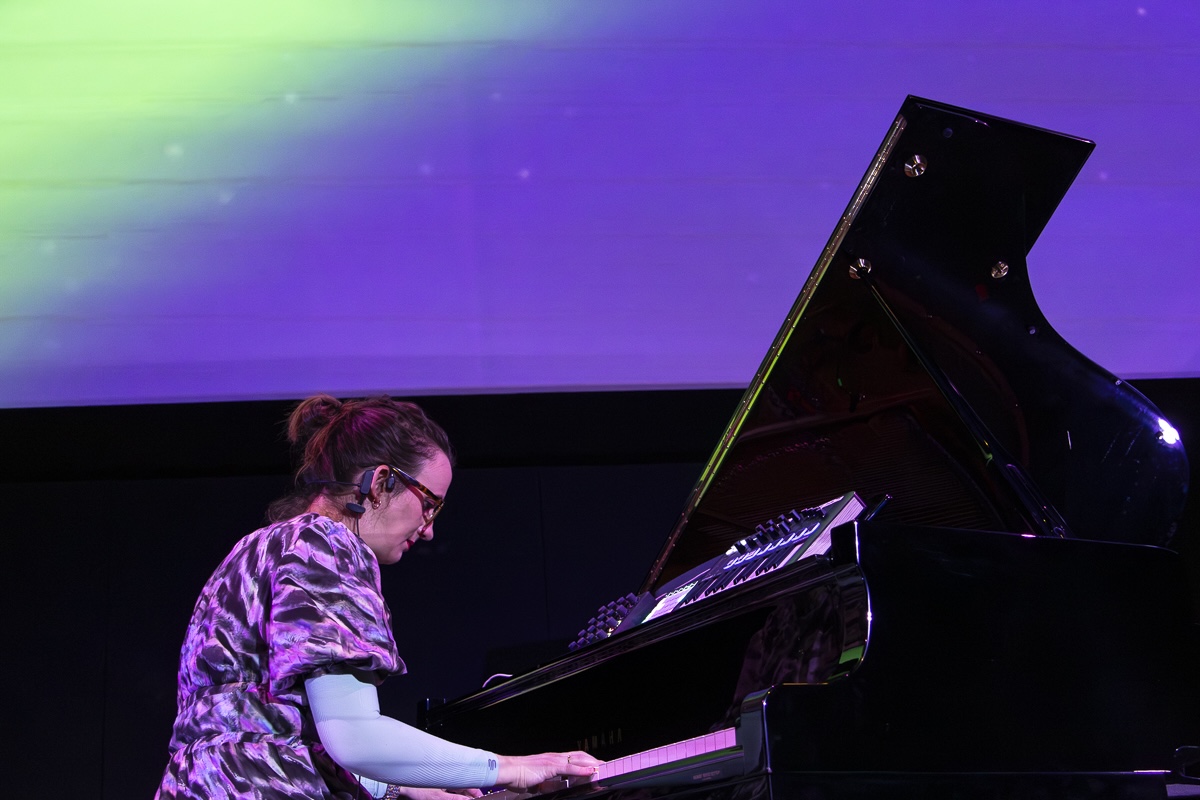
Nat Bartsch: Forever Changed. Photo © Dalice Trost
MAPPA invites audiences to curate their own experience by moving around the dimly lit gallery as musicians create sound using bells and knitting needles. Among the shifting activity, Miranda Wheen weaves and entangles herself in a giant web of yarn – an intense performance in which she battles the web before ultimately surrendering to it.
Audiences witness the magic of sound in Aaron Wyatt’s Digital Echoes. A packed gallery sees Wyatt (viola), Eugene Ughetti (percussion) and Rohan Goldsmith (audio engineer) beam sounds around Australia and back into the room. As if by an invisible force, various percussion instruments sound without human touch — an effect accentuated by Goldsmith’s timely nods. The concept and execution are clearly well developed, making Digital Echoes a captivating inclusion.
The Lyrebird Brass ensemble provides musical sunshine on a cloudy day. Several works by contemporary composers are performed in the NFSA courtyard and serve as pleasant accompaniments between sessions. However, their unfortunate positioning next to the theatre interrupts Joshua Hyde’s tender saxophone solo towards the end of the Fiona Hill Portraits concert.

Returning. Photo © Dalice Trost
In a striking ode to Indigenous understandings of motion, four First Nations composers tell their stories through Returning. Confronting snippets of poorly aged news clips (The Aboriginal Problem, by Aaron Wyatt) are juxtaposed with a swirling tree visualiser (Signpost, Midwife, Sister’s Return, by Nardi Simpson) and a contemplative view of native trees (The Journey Home, by Davin Ojala).
Nicole Smede leads Swiss ensemble Ensemble Contrechamps on a journey through Country, informing a delicate premiere of The Grassening – Breath Returns.
A mid-afternoon siesta is unnecessary for attendees of Scenery, a psychedelic concert of improvised ambient music and moving projection art by duo Sebastian Field and Nicci Haynes. Haynes’ melding, shifting live visuals are answered musically by Field on guitar and mixing desk, creating a mesmerising yet soothing effect.
Ending the day with an avant-garde program of short films and live music, four-piece band Melt is joined by Bartsch (piano) and Hyde (saxophone). A lack of coordination around bows and acknowledgements with the additional players results in a slightly untidy conclusion. Still, the performance’s relatable humanness does not prevent warm applause.

Comments
Log in to start the conversation.