Any program featuring Suite No. 2 from Daphnis et Chloé by Maurice Ravel is sure to attract a crowd. Saturday night’s concert at the Snow Concert Hall was no exception.
In a classically presented program packed with French crowd favourites, musicians from Lyrebird Brass, Switzerland’s Ensemble Contrechamps, and renowned pianists Timothy Young and Kristian Chong explored the elusive properties of time. Tissages du Temps (“Weavings of Time”) championed the contribution of French music to our understanding of time, moving from the Baroque period to modern spectralism.
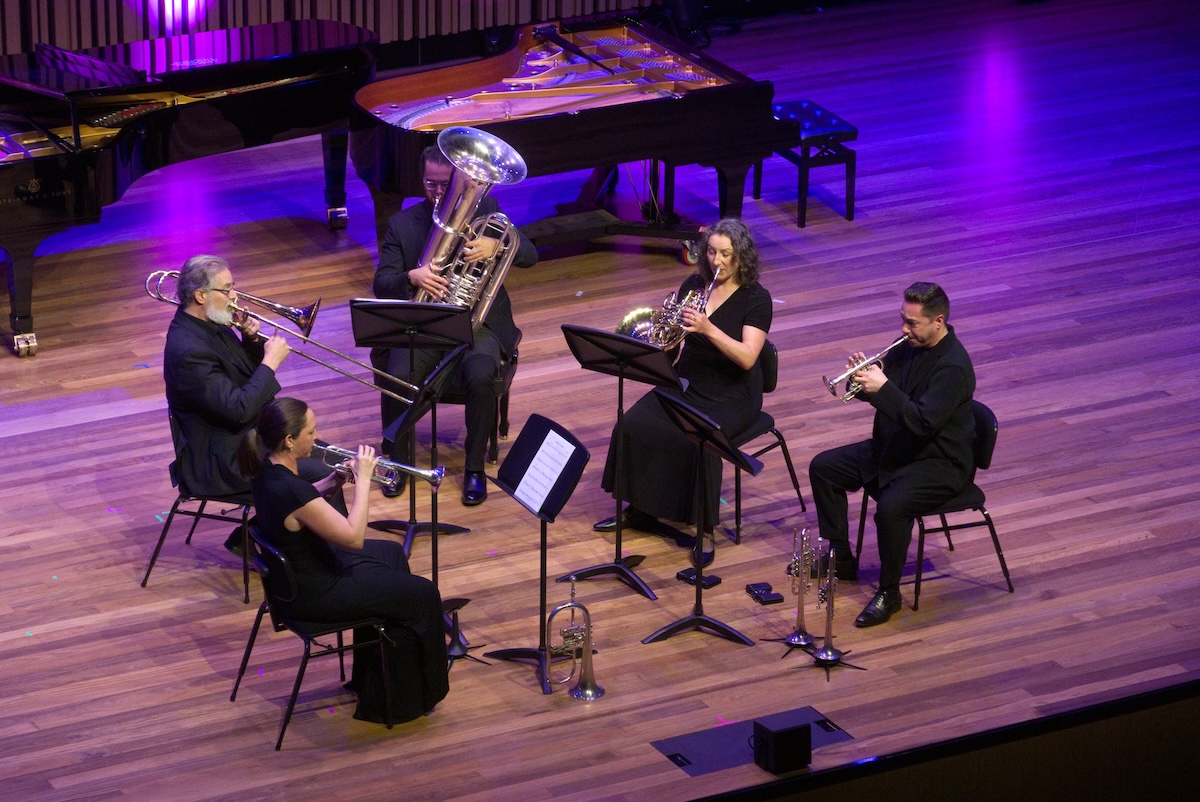
Lyrebird Brass – Tissages du Temps. Photo © Peter Hislop.
Starting with the tastefully familiar, Lyrebird Brass’ warm smiles and equally warm performance shone a light on individual threads of time itself. Marc-Antoine Charpentier’s Te Deum Prelude in D major – a march that was lost and later rediscovered – grounded the audience in a charming, clock-like pulse.
The ensemble delicately wove time’s thread in François Couperin’s well-loved Les Barricades Mystérieuses (arranged by Bernard Hughes). In this performance, the mysteries of the “barricades” were illuminated. Lyrebird Brass artfully highlighted the way melody can grow across time through multiple voices – something easily missed in keyboard renditions.
The unique sound of each player and instrument, combined with their sensitivity to harmonic structure, culminated in an exceptionally beautiful performance. Concluding their set with three delightful movements from Jean-Philippe Rameau’s Dardanus Suite (arranged by Steven Verhelst), they transported the audience to 18th-century French courts.

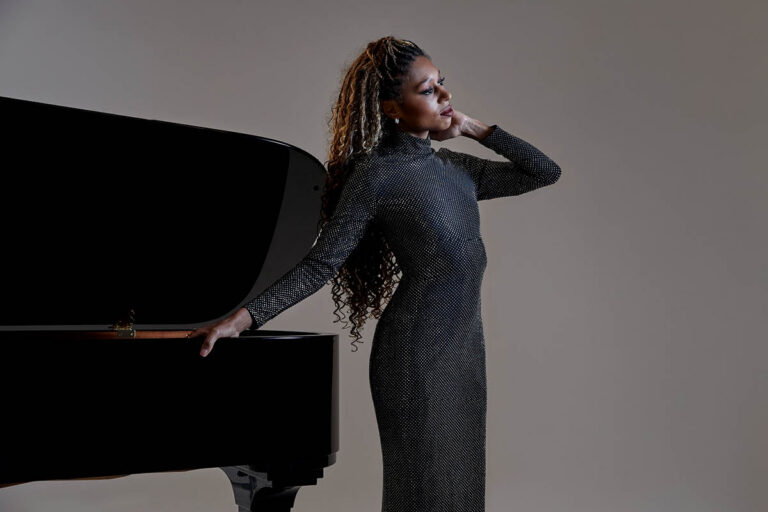
Timothy Young and Kristian Chong: Tissages du Temps. Photo © Peter Hislop.
A brief mishap in setting up Kristian Chong’s music desk had audience members chuckling before the much-anticipated piano four-hands arrangement (by Vyacheslav Gryaznov) of Daphnis et Chloé, Suite No. 2. To relieve tension, Chong and Timothy Young parodied tuning to each other before explaining why Young’s piano was on a short stick (to account for the instruments’ different sizes).
The unsettled start did not undermine the astonishment to come. In a performance that was magical from the opening, the two exceptional pianists painted the lines of over 30 orchestral instruments with just 20 fingers. Young exquisitely delivered the flute solo with a kaleidoscope of colour, while Chong supported with the thrill of a full woodwind section.

Ensemble Contrechamps: Tissages du Temps. Photo © Peter Hislop.
The post-interval set was reserved for Gérard Grisey’s epic Vortex Temporum, performed by Ensemble Contrechamps. Prepped with listening prompts from director Eugene Ughetti at the start of the concert, the recycled themes from Daphnis et Chloé provided a thread to hold on to.
Exploring how sound evolves over time through Daphnis’ thematic lens, the work gifted the audience complex and confronting harmonies and rhythmic structures associated with spectralism.
Ensemble Contrechamps’ remarkably impressive performance of this demanding piece captured the nuances of time and sound amid difficult extended techniques – a feat met with a well-deserved standing ovation.

Comments
Log in to start the conversation.