




Spring was in the air – and in the step of the audience afterwards – when the Australian Haydn Ensemble tracked the progress of the string quartet from its founder Joseph Haydn, through his more than apt pupil WA Mozart to a youthful Felix Mendelssohn in the colourful and atmospheric surrounds of the Paintings Galleries in Sydney’s State Library of NSW.
Among the eclectic collection of portraits on the walls of the three galleries laid out in a T shape were some early Colonial worthies who may well have heard some of the pieces on the program at a Government House reception or dinner.
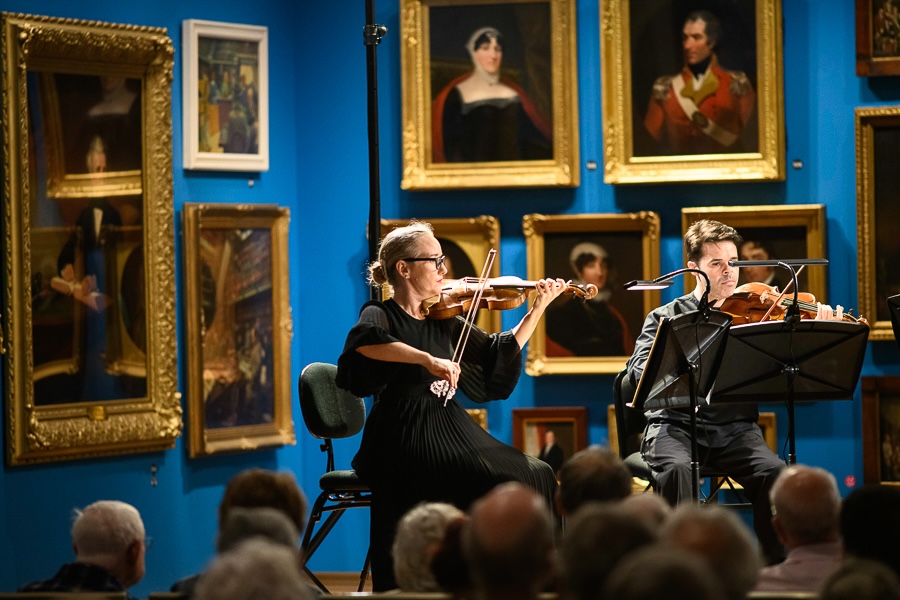
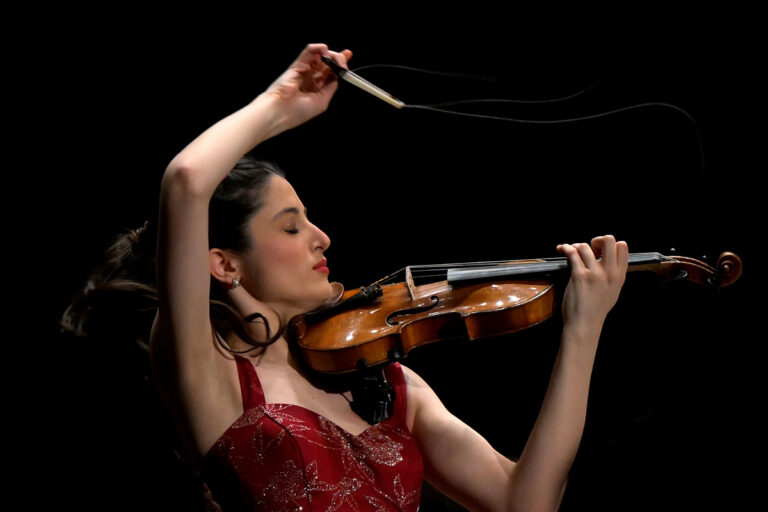
Australian Haydn Ensemble performs Mozart’s Spring at the State Library of NSW. Photo © Oliver Miller
Artistic Director Skye McIntosh led the quartet – Matthew Greco on second violin, Rafael Font, viola, and Daniel Yeadon, cello – in a neatly contrived program that started happily with the hopping and chirping motifs that gave the third of Haydn’s groundbreaking Op. 33 set of six works its nickname, Bird.
In Australia, where the seasons are less defined than in Europe, we don’t get that uplifting experience when the first crocus flowers and the birds start singing again after a long grey winter. All that feeling bubbles to the surface in the outer movements of Haydn’s work and this was captured by the ensemble with its excellent blend and precise attention to detail.
The inner movements show some of the composer’s much admired wit – the Scherzando quite hymnal in the lower strings before breaking out into a delicate and elegant violin duet, while the third movement has all the quality of a conversation between equal friends that Haydn promoted.
None of this was lost of his young protégé who started writing his “Haydn set” of six quartets shortly after hearing the Op. 33 set performed. The first of them, No. 14 in G major K387, is aptly named Spring and this work was performed in the second half.

Australian Haydn Ensemble performs Mozart’s Spring at the State Library of NSW. Photo © Oliver Miller
Before we got to that it was the turn of Mendelssohn who was only 14 when he wrote his String Quartet in E-flat major, which was published 32 years after he died. He dashed it off in 11 days and it shows that he has studied his Haydn and Mozart, as well as his Bach as the final movement is an energetic fugue.
The opening movement, which surges with youthful energy tempered with startling maturity, was beautifully played, and Font’s viola featured prominently in the yearning Adagio buttressed by Yeadon’s weaving cello lines.
The teenager shows a dash of Haydnesque wit in the Menuetto and the fugal finale reminds us that he would go on to reintroduce the public to the then-neglected works of Bach.
McIntosh and her colleagues excelled in the second half with a sunny reading of Mozart’s Spring quartet with some fine interplay and tight ensemble work. The gorgeous Andante third movement was a highlight with McIntosh’s 1770 gut-stringed violin soaring effortlessly.
Next up in April/May the AHE will perform one of their specialty pocket-sized editions of great orchestral symphonies – this time it will be Beethoven’s Fourth.
Australian Haydn Ensemble performs Mozart’s Spring at Melbourne Recital Centre, 11 March, and Gandel Hall, National Gallery of Australia, Canberra in 12 March.




Comments
Log in to start the conversation.