




This Valentine’s Day program draws a sell-out crowd studded with musical royalty – guitarist Karin Schaupp, percussionist Vanessa Tomlinson and composers Robert Davidson, Erik Griswold and Paul Dean among them.
The curation is astute: the centrepiece, and longest work at 32 minutes, is a world premiere – a Harp Concerto by Tristan Coelho, gifted to his wife Emily Granger, QSO’s Principal Harp, for the occasion.
Since meeting a decade ago, Coelho has written short harp works shaped by Granger’s virtuosity, stylistic strengths and her bold, bright tone. She once recalls being told by a conductor that there was “too much harp” – a curious criticism in a profession more often urged to project. Writing a harp concerto carries the inherent risk of submerging the soloist, yet Coelho’s deft scoring avoids that pitfall. Soloistic fragments flicker against quick-draw orchestral responses, ensuring clarity and momentum.
Granger’s playing is generously communicative and easeful, and she clearly relishes stepping from the orchestral ranks into the spotlight – a move warmly supported by her colleagues’ attentive commitment.
In Monoliths, inspired by Yosemite’s vast granite formations, the harp erupts from an orchestral maelstrom. Granger’s brutal, accented strikes dispell any lingering cliché of angelic ripples and soothing broken chords. Those familiar textures appear, but subverted – syncopated, sharpened, made muscular. Coelho has described imagining “the harp as a warrior doing battle with the orchestra”, and the metaphor rings true.

Emily Granger and Queensland Symphony Orchestra. Photo © Curtis Brownjohn
The concerto’s orchestration proves equally compelling. While the harp dominates, Coelho distributes soloistic moments generously: concertmaster Natsuko Yoshimoto, Nick Mooney (French horn), Irit Silver (clarinet), Hayley Radke (flute) and Phoebe Russell (double bass) all contribute tellingly. Extended techniques and shifts between dissonant and tonal language create vivid contrasts. The tranquil Silken Stream offers lyrical respite, while the finale, Chasing the Light, is a rhythmically charged romp demanding razor-sharp precision. Overall, the concerto emerges as a transporting, expertly crafted addition to the repertoire – a showcase not only for harp but for the orchestra’s full expressive range.
The program opens with the Intermezzo from Cavalleria Rusticana – no easy curtain-raiser, given the violins’ exposed, translucent melody. Yet the tone is luminous, the phrasing cohesive under chief conductor Umberto Clerici, setting an attentive mood for what follows.
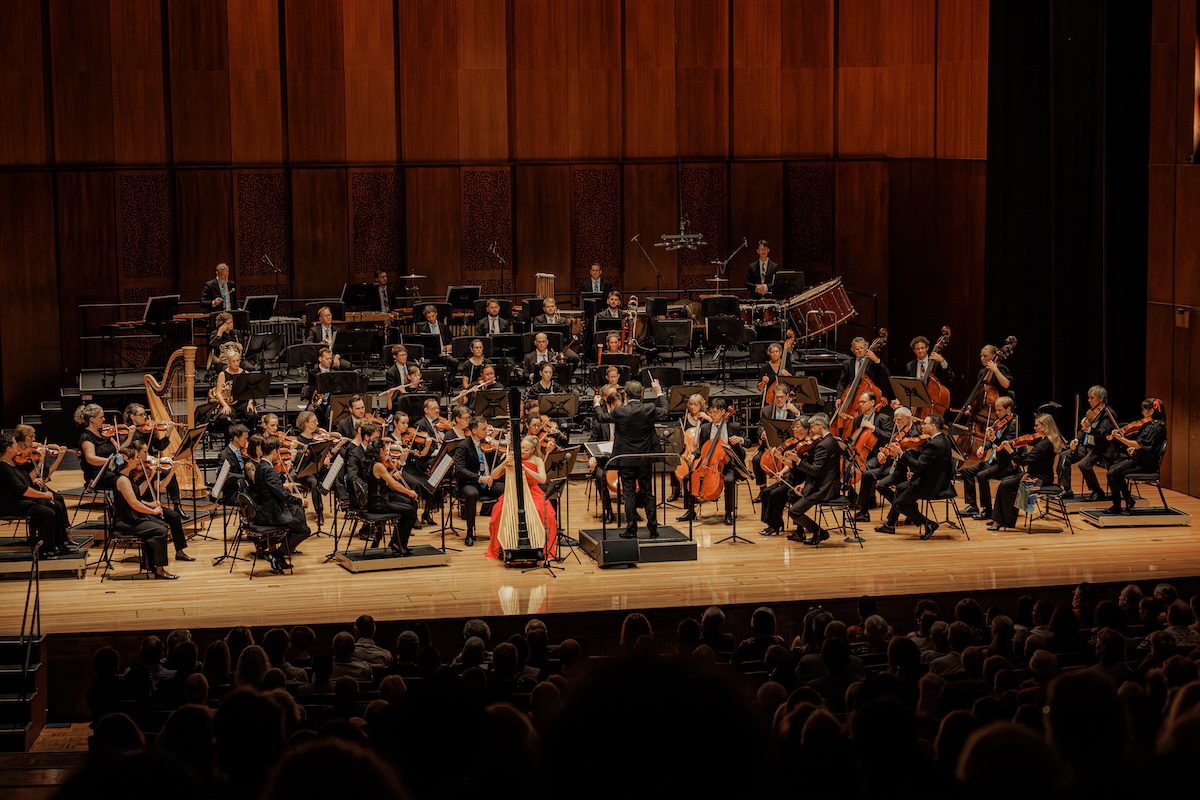
Emily Granger and Queensland Symphony Orchestra. Photo © Curtis Brownjohn
Samuel Barber’s Adagio for Strings, often dubbed the saddest music ever written, unfolds in sustained, marble-like lines shaped with patience and restraint. The string sound is beautifully graded, grounded by sympathetic double basses, and Clerici judges the emotional arc with care. The final suspended silence is particularly affecting.
Tchaikovsky’s Romeo and Juliet Fantasy Overture closes the program in full Romantic bloom. Clerici draws muscular intensity from the warring factions, while the love theme unfolds pliantly, voiced with warmth and eloquence across the sections.
What ultimately elevates the evening is Clerici’s insistence on expressive integrity. Rather than settling for polish alone, QSO plays with collective commitment and theatrical purpose. The result is an entertaining and emotionally direct concert, with orchestra and conductor alike wearing their hearts on their sleeves.




Comments
Log in to start the conversation.