Aaron Choulai is a highly accomplished composer and musician. Judging by the wonderful performances I’ve had the pleasure to enjoy over the last couple of years, he’s also doing an excellent job as the director of the Australian Art Orchestra.

But, like many artists, he wriggles a bit uncomfortably when it comes to talking about his work. This is the case when, on Wednesday night, Choulai emerges from the shadows to introduce, before conducting, his latest composition, Smoke Between Mountains.

He needn’t have worried. Choulai’s introduction to this blend of Indigenous Australian and Japanese traditions captures his intercultural appreciation and sensibilities. As with 2025’s magnificent Ane Ta Abia, which brought together a Papua New Guinean choir and a jazz ensemble, the rest of the night is a quietly confident demonstration both of Choulai’s talents as a composer and of his ability to reach across musical, visual and cultural worlds.
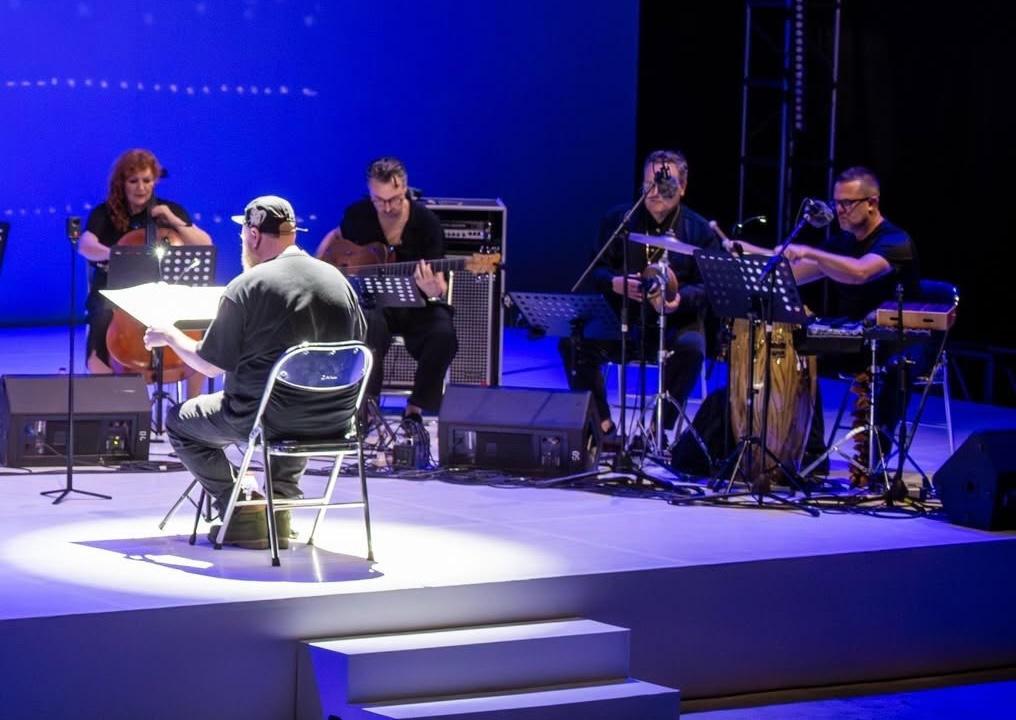
Smoke Between Mountains at the Immigration Museum, Melbourne. Photo © Australian Art Orchestra

Smoke Between Mountains was inspired when, while on tour in Osaka, Choulai watched musicians Kutcha Edwards and Miyama McQueen-Tokita discover a shared understanding between First Nations Australian and Japanese knowledge systems, and their relationships to Country. The piece draws on elements of both cultures, and with some of Melbourne’s best musicians helping to realise Choulai’s ambitious vision, the effect is uplifting and harmonious.

Miyama McQueen-Tokita is a star performer. She plays the unusual and highly compelling bass koto, sings with warmth and spiritual depth, and narrates the story that propels the piece. Depicting a girl from coastal Japan and a boy from inland Australia, the narration allows a broad spectrum of emotions to be explored. Across the hour and a bit, we soar, ache and hope.

The storytelling is also beautifully supported by the video art of Michael Carmody, projected onto the columns behind the musicians and creating a harmony that few multimedia presentations achieve. In this too, Choulai gets things right by commissioning Carmody, for it is not often that films complement the music so aptly.

The venue – Melbourne’s Immigration Museum – is also a pleasing choice. The full-house audience is welcomed into the Long Room and, although I was curious about whether the acoustics would suit the performance, the venue proves more than capable in that regard, while also enhancing the ambience with its celebration of Australia’s intercultural diversity.

But the riskiest aspect of the show, namely Choulai’s sono-kinetic conducting, is the real test of the performance. The method, developed and increasingly honed by Choulai, relies on a blend of conventional conducting and an approach that allows for “live composition” and improvisation.

From the front, Choulai uses idiosyncratic hand gestures to direct the ensemble, instructing long or short notes, trills, slides and key changes. Directing solos, pairs and groups, he allows the individuality of the musicians on stage to emerge.

Choulai considers the sono-kinetic approach can be taught to anyone. He is probably right, but by working with these particular musicians – some of Melbourne’s and Australia’s most accomplished and versatile performers – he is better able to demonstrate the strengths of his nascent technique. Chris Hale’s evocative bass playing and Ryan Williams’ recorder solos are two standouts on the night, but every member of the ensemble distinguishes themselves.

It is good to see the talented Adam Manning, a musician and artist of the Kamilaroi people, who was the AAO’s First Nations artist in Residence in 2025, front of stage, playing passionate percussion.

Though the piece overall – and perhaps one improvised string section towards the end – goes on a little longer than would be ideal, it is a privilege to be part of the audience for this latest demonstration of the Australian Art Orchestra’s exciting artistic direction.


More information about the Australian Art Orchestra is available here.

Contribute to Limelight and support independent arts journalism.