Working from the frame of Anton Chekhov’s prescient comic drama, adaptor-director Simon Stone transplants the story of a wealthy family’s dissolution to contemporary Seoul – and, more pointedly, into these global times of collapsing certainty.
Doyoung Song (played by Doyeon Jeon) – Chekhov’s Ranyevskaya – returns to the family compound after five years in New York, grieving a lost son and trailing the scent of a life lived recklessly.
The house stands unchanged. South Korea does not. The old hierarchies are buckling; public deference to authority and inherited privilege is eroding. The family’s sprawling conglomerate, once as politically potent as it was profitable, is sliding into bankruptcy and disgrace.
Into this whirlpool strides Doosik Hwang (Haesoo Park), the son of the family’s chauffeur and now a successful businessman. He has a plan to salvage the family name – and perhaps a portion of its fortune – if they will accept his terms.
But can a chaebol dynasty take advice from an erstwhile underling? Can it see beyond its own entitlement far enough to survive?
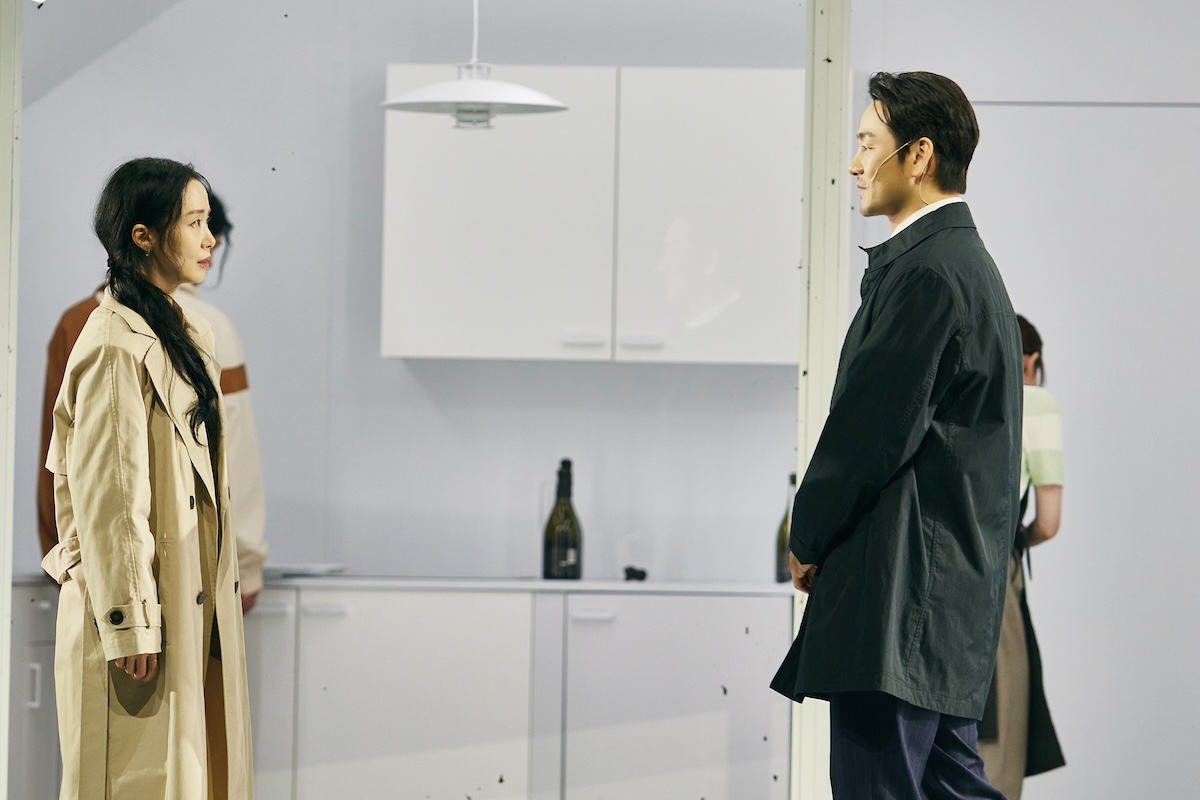
Doyeon Jeon and Haesoo Park in The Cherry Orchard. Photo © LG Arts Center
Stone’s script, performed in Korean, is colloquial, rowdy, frequently comic and occasionally bawdy. He has argued that Russians and Koreans share a certain emotional volatility, and his Cherry Orchard makes a convincing case for that possibility. Exchanges are blunt, frequently abrasive. There is ritualised deference to elders and social “superiors”, but little in the way of cushioning politeness – even from the family’s maid. Conversations surge into argument, then crash.
The parent-child fracture cuts through. Doyoung’s daughters, Hyunsook (Moon Choi) and Haena (Jihye Lee), rage against a mother who refuses to grow up, clinging to glamour as the ground gives way beneath her.

The Cherry Orchard. Photo © LG Arts Center
Visually, the production is striking: a pyramid-shaped doll’s house of steel and glass, designed by Saul Kim. Its roof doubles as staircase and soapbox. The design’s transparency is thematically apt – nothing can be hidden now – but practically tricky. Sightlines can be obstructed, and even a fleetingly obscured face makes it harder to track who is talking when you are a not a Korean speaker and relying on surtitles. Uniform amplification further flattens spatial cues; in crosstalking ensemble scenes, you have to focus hard to keep up.
Quicksilver performances repay the effort. Park is magnetic as the ascendant Hwang; Jeon’s Doyoung is luminous in her obliviousness to others; Sangkyu Son brings an offbeat charm to the dreamy older brother Jaeyoung; Byunghoon Yoo is clownishly funny as the parasitic cousin Youngho.
After a breathless first half, the post-interval action settles and deepens. As the house is stripped and sold, the house itself seems to die before your eyes. We hear bulldozers revving, ready to raze it for a wellness-spa development and we find ourselves – as Chekhov intended, one likes to imagine – suspended between pity and contempt.
The Cherry Orchard plays at the Adelaide Festival Theatre until 1 March.

Comments
Log in to start the conversation.