




At the core of Canberra-based baroque performance specialists Apeiron Baroque is husband and wife team John Ma (violin, viola, d’amore) and Marie Searles (harpsichord, fortepiano, piano). They are most often seen performing in a full chamber strings ensemble with guest artists on woodwind, and occasionally more exotic or overlooked instruments from the period. So it was a rare pleasure to see John and Marie performing the bulk of this program as the tightest of duos.
The intrigue was supplied by Simon Rickard who is by day a professional garden designer, garden communicator and leader of garden tours internationally.
His other life is as a specialist in historical reeded instruments and the baroque musette (which he played in several pieces in this program). Apparently he’s a dancer as well!
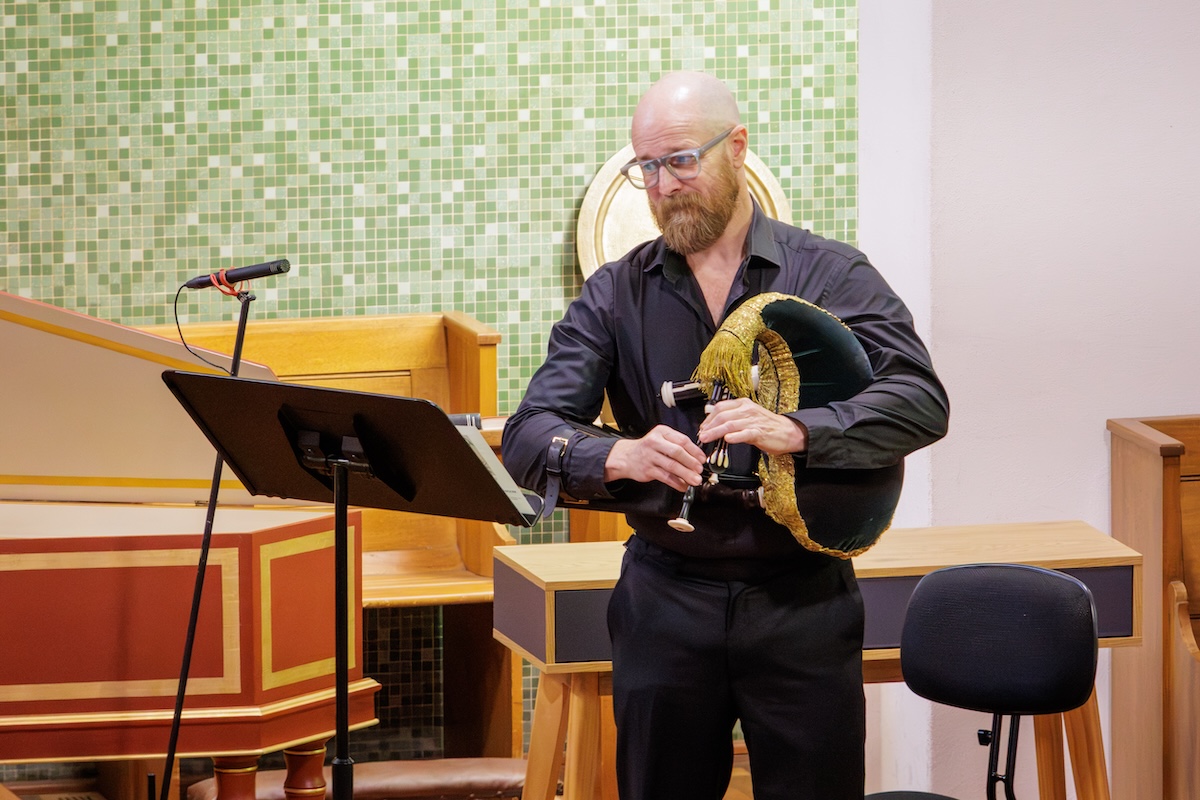
Simon Rickard. Photo © Dalice Trost
Hence the concert title. Surviving compositions for baroque musette can’t be voluminous, but it’s an intriguing instrument. Bellows-powered under the arm like the bagpipes, but not blown, it renders a surprisingly delicate presence, to the point that violin and harpsichord needed to hold back to allow the musette to come through. Its tone is somewhere between bagpipes (but much softer) and oboe (but more trebly). Distinction between notes is also much more subtle than most reeded instruments, perhaps more like a flute.
The program, with Rickard’s informative, light-hearted and clear narration between brackets, also attempted to match themes common to both music and gardening. While this approach was thought-provoking (time as the 4th dimension in music-making and gardening, but at different ends of the scale; the age-old question of what makes an ‘authentic’ creation), it was still the program of lesser-known baroque creators – researched painstakingly by Ma and Searles – that provided the main focus.
Highlights included the first work performed by all three instruments, Joseph de Boismortier’s Prelude from Il divertissemens, with the harpsichord carrying the musical flow forward while the musette and viola played quite contrasting lines.
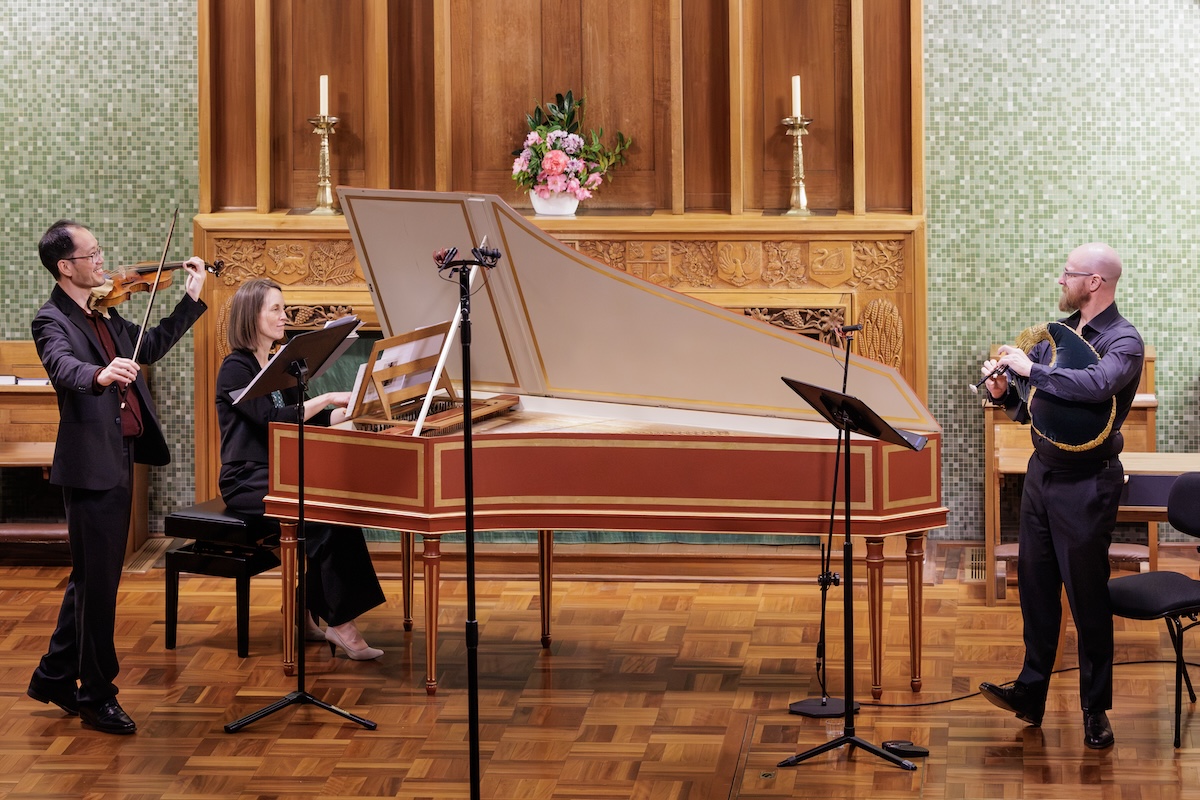
John Ma, Marie Searles and Simon Rickard. Photo © Dalice Trost
Johann Schop’s Lachrimae was as warm as honey and rich of tone in Ma’s violin and Searles’ perfectly sympathetic harpsichord. Effortless tempo changes and an introspective mood made the performance almost a meditation.
In Philibert Delavigne’s La Rose, Ma and Rickard somehow rendered two quite different musical lines into a charming duet. Johann Baal’s Violin Sonata from Opus Primum featured some exquisite articulation of descending semitone phrases from Ma, and Christoph Graupner’s Chaconne from Partita in C Major was an entertaining arrangement of variations on a simple melodic theme.
The three artists came together once again for a satisfying finale in de Boismortier’s scrapbook of contrasting tastes: Balets de Village #1.
Apeiron Baroque concerts are consistently educational, energetic and of a high technical standard. This one had the added interest of a seldom-showcased and completely intriguing instrument in Rickard’s enthusiastic hands. It is in offering new experiences through ancient creations to modern audiences that will keep the baroque tradition fresh and still with the capacity to surprise.
For more information on Wesley Music Centre programming, visit wesleymusiccanberra.org







Comments
Log in to start the conversation.