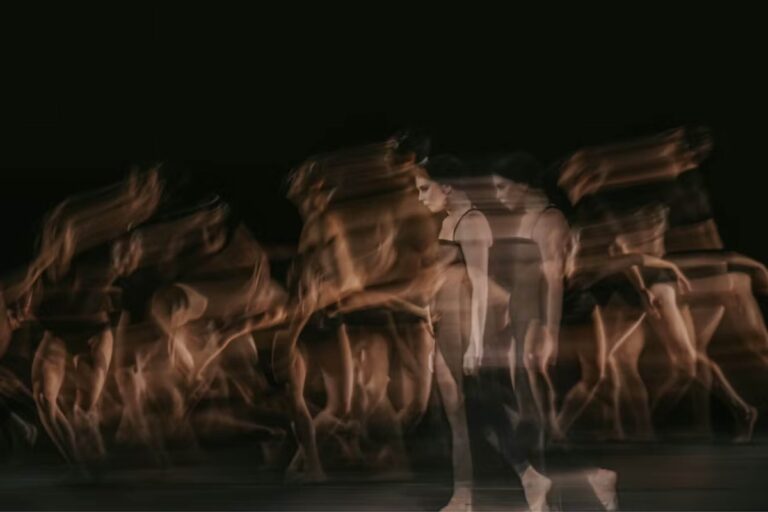
Composed for abstract digital pre-record and live ensemble, French composer Lionel Marchetti’s Lac intérieur is perhaps best translated as The Interior Lake, given the piece’s introspective yet expansive quality – one brought out in this performance by Decibel, an ensemble consisting of Cat Hope (flute), Lindsay Vickery (bass clarinet), Tristan Parr (cello), Aaron Wyatt (viola and violin), Stuart James (recorded piano) and Louise Devenish (percussion).
The performers also use ocarinas, harmonicas, Tibetan prayer bowls, hand-held radios and other items.

Decibel performs Inland Lake. Photo © Edify Media
While in the genre of musique concrète – a form in which recorded noises are stretched and bent like plastic to become otherworldly textures – Decibel’s realisation is gentle, even meditative, compared to the work of, say, concrète artist Bernard Parmegiani. There is a rich, bass-driven depth at times, but the piece does not shock. Lac intérieur is closer to a complex, dirge-like ambient work than to the stochastic swishes, wipes and jagged blips of Parmegiani, and it progresses through accumulation and withdrawal rather than the busy sense of evoking an “astonished ear,” which Pierre Schaeffer aimed for.
Marchetti calls his recording a partition concrète (“concrète score”), meaning that the recording leads the live performance, not vice versa. However, because Marchetti’s partition generates a multilayered block suffusing the space, the role of the live performers becomes structurally important, providing accents, variations and signatures that counterpoint and animate an otherwise slowly evolving mass.
This relationship is complicated by the fact that the partition is also punctuated by recordings of Decibel’s performers themselves. Sonic doubles and ghosts arise as disembodied yet present sounds, like distant memories now only partially accessible. Distorted radio transmissions and telegraph blips are also triggered, invoking a history of transmission and its disappearance into the void.

Decibel’s Cat Hope: Inland Lake. Photo © Edify Media
Karl Ockelford has produced a black-and-white film to accompany the online release of Lac intérieur, showing a flooded valley with dark reflections and shimmering sunlight bouncing off the water’s surface, interspersed with a slow pan of the lake and ghostly dead trees thrusting out of its depths.
In this latest showing, the film is spatially distributed by Sohan Ariel Hayes. Ockelford’s work is thus only partly decipherable, projected onto oddly hollow, crinkly metal pillars suspended in the venue—one pair flanking the performers, with two more placed behind. Ockelford’s material is thereby transformed into indistinct textures rather than images.
Hayes has the relative intensity of the projections rise and dip as peripheral lights come in, creating a sense of stark openness in the venue before they wink out and enrapturing darkness returns. Other mechanical lights, arrayed like sentinels across the back of the stage, blink into action, casting shifting, crossed beams before cutting out. The lighting and production function according to their own parallel rhythm, offering an additional counterpoint to the turning over and plateauing of sound.

Decibel’s Louise Devenish: Inland Lake. Photo © Edify Media
One is tempted to compare Decibel’s performance of Lac intérieur to Wassily Kandinsky’s purportedly unstageable Yellow Sound (1912) or other sound/sculpture/performance mash-ups by the Dadaists and Futurists of the early 20th century. Certainly, Lac intérieur recalls what post-war German artists called Musiktheater – abstract sound-music combinations in which the music and performance comment on or sit alongside each other, rather than producing a coherent human drama or opera.
This is not to say Decibel’s performance is unmoving. The evocation of landscapes – particularly in the sounds of wind and echo that bookend the piece – and the speech and language alluded to through telegraphy and radio, all of which remain incomprehensible and hence lost, produce complex affective responses.
It is a powerful piece, and I, for one, loved it.

Comments
Log in to start the conversation.