


The King Who Was a King is a curious adaptation. The source text is an H.G. Wells film that was never made. Instead, the War of the Worlds author turned his vision into an odd kind of book – combining a screenplay with a history of cinema meditation, and a meditation on the purpose and structure of narrative.
In Belvoir’s Downstairs theatre, Irregular Programming has produced another iteration of the work under the 25A program. Ayah Tayeh adapts and directs this stage treatment, which incorporates H.G. Wells himself (Marco Chiappi) as a narrator and participant in the story.
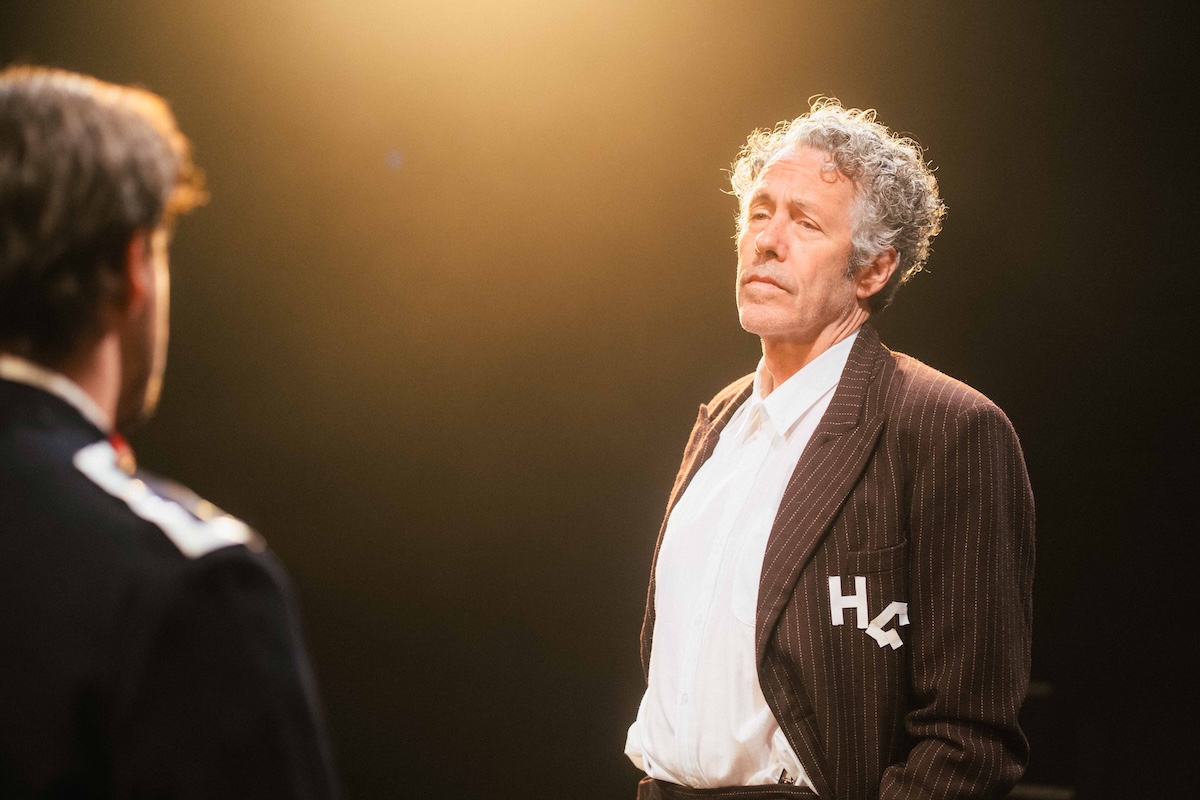
Marco Chiappi in The King Who Was a King. Photo © Patrick Phillips
Wells published his book in 1929, with a soul still troubled by the war to end all wars, and perhaps prescient of the next one looming over the horizon. The nations and militaries of Clavery, Agravia and Saevery are circling one another over critical mineral deposits. Behind them stand the United States and United Kingdom, manipulating them like pawns.
The story is simple and didactic, explicitly used to educate and illustrate. This is a clinical treatment of an immense horror, despite Wells’ (both the character and the author) inclination to speechify on the merits of aesthetics and emotion in art.
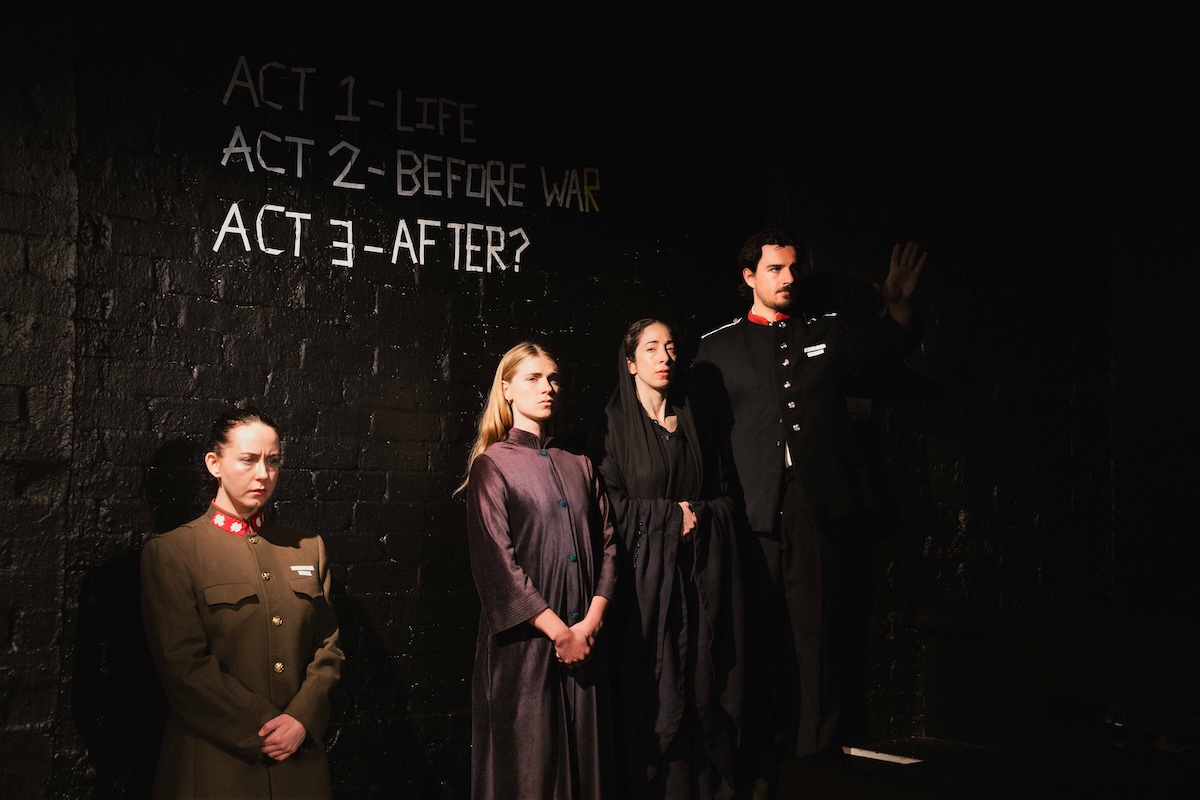
Meg Hyeronimus, Brittany Santariga, Violette Ayad and Toby Carey. Photo © Patrick Phillips
It’s heavy, heady stuff, but the pomp and stuffiness that Wells produces (his most famous work dates from the Victorian era) make for easy comedy. Indeed, it would be difficult to reproduce some of his lines about (for example) gender roles, without highlighting the inherent farce.
Tayeh also introduces a contemporary framing narrative, which ties in to the source text’s theme of war. The cast of Meg Hyeronimus, Brittany Santariga, Harry Stacey and Toby Carey slip in and out of roles in both the play, the play-within-the-play, and nebulous scenelets between.
Carey and Stacey in particular are set up as mirror images, while Hyeronimus and Santariga – as befits the source material – are usually caricatures rather than fully-drawn women. It’s Violette Ayad who has the chewiest part, and she does well to draw the audience with her on a emotional journey without hammering the point.
Credit in part goes to some understated but excellent costuming by Andrea Knezevic, which aids in both the mirroring and also the school-production vibes (epaulettes made of sticky tape are a nice touch). The set by Bronte Hunt is also simple and effective. A web of white lines on the black backdrop wall and floor stand in for constellations, a map, a chalkboard during a lecture.
All the elements are here for a good, and maybe even great, play. The production is simple but solid, the script is a deft re-work, and the actors play their (albeit limited) roles well. However, the result is a little less than the sum of its parts. Perhaps one more go-around might finally crack The King Who Was a King into the right shape – it’s not uncommon for a play to debut at 25A before taking another form elsewhere – or perhaps the material simply doesn’t quite work.
Tayeh directs an enjoyable night of theatre, and one that shows its work, if you’re into that kind of thing. But The King Who Was a King is unlikely to make a strong impression.
The King Who Was a King plays in Belvoir’s Downstairs Theatre until 22 November.








Comments
Log in to start the conversation.