D’Arcy Niland’s debut novel The Shiralee struck a chord with Australian audiences when it was published in 1955. The bestselling book – and its unflattering depiction of Australian masculinity and fatherhood – quickly became a classic and raked in plaudits both here and abroad.

The 1957 film by British director Leslie Norman, starring Peter Finch and Dana Wilson, stopped country NSW in its tracks when it was filmed in rural Binnaway (where they talk about it still). The mini-series of the same name, starring Bryan Brown, Rebecca Smart and Noni Hazlehurst, was the most-watched television show in Australia in 1988.

Sydney Theatre Company’s The Shiralee. Photo © Prudence Upton

This stage adaptation by Kate Mulvany for the Sydney Theatre Company – with its subtly introduced Indigenous and queer characters – is likely to become a classic of this country’s modern-day theatre canon. Seventy years since it was first published, Australia is still grappling with its sense of masculinity and misogyny, but this play’s portrayal of blokey bush culture – complete with bully beef, damper, billy tea and swagmen – shows us just how far we have come on so many levels.

Mulvany’s keen ear for dialogue and a good gag is well honed in the final part of her trilogy, following her two adaptations of works by Niland’s wife, Ruth Park – The Harp in the South and Playing Beatie Bow – for STC (all three with Kip Williams as dramaturg). Coupled with Jess Arthur’s deft direction, we are left, surprisingly, equal parts laughing and crying at what is, at its heart, a depressing storyline.

Kate Mulvany in The Shiralee. Photo © Prudence Upton

This version begins in the boxing ring in Grafton and ambles through Collarenebri, Coonamble and Casino along the Wallaby Track – the mythical place where swagmen went during the Great Depression in search of seasonal work. Macauley (Mac) – once a prize fighter, played with appropriate gruff humour and gentle pathos by Josh McConville – is one of those itinerant, illiterate bush workers. On one of his rare visits to his wife Marge (played by Mulvany) in Sydney’s Kings Cross, he steals his 10-year-old daughter Buster (Ziggy Resnick) in a fit of temper, then must learn to face parental responsibility for the first time in his life. Resnick’s STC debut is dynamite.

A shiralee is colloquially a swag, a burden, a millstone or an albatross around the neck of those who “humped their bluey or their Matilda” and hit the road looking for work. Buster and her toy, Goobi, start out as complete strangers to Mac, but by the end, the child’s innocence and optimism work their magic on his hardened heart, revealing his own childhood trauma. The metaphor reveals itself when the burden becomes a blessing.

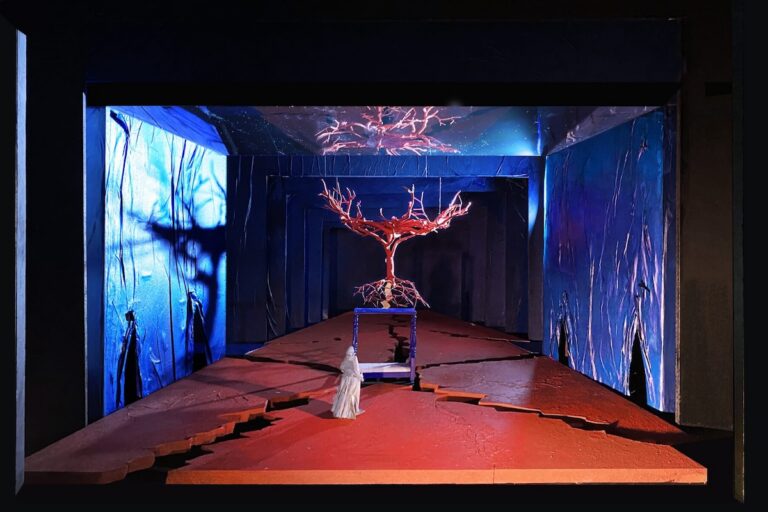
Jeremy Allen’s set is spare but cinematic, with real campfires and giant ghost gums wheeled onto a stage of outback ochres. Trent Suidgeest’s lighting creates a recognisable Kings Cross with its old Penfolds sign in place of today’s Coca-Cola neon version. Sound designer Jessica Dunn has composed a musical backtrack as familiar as the old Aeroplane Jelly radio jingle.

Catherine Văn-Davies and Josh McConville in The Shiralee. Photo © Prudence Upton

A stellar supporting cast includes Paul Capsis as cabaret performer Ruby Razzle and Desmond, a bush poet; Catherine Văn-Davies as Lily, Mac’s true love; Lucia Mastrantone as Bella, the larger-than-life mother figure; and her doting husband, Beauty, played by Aaron Pedersen. Stephen Anderson plays a dastardly Donny, and the whole cast come together around the campfire as swagmen and women.

Like fellow husband-and-wife duo George Johnston and Charmian Clift, Ruth Park and D’Arcy Niland’s contribution to Australian literature was immense. As Mulvany says in her speech after opening night, she “yearned to pay artistic respect to their magnificent opus of work.”

She’s done that and more in this narrative she took two years to craft. She’s taken Niland’s epic, with all “its scope and scars,” as she calls it, and, just like one of Mac’s uppercuts in the wrestling ring, created a script that punches you in the gut and the heart.

It’s larger than Niland’s examination of the inner psychology of men. It’s a poetic parable on parenting – and the difficulties of doing it alone – whatever your gender. In Mulvany’s rendering, child-rearing is equally hard for Marge, struggling in Sydney’s Kings Cross – driven to great lengths to keep a roof over their heads – as it is for Mac in the bush, hungry and homeless, sleeping rough each night with his ad hoc family of swaggies.

You don’t need to have grown up in old-school rural Australia, where women and children were barred from pubs, but it helps to recognise many of the Henry Lawson-style bush balladeer characters. He romanticised this life in the pages of The Bulletin but, like Mac, struggled with his own demons in the form of alcoholism and mental illness.

Just like Aaron Pedersen’s blind Indigenous character Tommy, when he explains an opal to Buster as an “underground rainbow,” this script is an “above-ground rainbow.” A gem. See it.


The Shiralee plays at the Drama Theatre, Sydney Opera House until 29 November.

Contribute to Limelight and support independent arts journalism.