

Inspired by the discovery of two entwined skeletons, from different worlds yet locked in an embrace, Two Blood draws its central narrative from two stories: a Tagalaka woman forcibly separated from Country (Zoe Wozniak) and a Chinese migrant (Zachary Lopez) caught between his ancestral world and the one he has assimilated into.
Alongside them is a third, more abstract story of an Indonesian woman fleeing a flood-ravaged village for Singapore (Yilin Kong).
There are some jagged edges in the production’s overarching structure; however, all three performers, supported by a cohesive ensemble, deliver expressive and emotionally committed performances. Wozniak’s duet with Carly Sheppard captures the painful push and pull of fighting to maintain a connection to Country, while Kong’s command of movement alongside dialogue is particularly impressive.
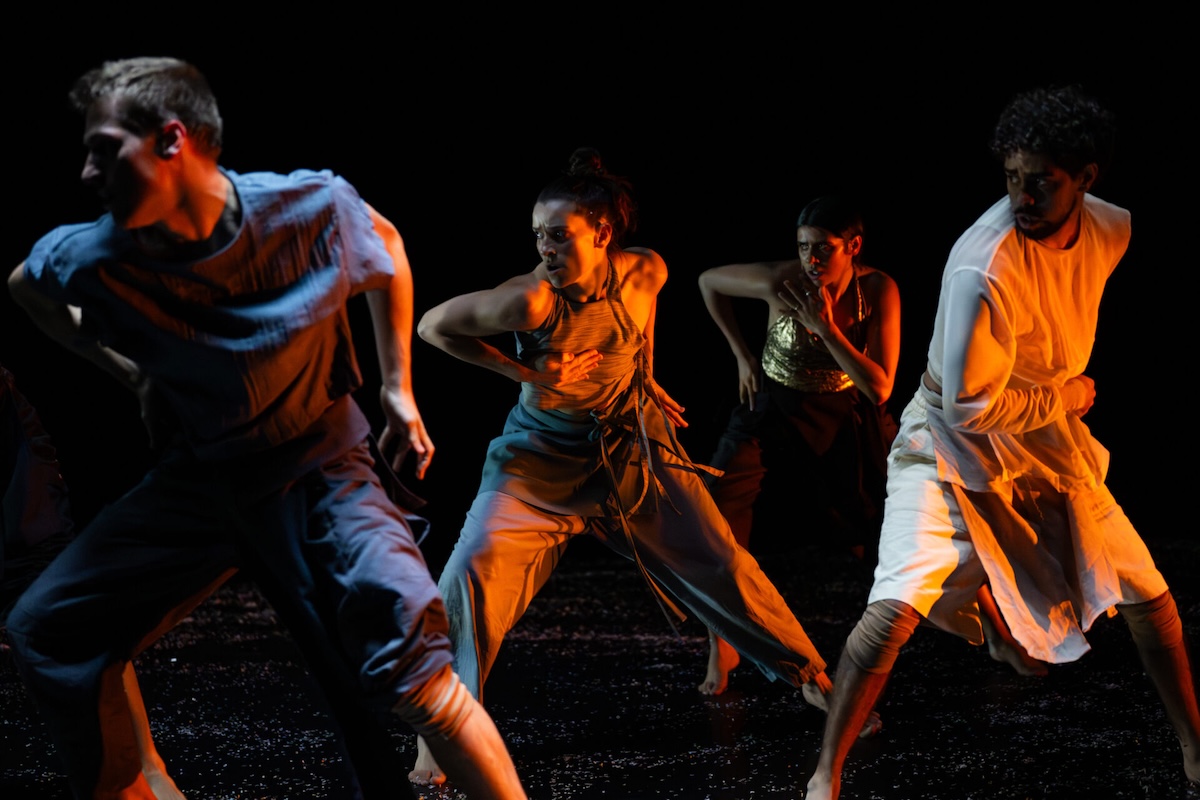
Australian Dance Theatre & Kurinji: Two Blood. Photo © Morgan Sette
The show’s highlight is the exploration of the Chinese migrant experience. A powerful trio between Lopez, Macon Escobal-Riley and Sheppard captures the mania of trying to find yourself amid a sea of outside noise. Interspersed with simple, repetitive dialogue, co-choreographers Daniel Riley and Jasmin Sheppard use their skilled ensemble to create a compelling sense of disorientation.
James Howard and Andy Qulong Chia’s harsh, unrelenting score, blending Eastern and contemporary influences, amplifies the protagonist’s fractured identity, making the eventual release in the final number, euphoric when he finally accepts himself and love.
While some abstraction is inherent to dance theatre, S. Shakthidharan’s storytelling feels underutilised here. This becomes even more apparent when Two Blood is considered alongside 宿 (Stay), his previous collaboration with Sullivan, and the show that inspired this work.

Australian Dance Theatre & Kurinji: Two Blood. Photo © Morgan Sette
宿 (Stay) hangs over Two Blood like a protective older brother, its essence lingering in all aspects of production, never quite allowing the new work to stand entirely on its own.
What remained with me from 宿 (Stay) was the strength of Shakthidaran’s script and the effortless integration of dance into a deeply moving story about identity.
Here, that skilled storytelling hand feels reduced to whispers, leaving the audience to fill in too many blanks, without a clear connection between the three characters to anchor the narrative.
Two Blood contains moments of genuine beauty, anguish and euphoria, but in reaching for three stories, it struggles to give its most compelling one – the one of two bodies locked in embrace – the space it deserves.
Two Blood plays at Carriageworks, Sydney until 15 August.
It then plays The Arthouse, Wyong, NSW on 20 August and the Alexander Theatre, Monash Performing Arts Centre, Melbourne on 5 September.

Comments
Log in to start the conversation.