




The Limelight Recording of the Month for August is Wishing Tree, the latest album from a cappella sextet The Gesualdo Six.
It’s a captivating program in which the British masters of Renaissance polyphony venture into less-familiar territory with the natural world at its heart. There’s Vaughan Williams’ classic take on the folk song Bushes and Briars, a multi-textured arrangement of The Oak and the Ash by Gordon Langford and Stanford’s The Blue Bird. From Gibbons’ The Silver Swan to Josquin’s chirping El Grillo, the music casts a magical and notably a secular spell.
Clive Paget talked to founder, conductor and composer Owain Park about programming, the importance of blend and future plans.
Your reputation is generally based on sacred music. Have you always sung secular works and folk song arrangements alongside it?
In the first couple of concerts, no. The first time that we really started thinking about enticing audiences by showcasing a broad range of music and styles was when we escaped Cambridge. Just being another group that did one very particular thing, and having no reputation at all, it would’ve been tricky, I think.
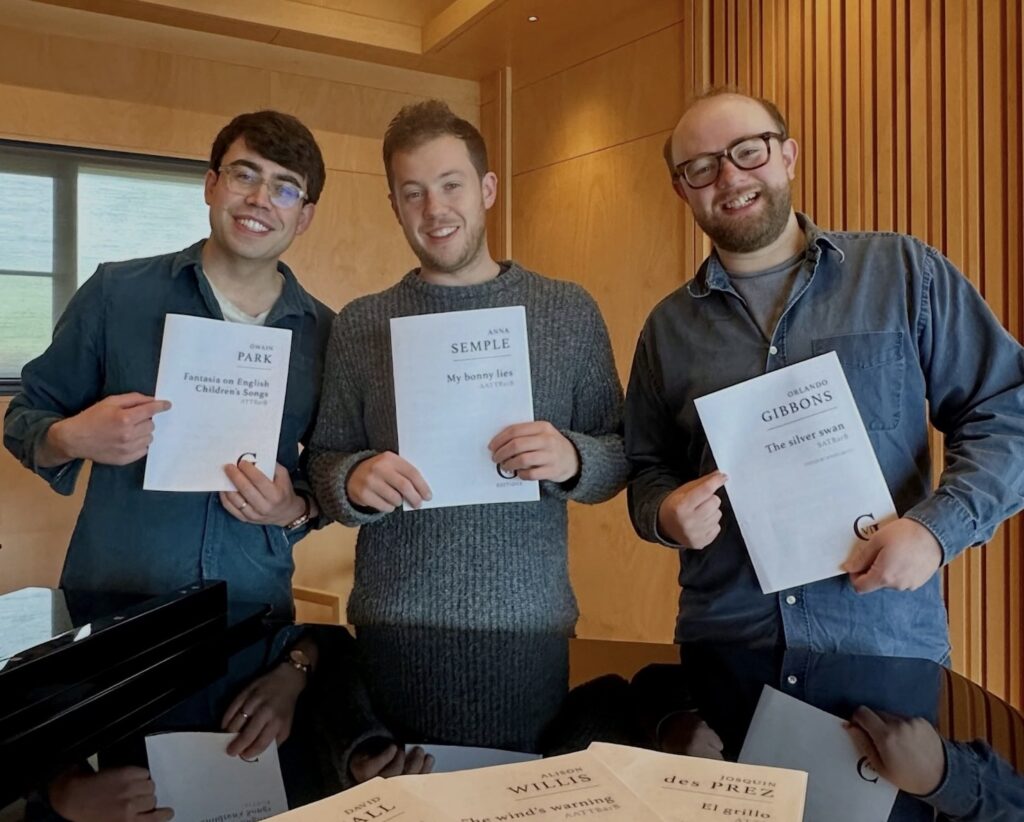
The Gesualdo Six’s Owain Park (left), Simon Grant and Joseph Wicks with music from Wishing Tree. Photo supplied
What was your personal journey through this kind of repertoire?
A lot was at school where a few of us picked up partsong books. We enjoyed the sonorities while thinking about the way traditional folk melodies have been passed down for generations and the simplicity of some of those arrangements versus the complexity of some of the new ones. It was good just trying things out, enjoying sounds that we couldn’t make singing polyphonic music; enjoying that sonority with the tenors being high. We’ve got a few tracks on the album that have that: the Poulenc, the Christian Holmes, the Vaughan Williams. In a concert setting, they kind of keep the audience’s ears active. With just six of us, we can vary the timbre quite a lot depending on who we’ve got on stage at any one time.
Wishing Tree is the title of the album. Is there a special meaning behind that?
Joby Talbot’s piece wasn’t actually in that original program. We toyed with different titles – I think I used Bushes and Briars for a bit, actually. But then I discovered Wishing Tree and it seemed to work nicely as it’s an evocative title. It instantly gives this nod to nature, but also to dreams and perhaps that sense of innocence and childhood. It also suggests the folk custom of people wanting their wishes granted by pressing coins into trees.
In a concert setting we tend to do it back to back with the Alison Willis piece, The Wind’s Warning. Out of the wind comes the Joby Talbot, and it’s a very stark contrast, which has audiences sitting back as if someone’s just pressed the accelerator in an electric car. It signals that you might be quite comfortable with this repertoire – it’s all quite pleasant to listen to – but actually there’s a story to tell and lots of different voices to be heard.
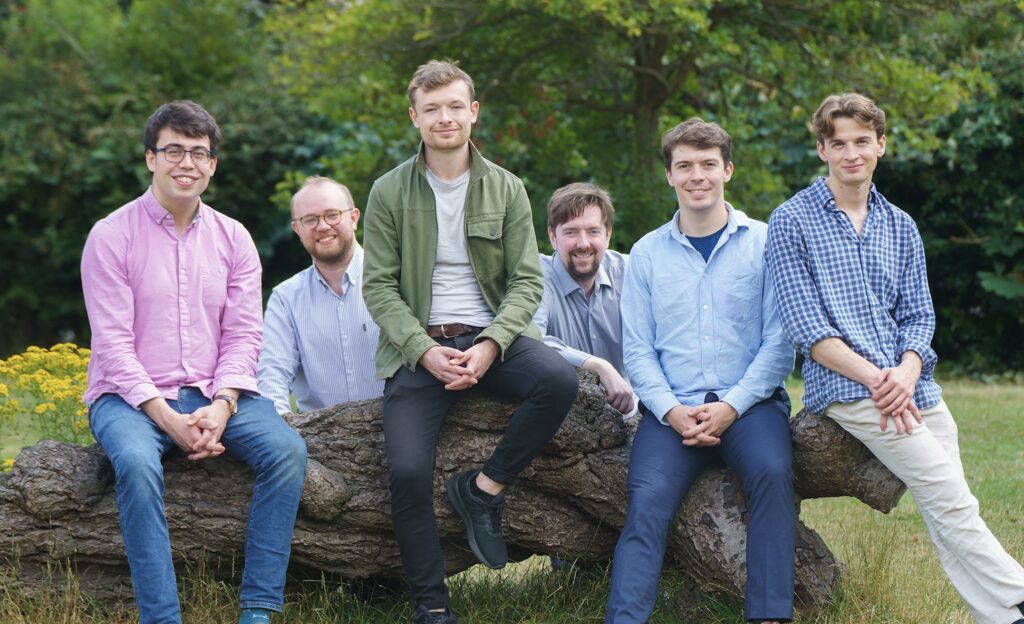
The Gesualdo Six. Photo supplied
Is there a journey through the program you wanted to capture, from the first song to the last?
It’s not a linear journey. If you take a tree, you look up at a branch and you see it is complemented by something else. Each part has its own personality and character, but the sum of the parts is the tree, which is the image of everything.
How did you choose the folk songs?
When we first did these programs, we tried to have one folk song from each corner of the British Isles. We haven’t quite managed that on this album, although since recording the program, we’ve added pieces we have been involved with commissioning-wise. It’s interesting how things keep evolving. Otherwise, it was just melodies I thought suited us nicely and fitted the theme. There’s a couple of lovely things: Red, Red Rose, for example; I had that sung at my wedding.
Within my Fantasia on English Children’s Songs, which is quite a long piece, there are lots and lots of tunes, not particularly folk tunes, but children’s melodies. One of them is Old King Cole, which is a tune I knew growing up, but then I found an old anthology of nursery rhymes, and there was a different tune to it, so I put them side by side because they work quite nicely.
And then you’ve got Anna Semple’s My Bonnie Lies as well. So, we’ve got songs and folk tunes and childhood numbers all contributing to this sense of an oral and sung tradition – something people recall as they go through life and go, “Ooh, that’s interesting.”
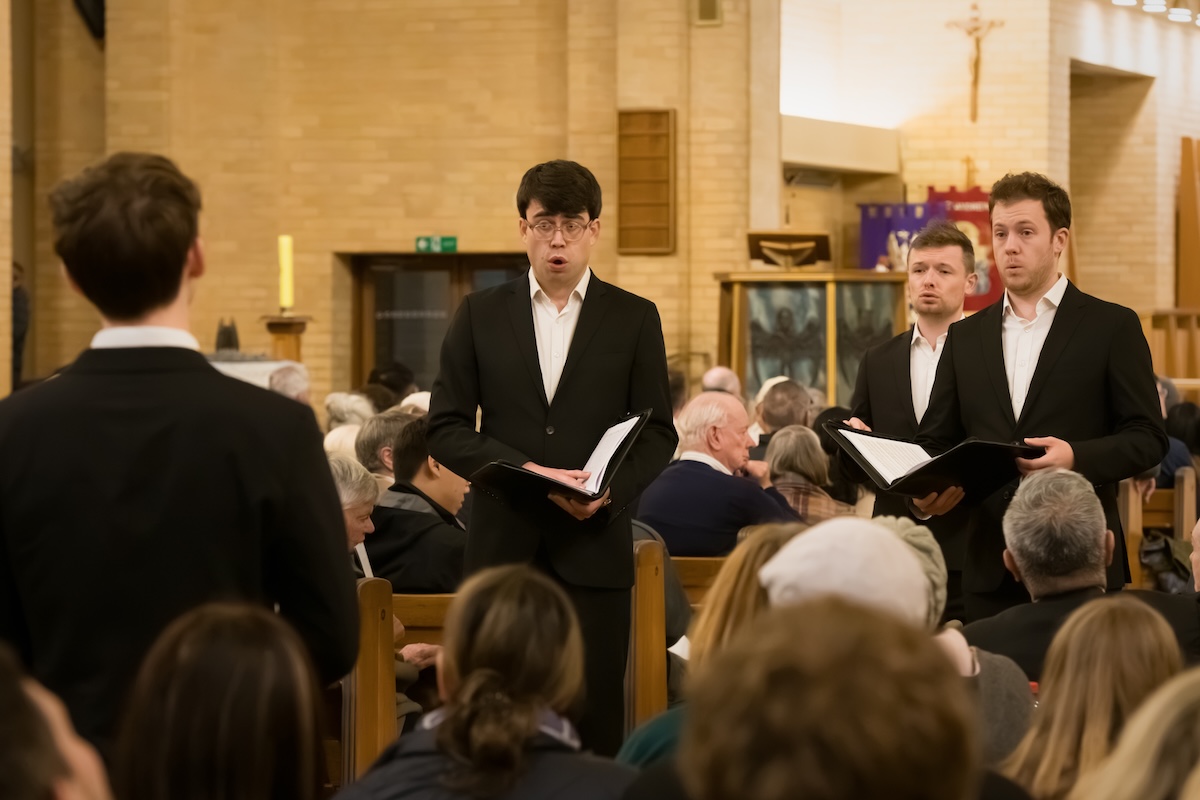
Owain Park, Josh Cooter and Simon Grant of The Gesualdo Six. Photo © Pat Charles
When you started out, was there a particular Gesualdo Six sound you were looking for, or is that something that’s evolved?
We talked about it at the beginning and tried to think about what that trademark sound would be, but it was very much linked to the repertoire we were singing. For example, there was a piece by William Cornysh we wanted to sing in a certain way that was energised and exciting. But really, over the years, as the group has evolved and we’ve had singers come and go, it’s been more about how we meld all of these timbres into a whole. People say, and I agree with this, that if you come to a concert, you can hear everyone individually, but equally it’s a whole.
What’s next for you on disc?
There are two projects. One is Orlando Gibbons and some new commissions, so lots of verse anthems. It’s a very different thing for us to be doing, but really exciting. Then there’s the second in our series of Gesualdo recordings. We’re gonna do the Tenebrae Responsories for Good Friday with some lamentations and associated commissions as well.
The Gesualdo Six’s Wishing Tree is out now on Hyperion (CDA68480)







Comments
Log in to start the conversation.