


Archibald Prize-winning artist and musician Blak Douglas has been appointed Indigenous Artist-in-Residence at the Sydney Conservatorium of Music, where he will introduce students to the musical traditions, techniques and cultural significance of the yidaki.
The appointment brings more than two decades of Douglas’s experience as a musician, visual artist and cultural educator into the Conservatorium’s teaching program. He plans to explore the instrument’s distinctive rhythmic language, complex playing techniques and connections to First Nations cultural knowledge.
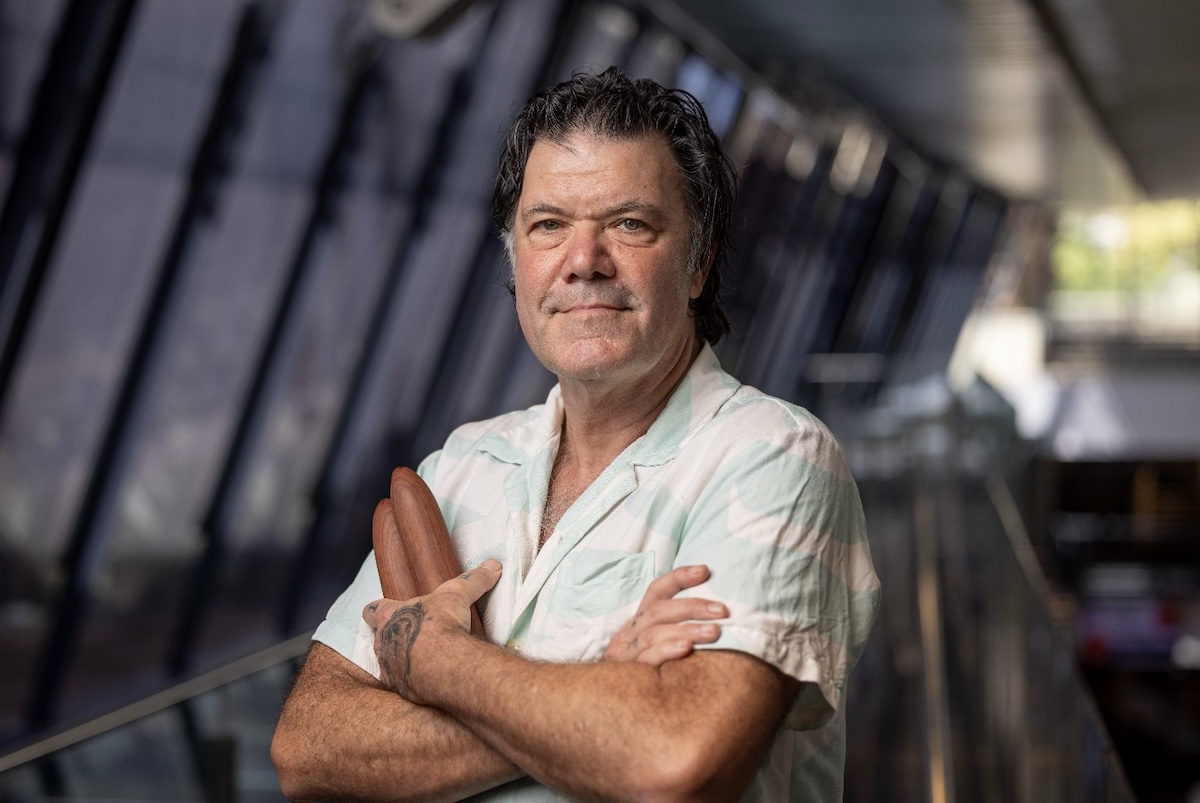
Blak Douglas at the Sydney Conservatorium of Music. Photo © Michael Amendolia/University of Sydney
Douglas, who won the Archibald Prize in 2022 for his portrait Moby Dickens, has played the yidaki (commonly known as the didgeridoo) for 26 years. His musical career began with a chance encounter with Bangarra Dance Theatre in 1997, when he was recruited as a novice player for the company’s Festival of the Dreaming production.
The experience introduced him to musicians from Arnhem Land, with whom he subsequently developed close relationships. He later travelled to the region to learn more about the instrument and its place within Yolŋu culture.
“I would never claim to be an expert in an instrument with Yolŋu cultural origins,” Douglas said. “What I can do is share the knowledge I’ve gathered over 26 years of playing and the different styles I’ve had the privilege of encountering.”
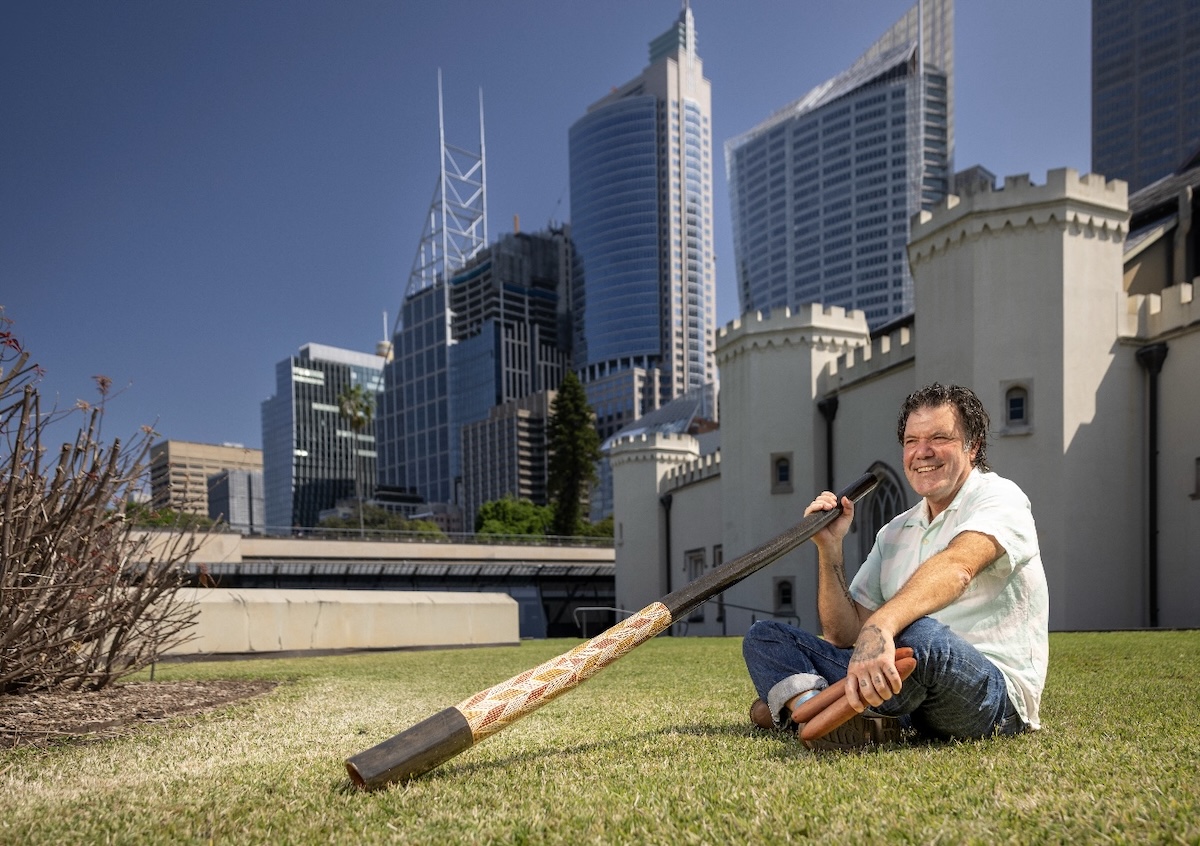
Blak Douglas at the Sydney Conservatorium of Music. Photo © Michael Amendolia/University of Sydney
Born in Blacktown, Western Sydney, Douglas is a descendant of the Dhanggati people of Kempsey on the NSW Mid North Coast. While his visual art has brought him national recognition, music has remained an equally important part of his creative practice.
He sees the residency as an opportunity to challenge common perceptions of the yidaki as a relatively simple, monotone instrument.
“I am looking forward to talking to the students about the mind-boggling physics of the instrument. It may seem basic because it’s a monotone instrument, but the playing style is complex,” he said.
“It’s one of the world’s oldest aerophones. It speaks to the landscape and everything in it. The instrument is much more than a way to make interesting sounds.”
Douglas plans to demonstrate circular breathing, rhythmic articulation and the range of sounds and notes that can be produced through the instrument. He is also interested in explaining the relationship between its musical patterns and language.
In Arnhem Land, he said, yidaki playing is closely connected to songs and ceremonial traditions, with players required to understand the phonetic rhythms of the music they perform.
The difference between playing to make sounds and playing a language through the instrument is one of the aspects he finds most fascinating, he said.
However, Douglas emphasised that teaching the instrument must begin with an understanding of its cultural origins and the responsibilities attached to traditional knowledge.
“In traditional Law, access to knowledge depends on the initiation ceremonies they’ve gone through and the status they’ve reached in the community,” he said. “I think it’s important to be respectful of that. I don’t want to give everything away in one go; I’d rather introduce material thoughtfully and build on it over time.”
He also hopes to mentor First Nations students and potentially develop a more sustained course at the Conservatorium. His teaching will extend beyond music to include the cultural origins of different Aboriginal art styles and the importance of culturally appropriate artistic practices.
Douglas’s appointment is part of the Conservatorium’s Indigenous Artists-in-Residence program, established in 2021 to bring leading First Nations musicians and cultural practitioners into the institution.
Associate Professor Damien Ricketson said the residency would encourage students to consider the broader cultural contexts of musical practice.
“For our students, this is an opportunity to consider ways of understanding music in which sound, language, Country and cultural responsibility are intimately connected,” he said.
Professor Anna Reid, Dean of the Sydney Conservatorium of Music, said Douglas’s contribution would bring important cultural perspectives into the institution’s teaching.
“Having artists like Blak Douglas working directly with our students enriches their experience and helps build a Conservatorium that is genuinely connected to the cultures and communities around us,” she said.
Douglas is also interested in exploring new possibilities for the instrument through the Conservatorium’s new recording facilities and emerging audio technologies in its soon-to-open Parramatta teaching space, and hopes to involve other First Nations musicians in the program.
“I’m looking for the next startling idea – the kind of thing that makes people say, ‘Wow, that’s a didgeridoo’,” he said.






Comments
Log in to start the conversation.