


Teaching game music composition at the Sydney Conservatorium of Music (the Con) provides a fun insight into how emerging composers are working in games, over time.
At this year’s PAX Australia, I was surprised to find quite so many members of the Con community among the hundreds of independent game developers showcasing their work.
Rory O’Connor’s Crabs! was immediately popular. The experience involves equipping your crab with as many arms, and therefore guns, as possible. Rory always had that knack for finding emergent humour within game mechanics.
Why crabs? Rory explained that crabs were, “a natural progression from the constraints of designing the game; messing around with procedural animation in 2D, and having dynamic legs and arms that could be attached.” The last time I saw Rory, he was prototyping a kind of gangly, puzzle-solving tongue. I appreciate the integrity of his creative trajectory.
Rory graduated from the Con’s Composition for Creative Industries (CCI) program in 2024. Has he also composed the music for Crabs!? He told me that the soundtrack is “still to come”. Certainly, building the game first is a common way for composer-designers to approach production.
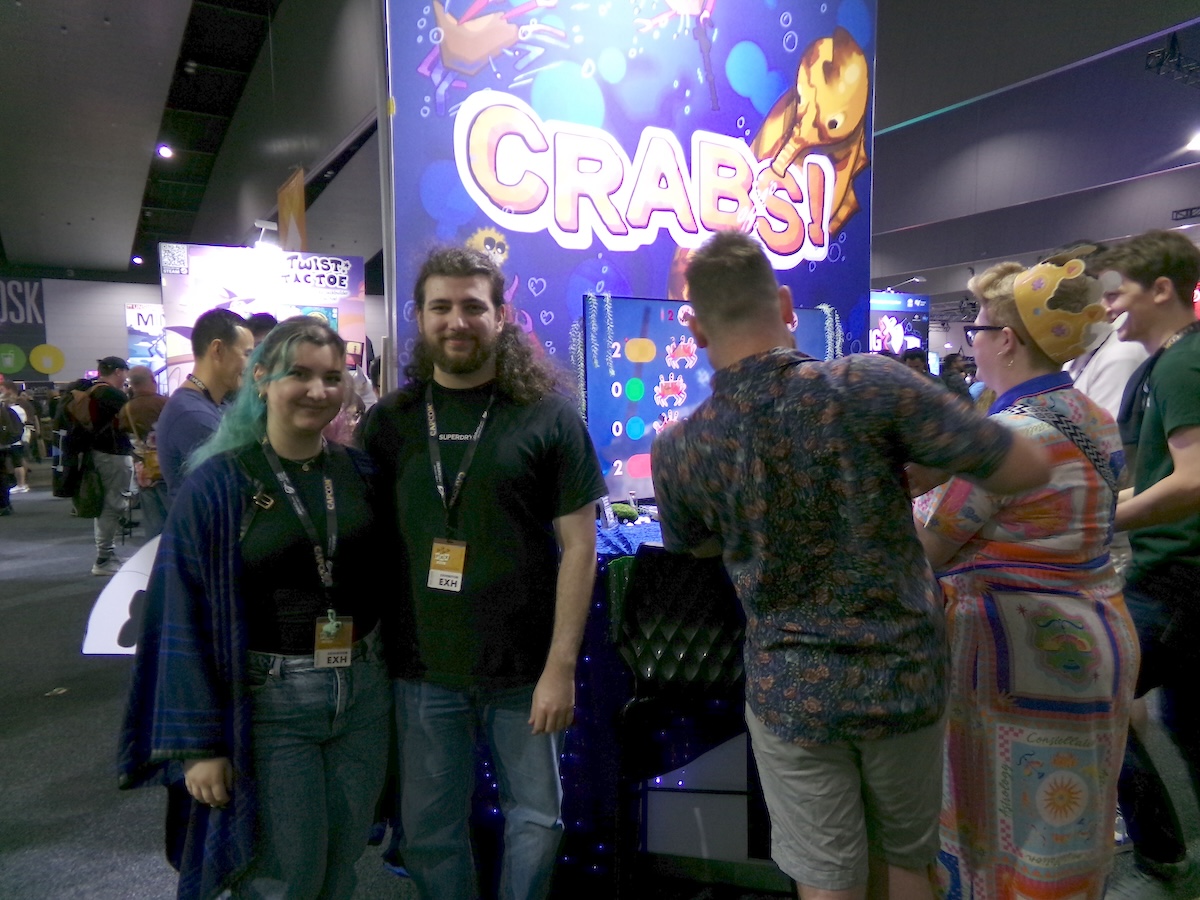
Aleyna Baran, Rory O’Connor and Crabs! Photo supplied
Tom Baltaks, a final-year Digital Media Composition (DMC) student, however, has established a professional game music practice in recent years. At PAX, two games featuring his work were being showcased in the PAX Rising area: Terminal Horizon and Multi-Merge Mayhem.
Despite the considerable differences between their cyberpunk and party-game aesthetics, both soundtracks had a recognisable musical personality. Tom is experimenting with a high-energy, up-tempo style, with an openness to chromaticism and chaos.
Another CCI graduate, Aleyna Baran, is working on sound effects for Hoppyscotch, a cosy, puzzle-based experience that channels a familiar kind of Frogger vibe, without the danger of ending up as roadkill. Her aim, she explained, is to make everything “cute and punchy”, while giving each environment its own distinctive sound palette. The game certainly delivers ‘cute’ and, incidentally, frogs also seemed well represented at this year’s convention.
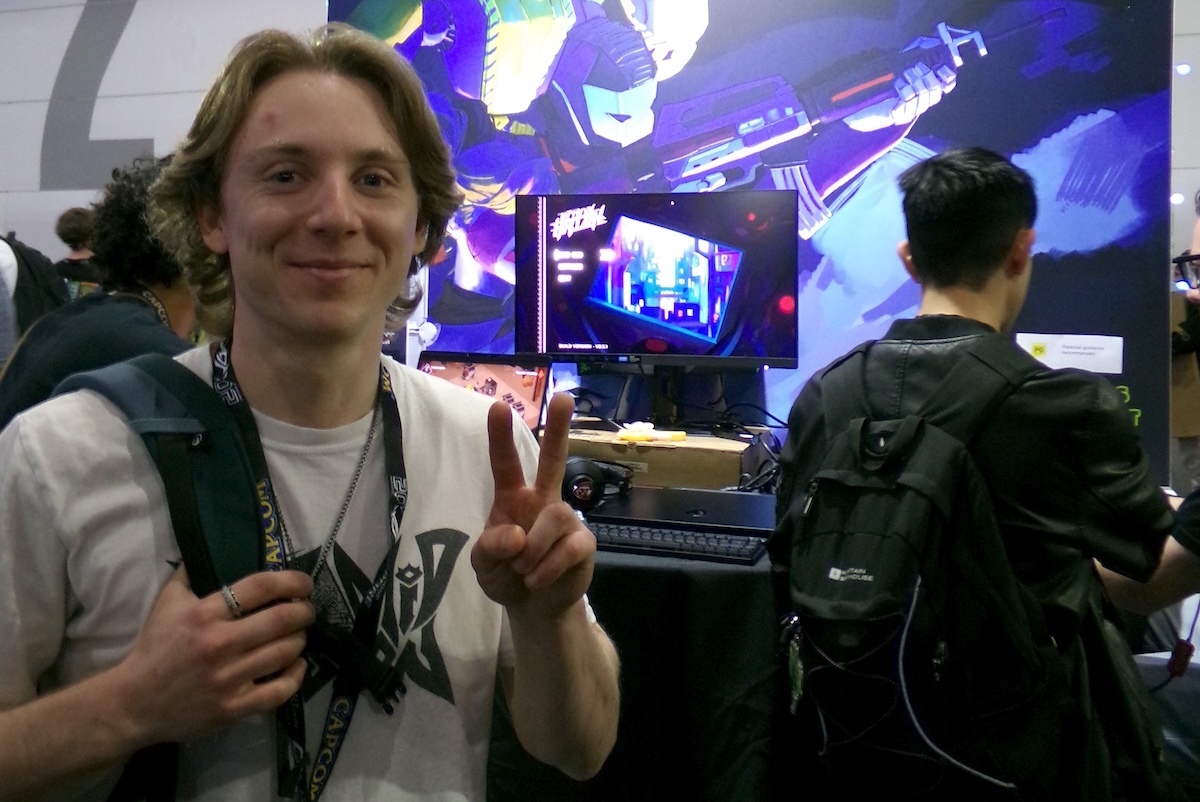
Tom Baltaks and Terminal Horizon. Photo supplied
My own reason for attending PAX was unrelated to the Con, but I made a point of ensuring students and graduates were looking after themselves: showing games for three days is a tough gig. Rina Amami, a final-year CCI student, was staying hydrated while showcasing Arrowhead with the University of Sydney’s Engineering Faculty, following a recent game jam.
Arrowhead is a reverse bullet hell in which players learn to get hit in strategic locations, rather than dodge arrows. It features an apple protagonist which, if it needs to be stated, is a clear reference to the William Tell story. Arrows are fired from bananas, because they’re curved like a bow and are fruit. This kind of subtextual humour works towards providing a strong experience of agency and discovery, demonstrating thoughtful game design.
I was particularly impressed by the precise, skilful orchestration of Rina’s soundtrack. She had also created the game’s art, user interface, and sound design, demonstrating the collaborative, can-do attitude that I associate with her work.
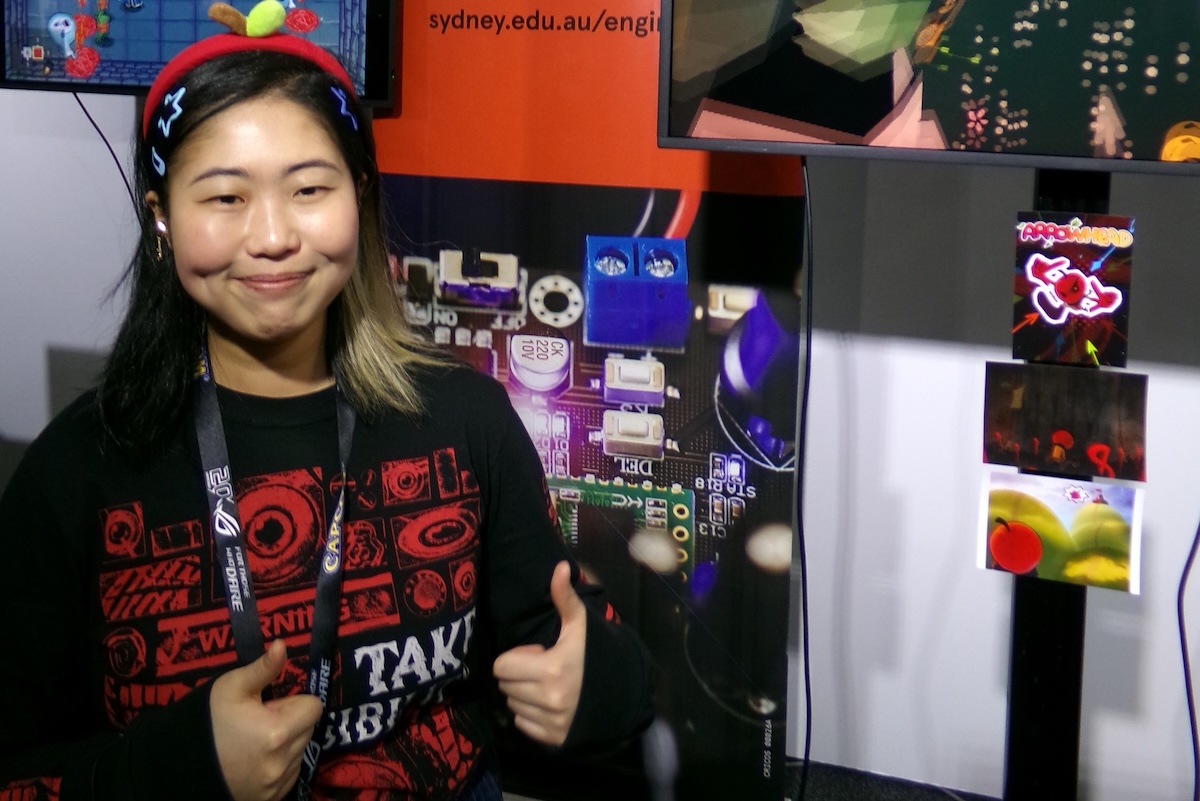
Rina Amami and Arrowhead. Photo supplied
PAX is just one aspect of the broader celebration of game-making and culture that is Melbourne International Games Week. The Con community was also well represented at the High Score game music conference, where students and graduates were contributing to conversations about the craft, business and cultural significance of videogame music.
Second-year CCI student Jack Lazzarotto was a finalist in this year’s Demo Derby, which challenges participants to develop quick musical pitches for real games. Jack’s brief was for Dungeons and Dining Tables. The experience, he said, helped him to understand, “the ways music direction, briefs, and the demo process is performed in a real-world environment and how game developers and composers reason their decisions”. Being selected as a finalist was an impressive achievement in a field that included both students and established professional composers.
CCI graduates Alexandra Moutevelidis and Jennifer Gao, creators of the videogame music live show Patch Notes, also took part in a panel exploring game music beyond the screen. Patch Notes is co-produced with CCI graduate Ryan Whitford. Alexandra and Jennifer discussed the people and organisations involved in curating and broadcasting videogame music.
Alexandra said the team had connected with its audience by presenting as, “a composer-adjacent team that celebrates music from emerging composers”. It’s an approach that speaks to how sustainable creative communities are formed: around opportunities to share, discuss and champion the work of emerging Australian game music composers.
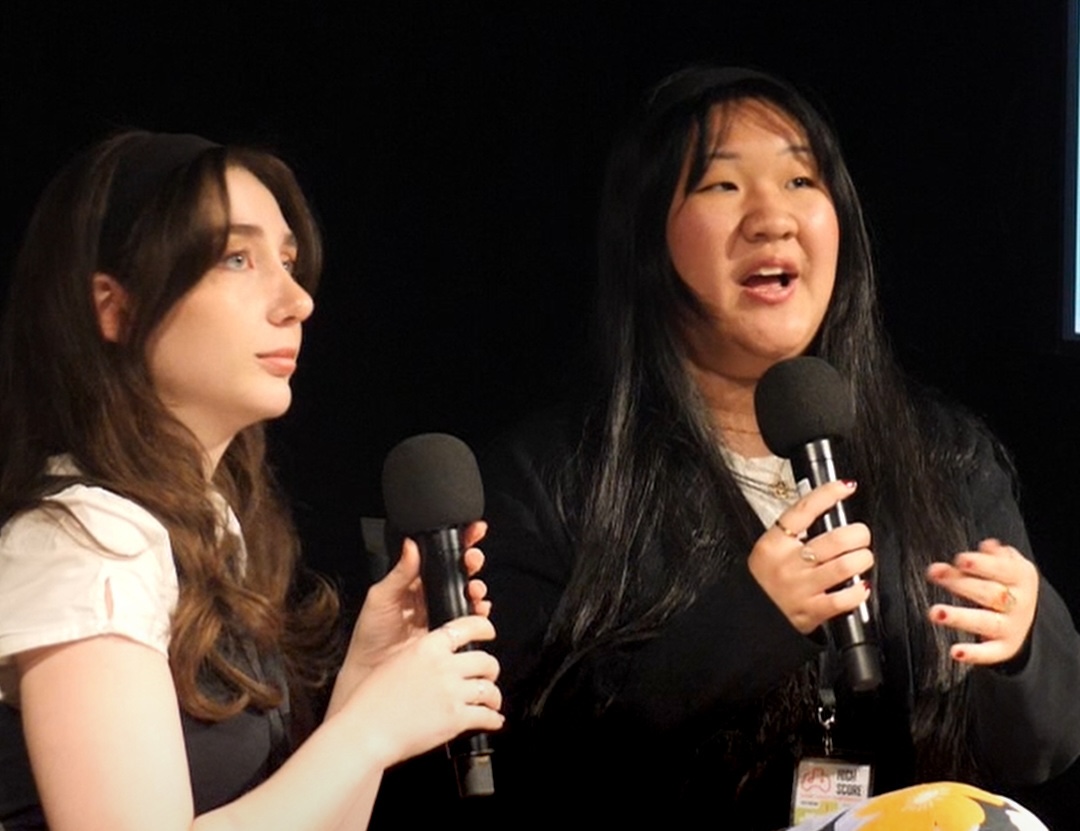
Alexandra Moutevelidis and Jennifer Gao. Photo © Ryan Whitford
Another CCI graduate, Morgan Ainsley, delivered more advice for emerging composers as part of the conference’s speed run panel. Her recent work includes developing and managing events such as the Making Waves Game Audio Festival, as well as hosting an Australian game-music segment at Waypoint Constellations.
I particularly appreciated Morgan’s candid observations about sustaining a positive and productive approach mindset, as a creative professional. “Community is one of the biggest strengths of the game industry in Australia, particularly the game audio scene, and being an active and constructive part of it is one of the best things you can do,” she said.
Bachelor of Music Performance graduate Paul Nicolaou offered another perspective, discussing the place of game music in orchestral programming. He argued that as orchestras increasingly embrace videogame music, they must also recognise its artistic value in its own right.
“The orchestral ecosystem and its cultural purpose are fundamentally dynamic,” he said. “This is not simply a commercial opportunity, but a contemporary artform deserving of celebration alongside the centuries of repertoire which came before it.”
This is a point worth emphasising. Videogame music is no longer a peripheral curiosity for orchestras, but an increasingly significant part of contemporary musical culture.
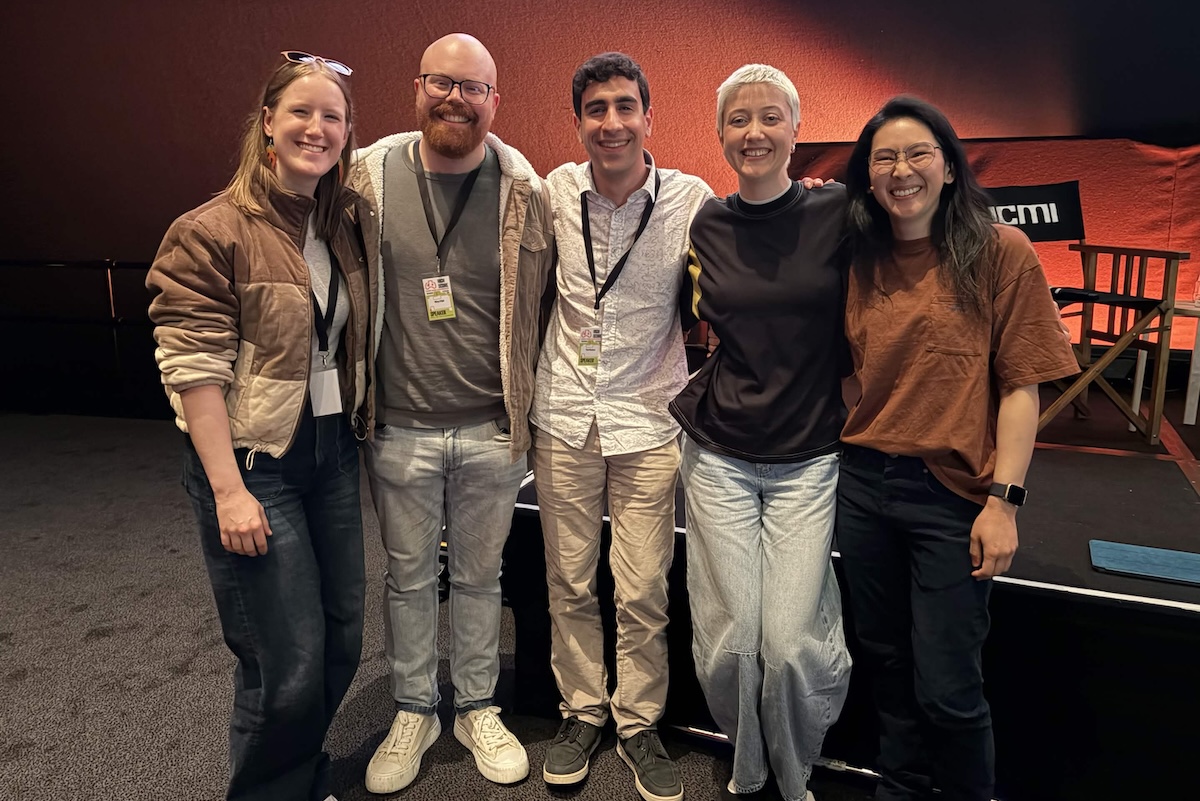
Morgan Ainsley (left), Paul Nicolaou (centre) and conference attendees. Photo supplied
In concluding this article, I spent some time trying to find a way to neatly segue from orchestras back to crabs, but no segue is required. Games are a diverse medium encompassing all manner of aquatic creatures, musical forms, and creative people.
After three days on the PAX show floor, I did check in with everyone. Approximately 90,000 people attended this year’s convention, so I was particularly pleased to hear that the students and graduates had taken one piece of advice to heart: playtest.
Rina described this opportunity to receive feedback as “incredibly enjoyable”, adding that it was also a chance to meet like-minded creatives. Tom enjoyed seeing visitors “locked-in or laughing hard, bobbing their heads while they played”. Rory, meanwhile, reported having, “a lot of fun and getting tons of great feedback”. He said, “I am extremely exhausted”.
Melbourne International Games Week was a window into how the wider Conservatorium community are emerging as creative, fun, and knowledgeable professionals in the games sphere.
Join us at PAX and High Score in 2027 and you’ll be among friends.
Meghann O’Neill teaches videogame music at Sydney Conservatorium of Music.






Comments
Log in to start the conversation.