Australian violinist Stanley Ritchie, a pioneering figure in the historical performance movement and a distinguished professor emeritus at Indiana University’s Jacobs School of Music, has died aged 91.

Ritchie died on 23 August, Indiana University announced. Over a career spanning more than six decades, he moved between the modern orchestral world and the emerging early-music movement, becoming a performer, teacher, author and mentor whose influence extended across generations.

Born in Australia in 1935, Ritchie joined the Sydney Symphony Orchestra while still a teenager and graduated from the New South Wales State Conservatorium of Music in 1956. The following year he became concertmaster of the first Australian Youth Orchestra and won the Australian Broadcasting Commission’s Concerto Competition.

A French Government Scholarship took him to Paris in 1958 to study with violinist Jean Fournier, followed by a scholarship to the Yale School of Music, where he studied with Joseph Fuchs. He also worked with Oscar Shumsky and Samuel Kissel.
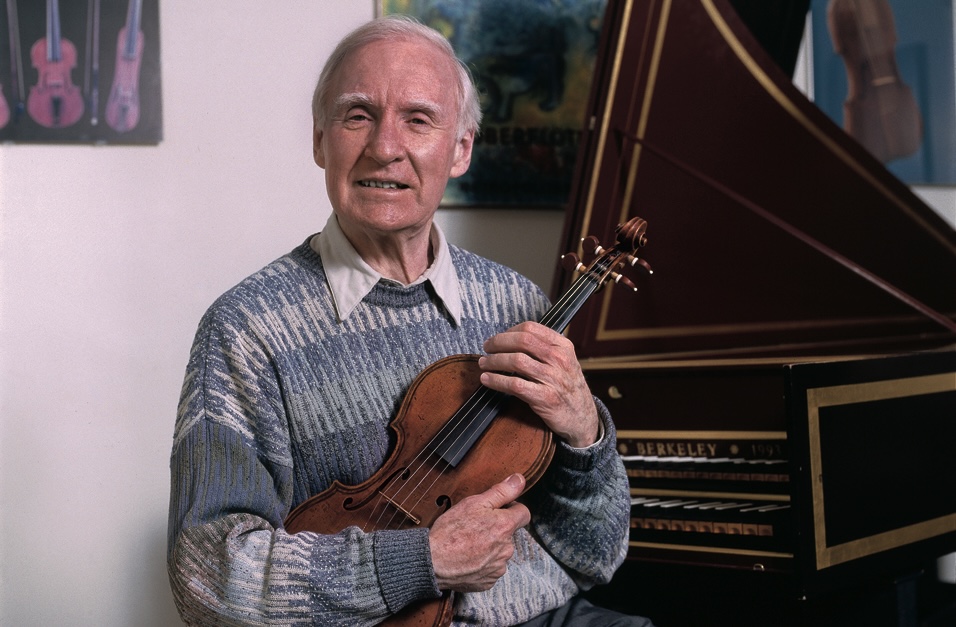
Stanley Ritchie (1935-2026). Photo courtesy Jacobs School of Music, Indiana University

Ritchie moved to New York in 1962, beginning a distinguished orchestral career as concertmaster of the New York City Opera Orchestra and, from 1965 to 1970, associate concertmaster of the Metropolitan Opera Orchestra. He later served as assistant concertmaster of the Vancouver Symphony Orchestra before joining the Philadelphia String Quartet as first violinist in 1975, when the ensemble was based at the University of Washington in Seattle.

His growing fascination with historical performance would ultimately become the defining thread of his career. Ritchie traced his interest in the field to a 1960 performance-practice course at Yale and began performing on Baroque violin in New York with harpsichordist Albert Fuller in 1970.

In 1974 he and harpsichordist Elisabeth Wright formed Duo Geminiani, performing throughout North and South America, Europe and Australia. The partnership later led to their appointments in 1982 to the newly established Early Music Institute at Indiana University, where Ritchie joined the Jacobs faculty and remained for nearly four decades.

He became a prominent collaborator with leading figures in the early-music movement, including Christopher Hogwood, Anner Bylsma and Malcolm Bilson, and performed as soloist or conductor with the Academy of Ancient Music, Tafelmusik, Philharmonia Baroque Orchestra and Handel and Haydn Society Orchestra. He was also a member of the Mozartean Players and Joshua Rifkin’s Bach Ensemble.

His extensive discography included music by Bach, Mozart, Schubert, Vivaldi and Bonporti, culminating in a recording of Bach’s Solo Sonatas and Partitas released in 2014.

Ritchie was equally influential as an educator. He founded the Jacobs Baroque Orchestra, served for a decade as artistic director of the Bloomington Early Music Festival and taught masterclasses internationally. Among his former students are musicians who have gone on to prominent performing and teaching careers in early music.

He published two books, Before the Chinrest (2012) and The Accompaniment in ‘Unaccompanied’ Bach (2016), exploring historical violin technique and approaches to Bach’s solo works.

In 2009, Early Music America awarded him its Howard Mayer Brown Award for Lifetime Achievement in Early Music. Indiana University named him a Distinguished Professor in 2016.

Jacobs School of Music described Ritchie as a “world-renowned musician and cherished mentor”, praising his musical sensitivity, curiosity and lasting contribution to historical performance.

Get our free weekly round-up of music, arts and culture.